

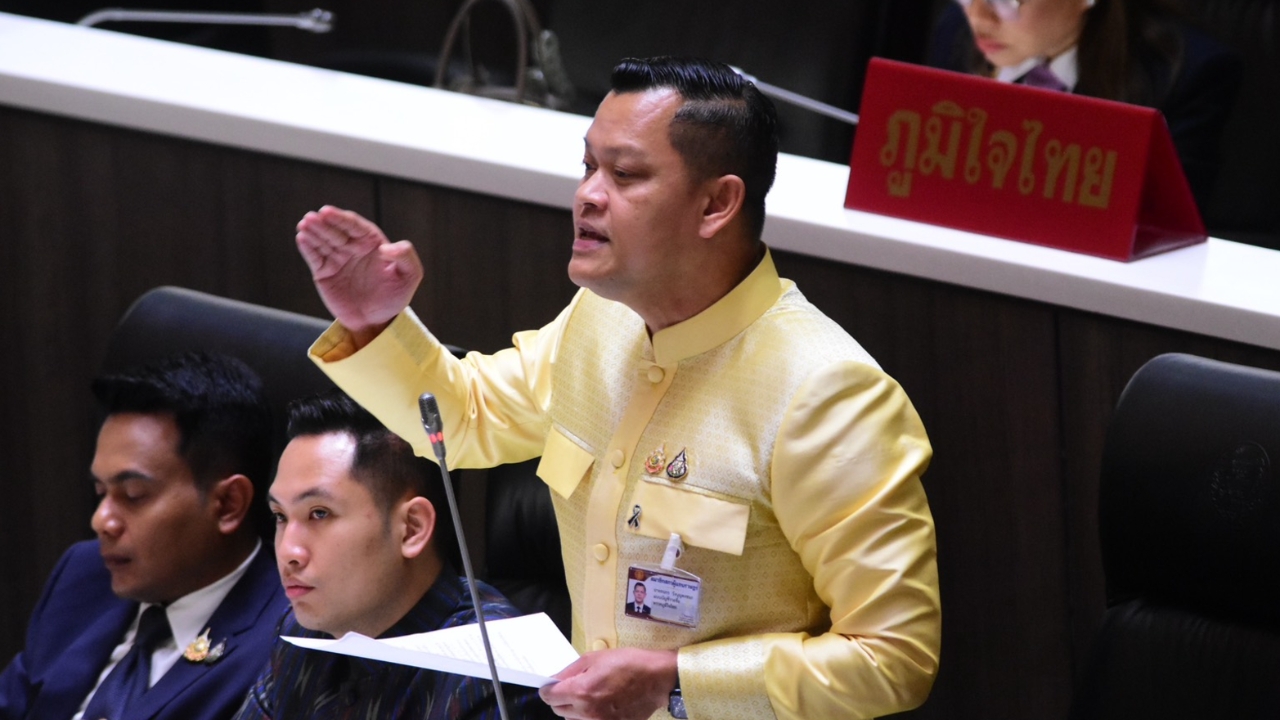
Thanakorn offered encouragement to the judiciary, expressing confidence that the public trusts and has faith in the justice system. He criticized political groups focused solely on discrediting the courts, while supporting earnest development of the justice process. He recommended adopting digital solutions and a one-stop legal service system to ensure justice is accessible to all citizens equally, promptly, and transparently.
On 28 May 2026 at the Parliament building, Thanakorn Wangboonkongchana, a party-list MP from Bhumjaithai Party, spoke about the development of Thailand's justice system. He stated that the judiciary is one of the country’s most important institutions and a key mechanism in upholding the rule of law, fairness, and social order. Over recent years, Thai society has faced many challenges in the justice system, including case delays, inequality in accessing justice, high litigation costs, legal complexity, and limitations in personnel and resources. Many citizens still feel that engaging with the justice system is difficult, time-consuming, and costly. Nevertheless, the judiciary has continuously adapted to modernize, become more transparent, and increase public accessibility. Currently, the Thai courts are moving from traditional paper-based systems toward concrete “Digital Justice” initiatives, developing e-Filing and CIOS systems that enable citizens and lawyers to file petitions, track cases, and obtain documents online conveniently, quickly, and at lower travel costs.
Thanakorn continued that the judiciary is also developing remote hearing systems, online bail petition submissions, integrating identity verification with ThaID, and document verification via QR codes to enhance convenience, security, and transparency in justice processes. Additionally, new technologies like speech-to-text conversion and AI are being studied and implemented to support case management, legal research, and public facilitation. The judiciary is also promoting an Online Dispute Resolution (ODR) system to reduce case backlogs, lower costs for the public, and encourage rapid, peaceful dispute settlements.
"These developments deserve praise as they show the Thai judiciary’s efforts to adapt to the digital age and genuinely make justice accessible to the public. However, despite these positive advances, there remain many issues that require urgent improvement to enhance the efficiency of Thailand’s justice system and increase public trust. The system must serve all groups and be accessible to everyone, including addressing case delays in many instances, inequality in accessing justice, and improving personnel development within the justice process," Thanakorn said.
Thanakorn added that to build trust and transparency amid rising public expectations, the judiciary should increase communication with the public, disclose statistical information that does not affect case integrity, and develop easily accessible case tracking systems. These measures will improve consistency, transparency, and confidence in the overall justice system. He emphasized that an effective justice system is not only a legal matter but also a fundamental foundation for the economy, investment, and national confidence. Public trust in the rule of law creates a country capable of economic stability, attracting investment, and sustainably reducing social conflicts. Therefore, the judiciary’s budget should not be seen merely as funding for one agency but as an investment in the rule of law and justice for the people. He hopes the government will seriously support justice system development in technology, personnel, and public access to ensure justice is equally, swiftly, transparently, and reliably accessible to all citizens.