

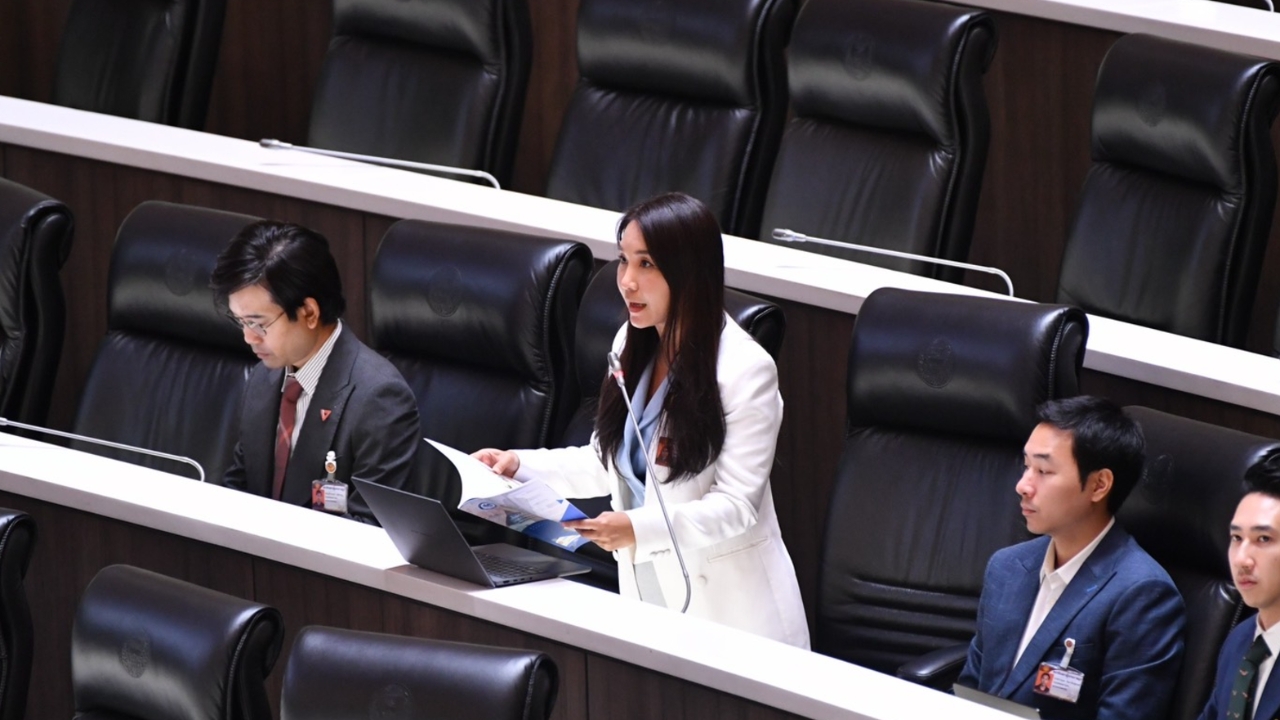
Sirikanya Tanakul criticized the State Welfare Card Fund for setting an insufficient budget, which forced it to use an 18.8 billion baht energy crisis loan to cover expenses, risking illegal action. She demanded disclosure of how many people the fund has helped rise above the poverty line.
On 28 May 2026, during a parliamentary session acknowledging the annual report of the People's State Welfare Fund for the grassroots economy and society for fiscal year 2024, Sirikanya Tanakul, a party-list MP from the Prachachon Party, raised questions about the fund's spending efficiency. She noted that after reading the report, she was surprised to see that in 2024, the fund received about 50 billion baht allocated through the normal budgeting system, plus approximately 120 billion baht from a project initially intended as a digital wallet, which later became a scheme topping up State Welfare Card holders with 10,000 baht each. However, there was no evaluation of the effectiveness or outcomes of this latter spending.
She questioned why the funds from the top-up project were not included in this report, despite the beneficiaries being State Welfare Card holders. Regarding effectiveness, there was only a rough estimate of how much the relief payments helped with living costs as a proportion of the poverty line. A better indicator would be how many people the fund has helped move from below to above the poverty line.
Sirikanya continued that while the report claimed the fund stimulated the economy by 0.14% of GDP and consumption by 0.68%, these may not be the fund’s primary goals, which are to assist low-income individuals. She also pointed out that the fund requires registration of new cardholders every two years, but the last registration round was in 2023, meaning the next should have been by 2025. As of now, no new registrations have occurred, exceeding the deadline by two years, raising questions about possible budget allocation issues this year.
She also noted certain budget patterns for the fund. In fiscal year 2024, excluding the 10,000 baht cash distribution portion, the fund was approved for 50.015 billion baht but actually spent 55.814 billion baht—significantly over the allocation. The extra spending came partly from leftover funds carried over from the previous year and partly from central budget requests.
Sirikanya said this pattern repeats. In fiscal year 2025, the fund was approved 50.4 billion baht but spent 62.207 billion baht. While higher spending might be necessary, she asked why allocations could not better match actual expenditures. For fiscal year 2026, the fund requested 69.154 billion baht but was only allocated 30 billion baht. The budget committee explained this was due to leftover funds and said additional central budget allocations would be considered if needed.
She explained that the fund’s spending plan clearly showed 30 billion baht would never be enough, as the fund expected to exhaust this amount by the second quarter of fiscal year 2026. Therefore, it had to apply to the 400 billion baht emergency loan act committee for an additional 18.8 billion baht. This amount is unlikely to fit the loan act’s stated purpose of aiding and relieving impacts from the energy crisis.
“The additional 18.8 billion baht requested is welfare that State Welfare Card holders are entitled to, regardless of whether there is an energy crisis. It is ongoing support, not new relief. I want to ask, if we want to end the vicious cycle of chronic under-budgeting for this fund, what should we do?”
Sirikanya concluded that she previously thought the Budget Bureau might be managing allocations according to legal budget proportions, requiring cuts to some regular expenses to maintain 20% for investment expenses as the law demands, which affects many regular budget items yearly. However, those explaining to the 2026 budget committee seemed unconcerned, confident additional central budget funds would come. Ultimately, emergency reserve funds are now depleted, forcing use of the loan act funds, which may be illegal. She asked those explaining today how to break the cycle of insufficient funding for the State Welfare Card Fund.