

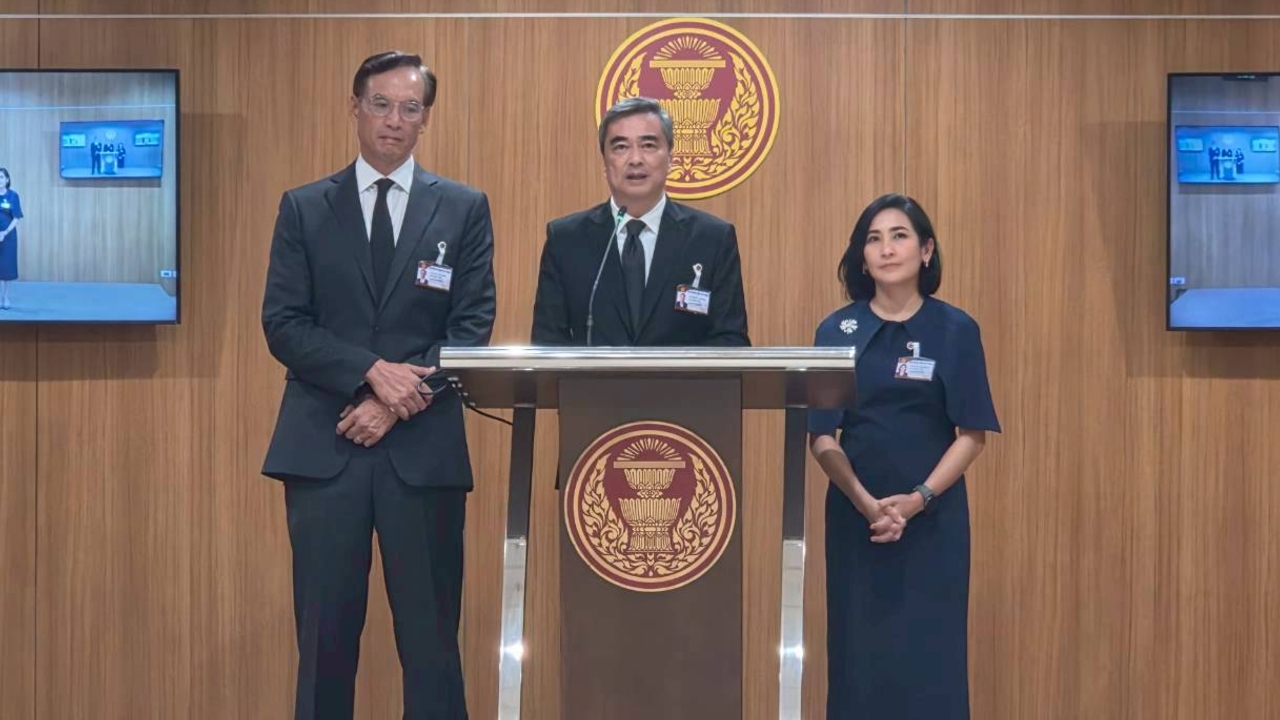
Abhisit criticized Eknat for reversing oil and electricity energy reforms, sarcastically asking if he retreated midway or was pressured by local toughs. He condemned the government's blanket labeling of households using over 400 units of electricity as wealthy, which is not the reality. Meanwhile, Kandee expressed concern about leaving the growing oil fund debt for the public to carry for a long time.
On 28 May 2026 at the Parliament, Mr. Abhisit Vejjajiva, party-list MP and leader of the Democrat Party, spoke about the government's energy management issues. He said Energy Minister Eknat Promphan had repeatedly assured Parliament during debates and question sessions that he intended to lower oil prices to help the public and was ready to confront energy business interests. However, this did not materialize. First, on oil, the Democrat Party has long demanded that the government should not let the country face a cost-of-living crisis and income crisis, which the government used as justification for borrowing an additional 400 billion baht in public debt. The Energy Minister had promised to restructure the entire energy sector by removing the use of Singapore refinery prices as a reference and instead applying a "Singapore discount" system to reduce refinery gate prices. But when some parties may not have closely followed this, the government stopped reducing prices. What was promised to the public about restructuring energy has now been abandoned, and instead the government reverted to using the oil fund to carry debt, doing the exact opposite of what was explained to Parliament.
"We note that previously the refining margin was calculated based on the difference between the crude oil input and the Singapore reference price. Currently, they say the refining margin has been adjusted, citing possible increased costs like insurance, but there is no transparency about the true oil production costs. I question why the Energy Minister did not follow through on his promises to Parliament. We think he retreated before even reaching halfway, and we don't know if he encountered 'local toughs' at the end of the street causing him to backtrack. Regarding whether previous assumptions about windfall profits were misunderstandings, we believe the refineries' profits in the first quarter prove these concerns are valid. We want to make it clear that currently the Energy Minister is not fulfilling his commitments to Parliament, which has a role in overseeing solutions for the people," Mr. Abhisit said.
Mr. Abhisit added that a major upcoming problem is rising electricity costs. The minister had promised to confront business groups to reduce electricity prices and campaigned on selling the first 200 units at 3 baht each. However, the Democrat Party's repeated proposals to revise the electricity and fuel adjustment (FT) calculation formulas have not been acted upon. Instead, the government continues to use the old formulas and shifts the burden onto users consuming over 400 units per month, portraying them as wealthy—an inaccurate depiction. Many extended families or small businesses with, for example, a beverage refrigerator, are labeled wealthy and must bear higher electricity costs under government policy. Meanwhile, all parties involved in the electricity business remain unaffected because the Ministry of Energy keeps the old calculation method. The minister's tough stance shown in Parliament contradicts these actions.
Kandee expresses concern about leaving the oil fund debt for the public to bear long-term.
Ms. Kandee Liaoipiroj, party-list MP of the Democrat Party, added that although pump oil prices have not risen much due to previous refining margin reductions, increased use of the oil fund has caused growing deficits. This crisis's burden is being passed on to the public. The Energy Minister has effectively chosen to make the people bear the growing debt every day. We are talking about a debt burden that increases daily.