

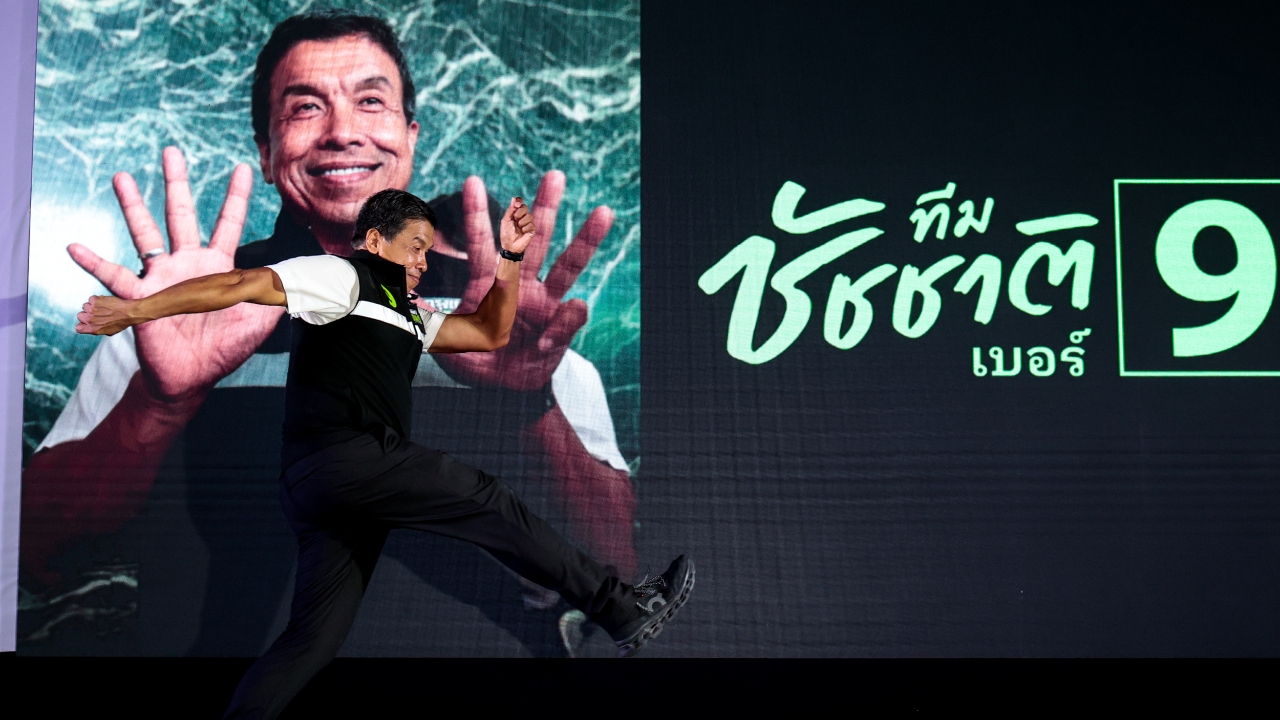
Chadchart gave a major speech unveiling over 250 policies to develop Bangkok in areas of people, city, economy, and systems, aiming to ensure residents can see a doctor within one hour. He hinted at a mega-project to build a pedestrian bridge over the Chao Phraya River and affirmed he would work independently, not affiliated with any political party.
On 28 May 2026 at Stadium One, Chadchart Sittipunt, candidate for Bangkok Governor, held a policy announcement event revealing more than 250 policies, following his registration and ballot number draw earlier that morning.
Chadchart said he was very happy to receive support. Today should be fun because policies need to be enjoyable. This day marks the launch of number 9. When drawing numbers, only two remained, and number 9 was a good choice. It represents progress from last time’s number 8 to 9. He introduced the policies planned for the next four years, telling his team that winning or losing the election depends on the people, but the important thing is having clear policies on what to do from day one. Every moment matters. He believes the next four years are crucial—not just for Thailand or Bangkok, but globally. If we don’t keep up with the world, we cannot compete and will struggle. Therefore, the future requires leapfrog changes with appropriate technology.

Chadchart recalled that four years ago, after winning the election, he did not feel joy but concern because there were still four years ahead. That was just the first step. He told his team that winning or losing is not important, but what you do after winning is more difficult. He hopes the past four years have not disappointed people. Some may feel disappointed, but most hope he will be allowed to continue working.
Chadchart summarized the past four years, addressing criticism that he did not undertake major projects but focused on minor infrastructure. He explained that their approach was strategic, analyzing Bangkok’s problems. If major arteries are weak, small vessels cannot function well; if small vessels are strong but major arteries are weak, it still fails. Therefore, the system must advance together. He cited major issues such as repaying 70 billion baht in BTS debt and adding four more hospitals, emphasizing health as a priority. Public health and education are critical, so investments were made. Bangkok faces problems with patient referrals, often lacking receiving facilities, and care is expanded as needed. They also built drainage tunnels.

Regarding minor infrastructure projects, like the Traffy Fondue app, which is more important than major arteries, he said it’s an app for reporting complaints to Bangkok authorities, with over a million issues resolved. Flooding in many areas has improved by over 70%. This infrastructure connects the entire water system. Other projects include creating dust-free rooms at 115 childcare centers, establishing 471 “15-minute parks” covering over 1,090 rai across Bangkok, improving 1,100 kilometers of sidewalks, planting 2.6 million trees, upgrading 46,358 computer rooms. He challenged critics who say only minor projects were done, stating these are powerful small-scale interventions that transform systems and surpass many mega-projects. They also addressed dust and waste problems, expanded public spaces for city activities, including arts and music in parks.
On corruption issues, he acknowledged it as a major concern. Complaints about corruption have decreased. They use technology to increase budget and procurement transparency, add corruption reporting channels via Traffy Fondue, move permit applications online, and employ AI for checks. Processes were adjusted, including an anti-corruption center, ethical codes, budget proposal reforms, refusal to accept budgets lacking details, disciplinary actions including dismissal, and development of systems to track investigations. He emphasized that corruption is a serious issue they have never ignored or compromised on.

Chadchart affirmed his candidacy is independent and not a hidden proxy. He will do his best. The Bangkok governor role differs from MPs who have government and opposition. As he is directly elected by all citizens, he is independent and does not need councilors’ support. Councilors are also independent from the governor. There is no opposition; everyone works as one team. He announced they have no councilors affiliated with any party but are ready to work with all elected officials. He urged councilors to collaborate with any governor because there is no guarantee the governor and councilors will come from the same party. The key is cooperation focused on public benefit.
The city's vision for this election is "To be a city that creates opportunities and hope for everyone." The policies are divided into four areas under 251 work plans: well-being of people, livable city, economic opportunities, and efficient systems, all to be implemented immediately after election.
Chadchart spoke about mega-projects. "A pedestrian bridge across the Chao Phraya River." This aims to boost the surrounding community economy, establish the Bangkok City Museum at the City Hall (Sao Chingcha), transform the City Hall plaza into a quality public space, and develop the Thonburi City Center with an art gallery, children's museum, and public areas.
Regarding policies for “people,” there will be universal free health screenings, drug screening in all communities to create drug-free zones, expand universal health coverage to 1.3 million people, increase Bangkok hospital beds by 2,000, and ensure waiting times do not exceed one hour. Healing activities in parks will be offered. The city will provide housing close to workplaces via a platform, launch the BKK Food Bank to distribute 10 million meals, employ 1,000 people with disabilities, expand early childhood care to 5,000 children, create a marketplace for senior employment, establish language schools in every district with free tuition, offer parenting classrooms for comprehensive child care, support education for special needs children in all 50 districts, maintain necessary teacher programs without unnecessary cuts, and use children’s outcomes as criteria for teacher promotion.
For a “livable city,” the plan includes adding adaptive traffic light systems at 200 more intersections, expanding skywalks, building bike lanes and sidewalks, dividing the city into smaller blocks for focused green spaces and transport, enabling detailed zone analysis. New zoning laws will cancel 52 roads to avoid compulsory land acquisition. The problematic On Nut waste plant contract will not be renewed, converting the site into Bangkok Green Eco Park. Plastic waste separation will be enhanced. Real-time dust detection tools will be used by environmental investigators. Sewage treatment points will be expanded, EV charging stations increased, a central Bangkok market developed, and more zero-emission vehicles promoted. Green spaces will increase with 1 million more trees, additional urban shade, six new forest parks surrounding the city, and 100% replacement if green space is lost. Animal sterilization and vaccination will cover 250,000 pets and strays annually, and animal clinics upgraded. Heritage tree registration will begin. Public spaces will increase by one per district, old buildings revitalized into public areas, more art galleries in Thonburi and the old city, two new children's museums, sports plazas, and toy libraries for home borrowing.
Regarding disaster management, safety standards for buildings will be raised, compensation for victims increased, operational guidelines introduced, water management models developed using technology, LED lighting expanded, and municipal officers will patrol regularly.
For labor skills and economy, an online learning platform will offer 1 million hours of courses, improve access to street economy funding, develop creative commercial spaces, and host world-class festivals including Songkran, Loy Krathong, Pride Month, and New Year. Transparency checks will use technology and AI. Bangkok district offices will move online to improve service convenience.
City management systems will address proactive urban problems, push for a new Bangkok Act to update laws, reduce redundant work, and increase public participation.

Chadchart added that all 251 policies are well-founded with clear origins and success indicators, which will be posted online for public tracking. After visiting Khlong Toei, he added a new policy to establish community physical therapy centers for bedridden patients.
Finally, referring to a Dusit Poll with four questions, one question moved him to tears: when asked how people think Bangkok will be after a new governor is elected, 78.03% said it will improve, 21.5% said it will remain the same, and less than 1% said it will worsen. This shows everyone has hope for the city, regardless of who becomes governor. It indicates two things: confidence in democracy as an effective system to choose capable leaders, better than dictatorship which ignores public voice.
Our duty is not only to build the city but also to build hope and confidence in democracy, showing it is a powerful system that solves urban problems and brings hope. This poll confirms Bangkok residents have hope. Don’t lose hope—life is sustained by hope. Our team will work hard to strengthen this hope. We believe Bangkok can be a city of opportunity and hope for all. Everyone must cooperate and participate to make this better," Chadchart concluded.

Chadchart explained measuring policy feasibility and leapfrog progress as “Scaling.” Over the past four years, they created a model showing real changes, which will be expanded citywide. The future involves using technology to accelerate leaps because technology has no capacity or speed limits. They have been implementing this for four years and can do everything. He confirmed these 251 policies are new, and they will also continue old policies, totaling over 500. The key to successful administration is having action plans aligned toward the same goals.
Regarding AI’s role in anti-corruption, he noted that groups focusing on this see it as important. However, AI is not a magical fix for all problems. AI needs training. He believes they are on the right path but will not consider AI the sole answer. Instead, AI will be an intelligent assistant (IA) to be used effectively against corruption.
Chadchart emphasized that focusing on minor infrastructure is not because of vulnerable groups alone, but because everyone faces these issues, like flooding. Small infrastructure affects all city residents, though vulnerable groups may need special attention. Caring for vulnerable groups can transform the city. The core of urban change is not technology but mutual understanding and empathy.
Additionally, at the policy launch event, Chadchart introduced his twin brother, Professor Dr. Chanchai Sittipunt, and his sister, Associate Professor Dr. Preecha Sittipunt, who joined to support the policy unveiling.

