

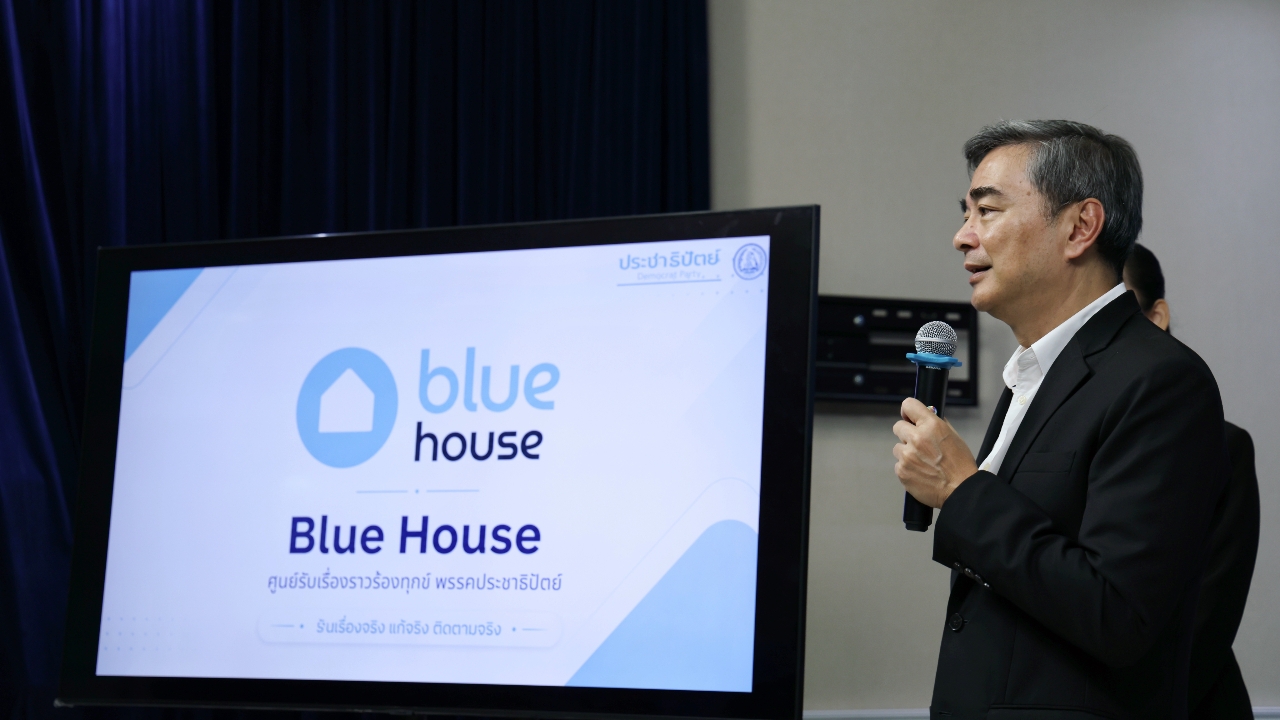
The Democrat Party has launched the “Blue House,” a digital complaint platform focusing on three core issues: legal problems, corruption, and public hardships. It guarantees security with a system that protects the identity of informants.
At 09:00 on 29 May 2026 at the Democrat Party headquarters, party leader Abhisit Vejjajiva chaired the opening ceremony of Blue House, a platform for receiving complaints from the public. Abhisit stated that the Blue House project was established to care for and alleviate public hardships, which is a vital responsibility of political parties. Whether it involves rights violations or inconveniences from government services, addressing these issues has always been a fundamental duty of political parties and representatives. The relaunched Blue House marks a significant turning point, featuring two main highlights that will transform proactive work.


1. Maximizing the use of technology. Over the past months, during the celebration of the Democrat Party’s 80th anniversary, the party clearly outlined plans to move forward sustainably in its 81st year and beyond by leveraging technology extensively. This upgrade to Blue House allows citizens to submit their issues and access assistance from the party easily and quickly.

2. Connecting volunteer lawyers to the state policy monitoring platform. Blue House will serve as the central hub linking to the recently launched volunteer lawyer project, which mobilizes personnel and former party candidates with legal expertise as key resources. The initiative began in the Andaman region and is rapidly expanding nationwide to ensure equitable access to justice, especially for rural populations. Additionally, Blue House integrates with the citizen oversight innovation app “Song Rat” (State Watch) to give the public a platform to voice concerns and report on real-life conditions such as cost of living, economic and social circumstances, and access to government programs. This data will be analyzed and compared with official policies to ensure government actions effectively address public needs and produce positive outcomes. This confirms the role of a modern political party not only to listen but to actively pursue sustainable change. This development marks another advancement of Blue House and will be a key component of the Democrat Party’s operations from its 81st year onward, employing new tools to fulfill its political responsibilities more completely.

Meanwhile, Jirawat Jangwat, Deputy Spokesperson of the Democrat Party and Director of the Blue House Center, said the intention behind transitioning to a digital system was to fix gaps in the traditional bureaucracy, where citizens often face difficulties in filing complaints, tracking progress, and problems get lost. Blue House will systematically screen issues in three main categories: 1) legal problems, 2) corruption, and 3) general hardships. Crucially, from a political party perspective, the goal is to resolve problems thoroughly by decoding public grievances to develop genuine policy solutions. The Blue House platform is designed with maximum security, featuring a whistleblower function allowing informants to conceal their identities. Communication will use case numbers instead of personal names to protect the informants.
