

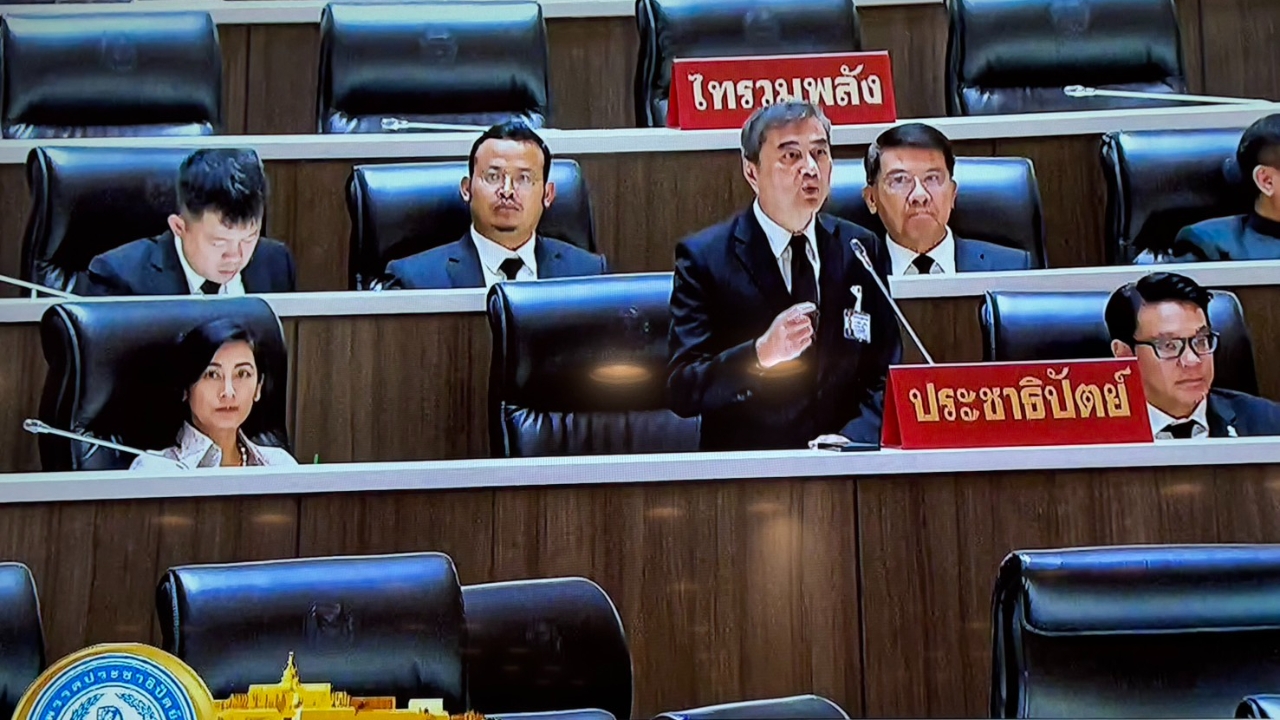
"Abhisit" sharply criticizes the Land Bridge project as an illusion that benefits land speculators, warning it risks inviting foreign conflict and the seizure of territory, repeating the Strait of Hormuz scenario.
On 29 May 2026, the House of Representatives held an urgent session to consider a motion requesting the establishment of a special parliamentary committee to study issues related to the Southern Economic Corridor transportation infrastructure development project, known as the "Land Bridge." The session was chaired by Mr. Sophon Sarum, Speaker of the House.
Mr. Abhisit Vejjajiva, leader of the Democrat Party, stood to debate, calling the Land Bridge project a "myth" that promises benefits but delivers none. He disputed claims that the project would save four days of shipping time, saying this is untrue because, in reality, multiple handling of containers between ships and trucks would occur, raising costs by up to three times. Furthermore, residents in the southern region would gain almost no benefits, as the area would merely become a transit point for foreign goods. The true beneficiaries, he said, are only two groups: construction contractors and investors buying land for speculation.
Abhisit continued that if the government insists on proceeding with this project without users, the abandoned structures would become "monuments to poor decision-making," favoring the interests of a small elite. In reality, improving the livelihoods of southern people could be achieved through other means with a budget under one trillion baht, such as developing existing ports or creating a logistics network called "Southern Connect" to maximize natural resource use locally, rather than turning the country into just a transit route.
Beyond economic issues, the Democrat leader warned of geopolitical security risks, comparing the project to "inviting conflict into the home." The area would become a strategic point vulnerable to great power conflicts between the U.S. and China, similar to historical disputes over the Suez Canal, Panama Canal, or the Strait of Hormuz. He cautioned that foreign powers might seize control through public-private partnerships, as occurred in the Panama Canal dispute where a Chinese company gained control of shipping lanes, leading to political pressure.
At the session's end, Abhisit expressed skepticism about the government's stance, saying he was confused by the idea of making Thailand like the Strait of Hormuz, a hotspot of conflict. He declared that if the House rejects establishing a special committee to study this issue, it would confirm suspicions of irregularities, lack of transparency, and the administration's attempt to rush decisions based on a single study, which cannot assure the public that no hidden interests exist. Such actions, he said, exploit and destroy southern Thailand's capital, resources, and opportunities. He urged all representatives to vote in favor of forming the special committee to monitor and carefully study the project before the country becomes a pawn in global power struggles.