

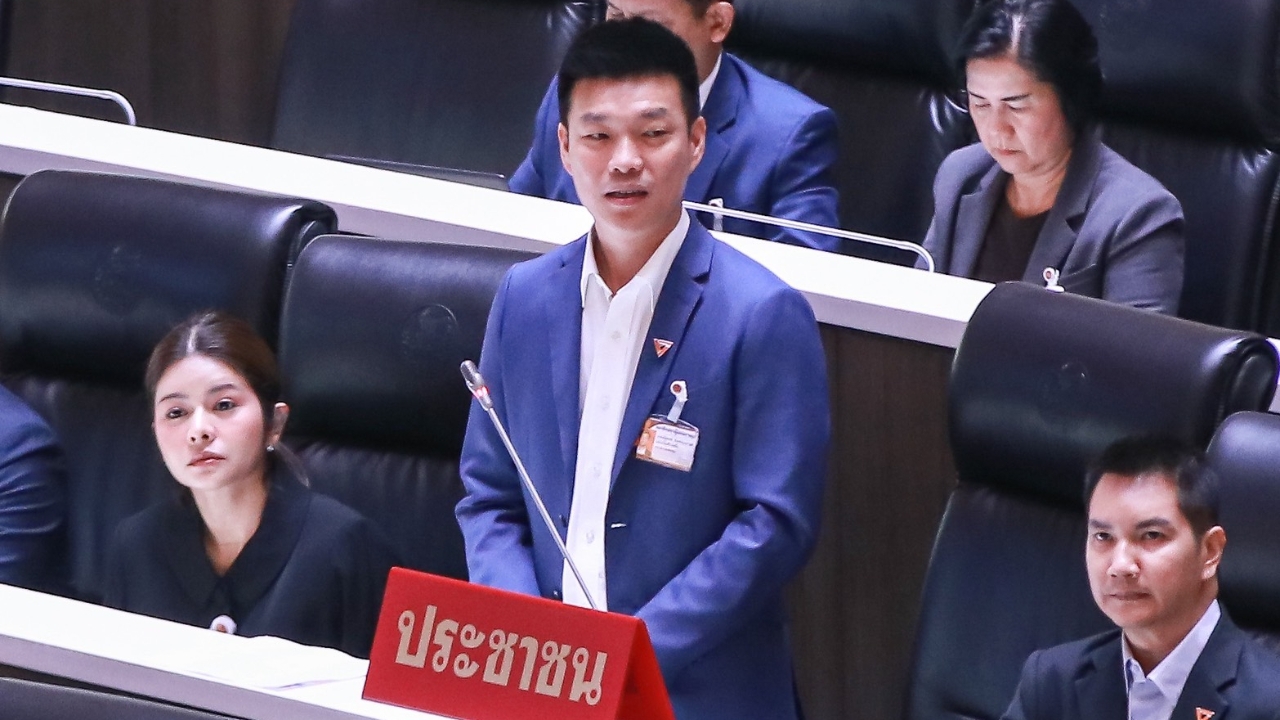
The opposition leader firmly opposes the land bridge project, urging development of Southern Thailand’s quality of life first and warning against viewing the Malay Peninsula merely as a “global goods transit route.” The opposition leader said this clearly and directly.
On 29 May 2026 GMT+7, during a House of Representatives session considering an urgent motion to study the Land Bridge and Southern Economic Corridor (SEC) projects, tensions escalated. Mr. Natthapong Ruangpanyawut, the opposition leader in the House, rose to deliver a concluding debate on behalf of the People’s Party, sending a straightforward warning to the government about the possible misguided direction of Southern Thailand’s development.
Mr. Natthapong questioned the true strategic direction for developing Southern Thailand, asking which path the government intends to pursue. He cited the Eastern Economic Corridor (EEC) as a costly lesson, pointing out that although GDP figures in the East have grown impressively, workers’ welfare and life security have not improved accordingly. Investment returns have largely gone to major conglomerates invited by the government, while small workers and local communities bear the brunt of pollution and environmental damage alone. He urged all parties to reconsider focusing solely on GDP figures when evaluating economic development.
The opposition leader also called on the government to revise its fundamental mindset, questioning whether the 14 southern provinces are viewed merely as a transit route for goods and global supply chains serving geopolitical goals, or as home regions where Thai people live and build futures for their children. He noted that government arguments invoking the Strait of Hormuz case clearly reveal that the government sees the South primarily as a transit point for global goods catering to external interests rather than the needs of local citizens.
Mr. Natthapong presented figures highlighting Southern Thailand’s structural problems: over half of southern farmers lack land tenure, the region has the lowest access to tap water nationwide, travel expenses are high, and inequality is severe. Ninety percent of tourism income is concentrated in just five provinces. Over the past 30 years, development has increased inequality; farmers and fishers have become more indebted. Additionally, the South faces frontline climate crises, suffering 3-4 times more disasters than other regions and has 11 provinces with newborns suffering from malnutrition.
“The question is whether the land bridge project will enhance security or undermine farmers’ land security. Just the news of the project has led speculators to rush buying land for profit. Instead of promoting eco-tourism and health tourism to distribute income to secondary cities, the land bridge threatens to destroy mangrove forests and existing economic engines,” Mr. Natthapong stated.
In conclusion, the opposition leader proposed a concrete alternative: the Southern Biodiversity Regeneration Corridor (SBRC). This blueprint focuses on leveraging Southern Thailand’s cultural assets and biodiversity to develop sustainable agriculture and community-based tourism. He urged the government to reallocate budgets to invest in infrastructure that improves quality of life in the South, including potable water, public transport, quality schools, and primary healthcare systems.
Mr. Natthapong emphasized that the SBRC does not require special legislation exempting multiple laws and needs only a budget of 500 billion baht over six years—half the 1 trillion baht proposed for the land bridge project. Yet, it promises a guaranteed GDP growth rate of no less than 4% annually, increases agricultural product value by at least 30%, and reduces farmers’ debts by 30%. He concluded by urging members of parliament to decide whether to treat Southern people merely as those affected by development or as rightful owners and partners in the region’s progress.