

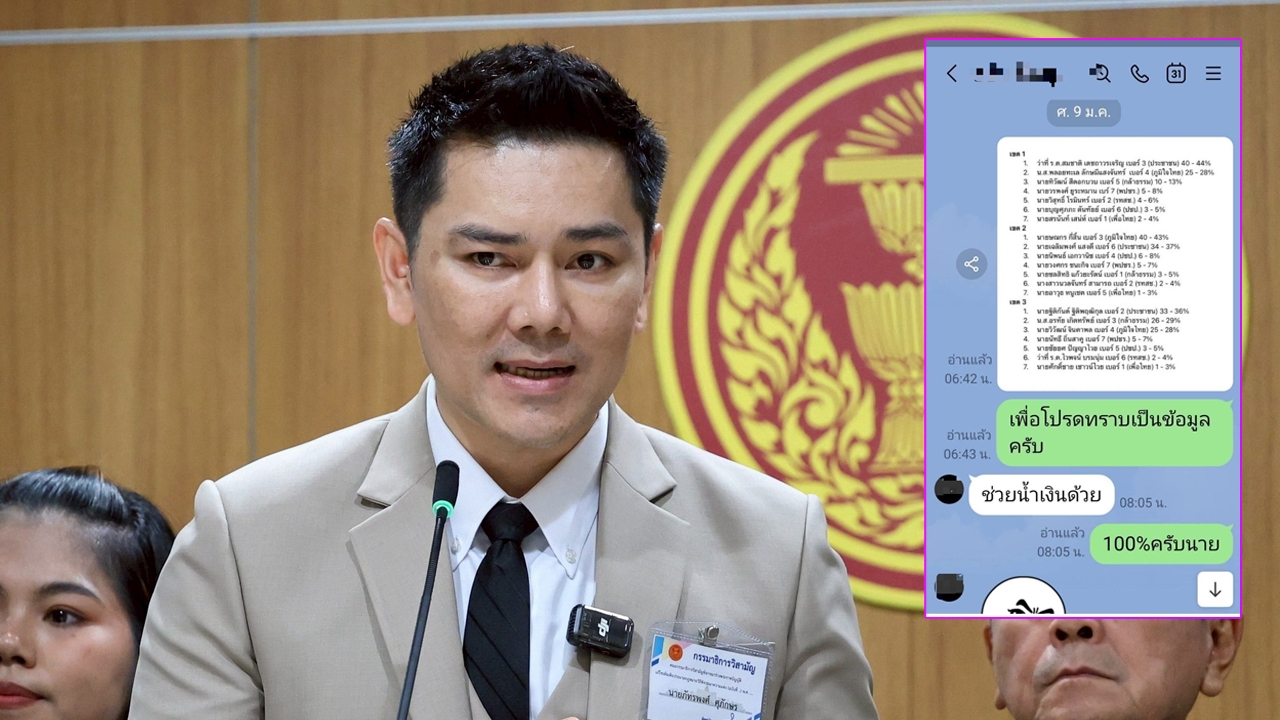
Lawyer Aun Buriram submitted leaked LINE chat evidence to the Constitutional Court, alleging that the Director-General of the Department of Provincial Administration ordered subordinates to "help the Blue Party" as part of the barcode case to request the election be annulled.
At 11:00 a.m. on 29 May 2026 at the Constitutional Court, Mr. Phattharaphong Suphaksorn, also known as Lawyer Aun Buriram, arrived to submit leaked LINE chat evidence. He claimed it was from the Director-General of the Department of Provincial Administration, instructing subordinates to “help the Blue Party” to the Constitutional Court, aiming to nullify the election.
Mr. Phattharaphong Suphaksorn, or Lawyer Aun Buriram, said that today he came to submit additional evidence to the Constitutional Court as he was previously asked for an opinion by the court. On 25 May, he had already submitted evidence and his opinion for the court's consideration in the barcode case investigation. However, new evidence emerged that he believed was crucial: leaked LINE chat messages between the current Director-General of the Department of Provincial Administration and the Phuket provincial secretary. Previously, he had presented to the court that this election likely lacked secrecy and could lead to a null and unfair election. The court asked how one could know the barcode would reveal who voted. He explained in two parts: his own opinion and the academic view from Professor Somchai and his team. He outlined three possible scenarios.
The first scenario is if the election official (abbreviated as กปน.) was prearranged, already possessing the original stub, and simply paired it with the barcode. The second is if vote canvassers hired and directed by political parties lined up 3-4 people under their control, memorizing the last three digits on their ballots. When counting votes, they would record videos or photos, then match those with the numbers. The third scenario is that the canvassers don’t need to be present; someone else memorizes the last three digits. In all cases, this is no coincidence. Previously, there were reports of senior civil servant transfers within the Ministry of Interior, production of barcode ballots at the military printing house overseen by the Minister of Interior, and managed by the Director-General of the Department of Provincial Administration—who also issued orders via LINE. This suggests a systemically prearranged setup. The Director-General controls provincial secretaries nationwide, who control district chiefs, who supervise village heads. Such a hierarchy could facilitate a rigged election system. Thus, he submitted this new critical piece of evidence, potentially the missing puzzle piece.
Mr. Phattharaphong added that whether the Blue Party is involved in directing Senators or not remains unconfirmed, but accusations have been made. The Subcommittee 26 investigating vote-rigging in the Senatorial election has alleged collusion between the Blue Party and the majority group of Senators. Today, even a breach of election secrecy is sufficient grounds to annul the election. He clarified he did not claim all election officials nationwide favor the Blue Party, but the evidence indicates the ballots were arranged to facilitate a political party. Whether the party benefited or not is unknown, but the mechanism involved orders from the Director-General, who oversees ballot issuance and district chiefs, effectively controlling local vote bases. These three roles—ordering, printing ballots, and controlling local officials—are interconnected, implying a single controlling entity behind these actions.