

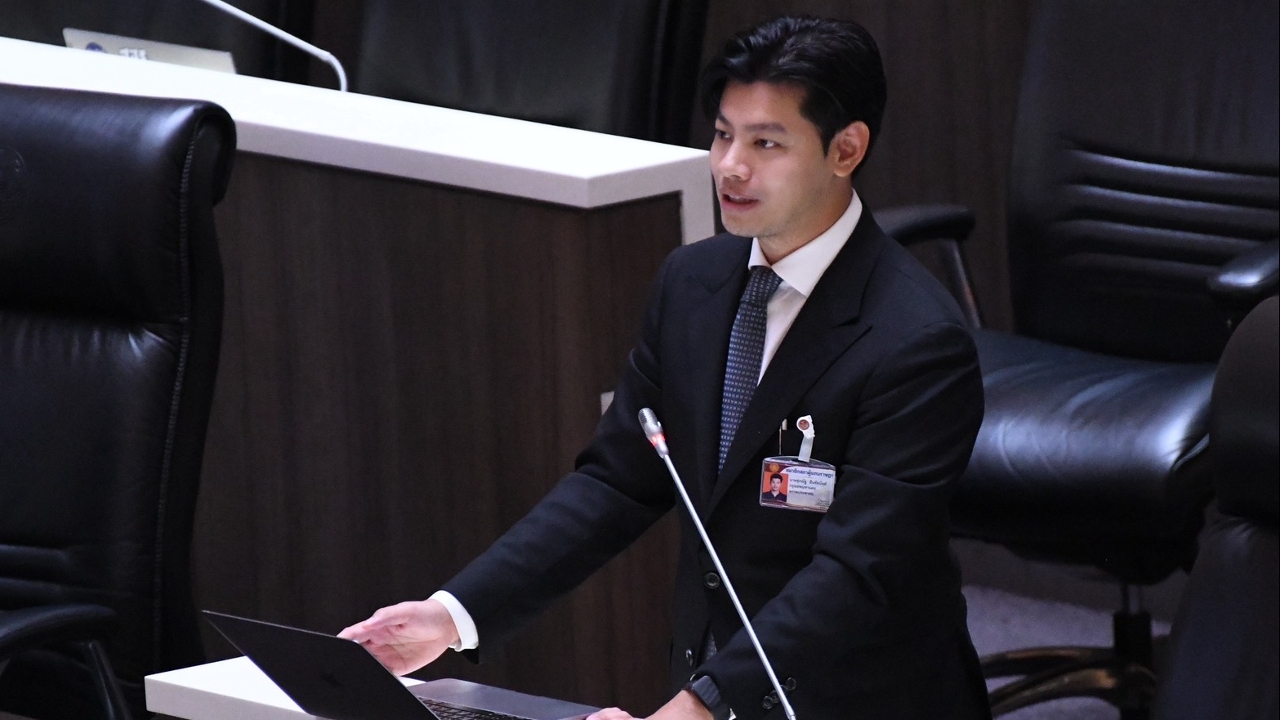
Supanat points out the government's failure to control major construction projects, criticizing the government for allowing the same contractor to continue bidding despite causing over 130 deaths within one year. He demands the establishment of an independent committee and the blacklisting of the contractor.
On 29 May 2026, during a parliamentary session, a motion was considered requesting the House of Representatives to establish a special committee to study and investigate problematic large construction projects causing public distress. The motion was presented by the People’s Party.
Supanat Meenachainan, a Bangkok MP from the People’s Party and the motion’s proposer, opened the debate by stating that reviewing the overall picture of large construction projects in recent years, managed by various agencies such as Bangkok Metropolitan Administration, Department of Highways, Expressway Authority, Office of the Auditor General, Mass Rapid Transit Authority, and State Railway of Thailand, reveals frequent accidents resulting in many fatalities.
Although some projects have begun reporting causes and investigation results, many still lack full reports available to the public. Only preliminary information has been released by agencies and committees, with no verification on whether all data has been thoroughly collected. Ultimately, if these reports are presented in court but found insufficiently examined, many companies may escape full responsibility or face less accountability than warranted.
Supanat added that investigation durations vary from 2-4 months for many projects, but in some cases—such as the sinkhole incident in front of Vachira Hospital—eight months have passed without any official report. Based on news, the investigation is expected to blame everything except the contractor. Although the Prime Minister previously declared in parliament he would not favor Sino-Thai company and would act decisively if wrongdoing was found, and promised the Ministry of Transport’s investigation committee would be independent, the actual committee composition shows very few outsiders compared to other similar investigation committees.
In the past year, projects constructed by Italian-Thai Development Company have resulted in over 130 deaths. Following the crane collapse incident in Sikhiu District, Nakhon Ratchasima Province, the Prime Minister announced contract termination. However, no actual contract cancellation with Italian-Thai Development occurred. This means the company responsible for projects causing over 130 deaths still retains the right to bid on all government construction projects nationwide.
Supanat further noted that the enforcement of the contractor record book, first discussed in 2024, has been repeatedly delayed. Most recently, following the crane collapse in Sikhiu District, the Prime Minister stated it would be completed by February 2026. Yet, to date, the regulations governing the contractor record book remain unfinished, indicating it will not be implemented anytime soon.
Besides monitoring the government's unfulfilled advertised measures, the motion also calls for tracking policies aimed at creating a new ecosystem to resolve safety issues in construction projects. Supanat emphasized that beyond the contractor record book, attention must be given to upgrading construction standards across all stages: upstream, midstream, and downstream.
1) Upstream involves procurement processes and contract design. It is necessary to review screening procedures and tighten contracts, create company profiles documenting each project’s history—not only for government but also private projects—to identify accident hotspots. Regulations for contractor registration, currently outdated and exclusionary, must be revised to allow more companies to advance as contractors.
Adjustments should be made to the value of completed work to reflect the larger economic scale, establish registration for building construction contractors, increase safety budgets in large projects, revise contracts aligned with international standards, require government projects to notify and submit plans to local authorities, and implement rules to manage obstacles that have historically delayed nearly all large government construction projects.
2) Midstream includes two aspects: construction supervision and personnel and professional oversight. For construction supervision, a construction map should be developed to show all current projects nationwide, consolidating data from all agencies for comprehensive monitoring. A system to track all construction sites should be established, along with standardizing construction manuals (currently each agency has its own), strengthening blacklists and the contractor record book system, and forming an independent central committee to investigate rather than letting ministries oversee investigations themselves.
Regarding personnel and professional oversight, workers must perform assigned duties properly. Many engineers currently handle multiple projects simultaneously, leading some not to visit sites at all. Additionally, worker training is lacking; some sites hire workers and immediately assign tasks without prior relevant experience.
3) Downstream should involve lessons learned and industry development strategies, including establishing a feedback system for public complaints about projects, creating a serious accident data center for construction projects, extracting lessons and proposing policies on project bidding, procurement, manuals, and standards—which have remained largely unchanged for years. Despite construction budgets forming the largest share of public investment, there has been no policy to develop the construction industry.
Finally, corruption in construction projects remains unaddressed. Contractors are pressured by politicians and officials to cut quality, pay bribes to supervisors, who then approve substandard work. There has never been thorough investigation into such practices. For example, some projects required concrete bridges but allowed wooden materials to be used instead.