

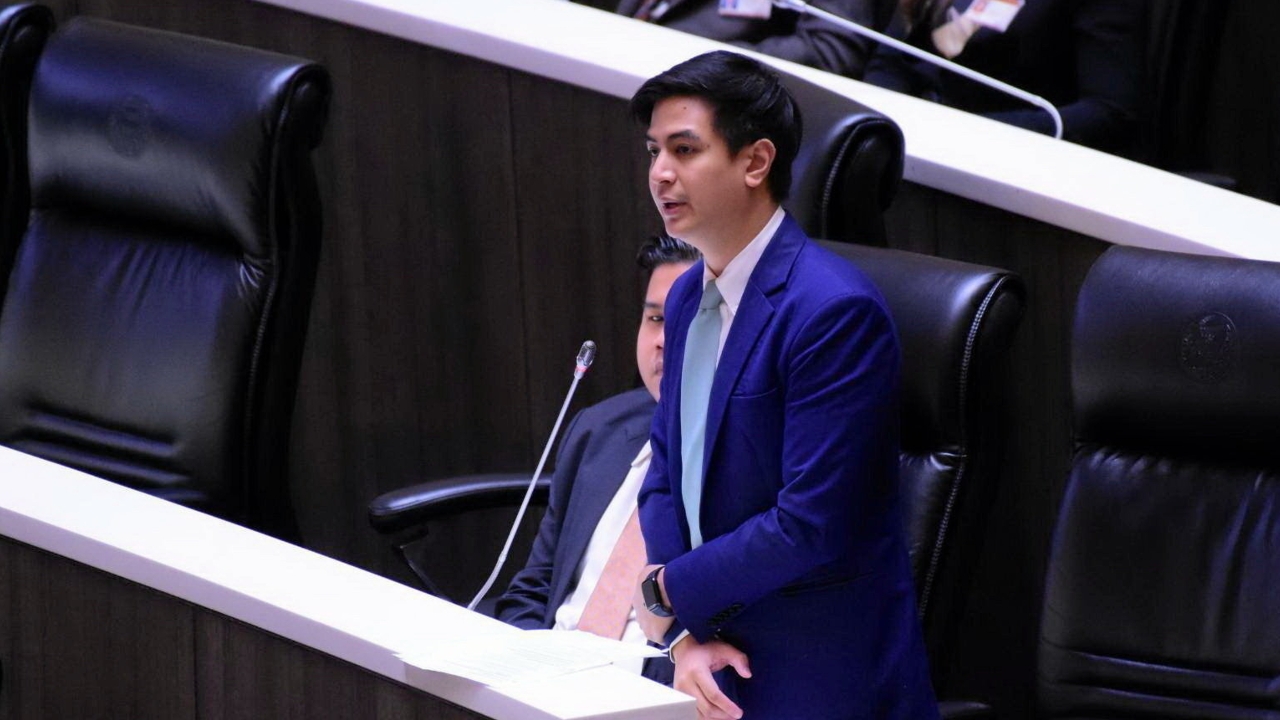
Mobilizing public power to block the blue regime from dominating the country, Prasit affirms the People's Party clearly states that the new constitution must not lead to a change in the government system, hints at removing the Senate, and warns the Election Commission to beware of collusion cases in Senate elections.
31 May 2026 GMT+7 Mr. Prasit Watcharasindhu, a party-list Member of Parliament (MP), deputy leader of the People's Party, and chairman of the opposition party coordination committee in the House of Representatives (opposition whip), commented on the case of Mr. Noraset Prachakorn, chairman of the Senate's Committee on Political Development, Public Participation, Human Rights, Freedoms, and Consumer Protection, who is preparing to collect 140 parliamentary signatures to submit to the Constitutional Court regarding the origin of the Constitution Drafting Assembly (CDA) members, saying discussions have been ongoing, divided into two issues:
1. The Constitutional Court's ruling 18/2025 creates real problems by stating that Parliament cannot allow citizens to directly elect CDA members. The People's Party fundamentally disagrees with this ruling because it contradicts democratic principles and the 2021 ruling affirming that people have the power to establish the constitution. However, since the ruling has been issued, it restricts direct election of CDA members by the people. Currently, MPs interpret this differently. The People's Party acknowledges Mr. Noraset's intentions and agrees this channel can be used for discussion. The outcome remains to be seen. It's worth noting Parliament is also attempting to advance this matter. Since Mr. Noraset has already proceeded, progress is expected to be maximal.
2. Assuming Senators (S) draft amendments to the 2017 constitution, it is necessary to see whether it aligns with the People's Party's three principles: (1) support for public participation via CDA members elected by the people, (2) prevention of monopoly or domination by any one faction, and (3) no increase in power or special conditions allowing Senators to decide the new constitution's content. If aligned, signatures will be given.
When asked about Mr. Natthapong Ruangpanyawut, leader of the People's Party and opposition leader in the House of Representatives, pointing out the blue regime to urge society to pressure MPs to amend the 2017 constitution to allow a CDA, Prasit responded, The People's Party aims for a good political system linked to the people and effective oversight mechanisms. The party clearly shows society that the country faces a problem with a political group trying to monopolize and control all institutions, from government, Parliament, to independent organizations. It is our duty to reveal this to society. To escape this problem, public support is essential to push forward a new constitution. This must be done without designing a process that allows this political group to maintain a monopoly. Therefore, it is necessary to expose the problem and the solution requires public support.
Regarding whether action must occur both inside and outside Parliament to mobilize people to surround Parliament or pressure MPs to amend the 2017 constitution fairly, Prasit said, “Don't call it surrounding Parliament. This applies also to other independent agencies. For example, in June, the collusion case involving Senators, the Election Commission's decision to send it to court or not is under a mechanism where citizens can petition to remove the Election Commission under the 2017 constitution, which currently does not exist. So if people protest, it exerts pressure for the Election Commission to consider public scrutiny of its work.”
When asked about the People's Party's position on amending Chapters 1 and 2 of the constitution, Prasit said, People are concerned whether drafting a new constitution will lead to a change in the state form or government system. We therefore clearly state that “the new constitution must not lead to a change in the state form or government system.” This approach eases societal concerns and may eliminate the need to lock down every provision in Chapters 1 and 2.
“Some provisions in Chapters 1 and 2 do not relate to the state form or government system, such as Article 1 in Chapter 2 mentioning Senators. Suppose in the future the CDA drafts a new constitution deciding to use a unicameral system without a Senate and removes mention of Senators. This is not a change in state form or government system but a choice available, similar to many democratic unitary states using a single-chamber system. However, if every provision in Chapters 1 and 2 is locked, it creates legal inconsistencies. We proposed this draft at the end of 2025, and MPs approved the principles, but at the committee stage and second reading, the majority wanted to lock all provisions in Chapters 1 and 2.”
However, when asked about some parties spreading rumors about another coup if the constitution is amended touching Chapters 1 and 2, forcing the People's Party to lock provisions clearly to prevent such incidents, Prasit said the facts show that from the 1997 to 2007 and 2017 constitutions, revisions to Chapters 1 and 2 have been made repeatedly. This is not new but a practice over 20-30 years. When society is concerned about the state form and government system, we write it clearly so that there is no worry.