

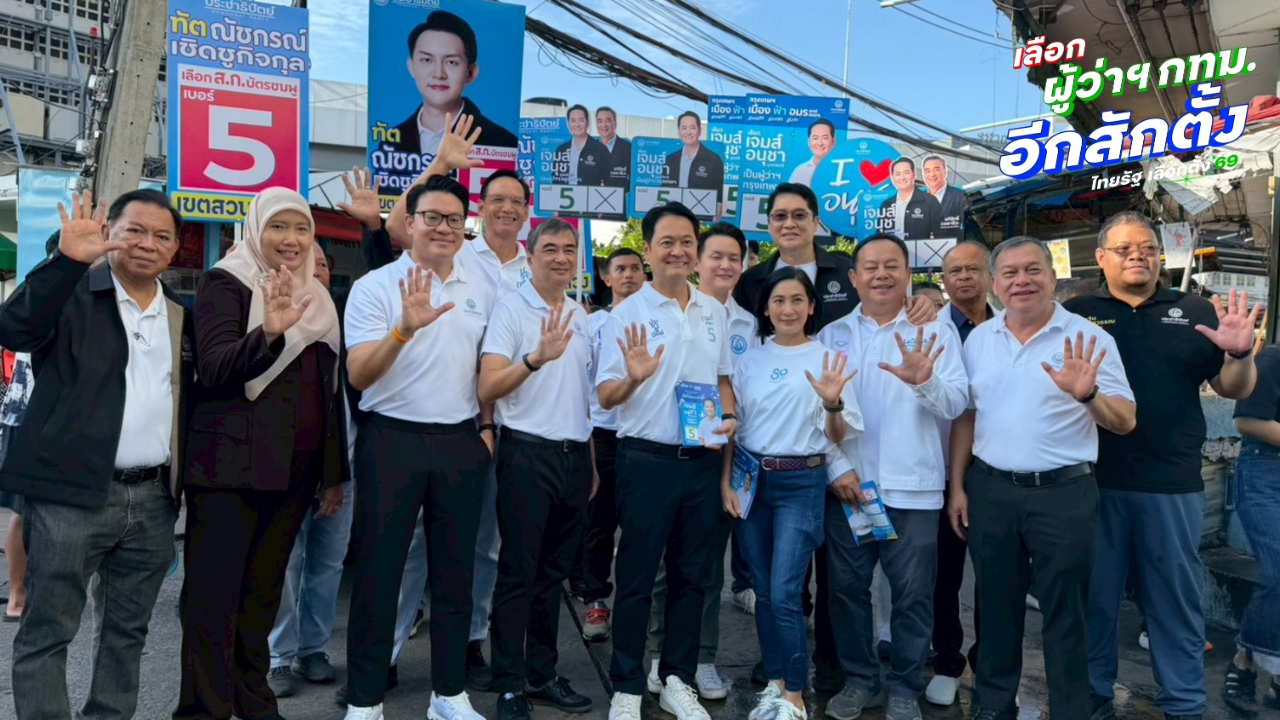
Anucha teamed up with Abhisit and the Democrat Party team to campaign for the Bangkok governor in Suan Luang district, promoting clean markets, managing homeless people, and implementing verifiable flood solutions. They emphasized comprehensive waste management and vowed to bring back supporters who love the Democrat Party.
At 07:00 on 1 June 2026 at Eiamsombat Market in Suan Luang district, Mr. Anucha Burapachaisri, Democrat Party candidate number 5 for Bangkok governor, together with Mr. Abhisit Vejjajiva, Democrat Party leader, party executives including Mr. Korn Chatikavanij, deputy party leader, Mr. Sakoltee Phattiyakul, deputy party leader, Dr. Kanday Liewpairot, deputy party leader, Mr. Ongart Klamphaiboon, party leader advisor, and Mr. Thanawat Cherdchookitsakul, candidate for Suan Luang councillor, campaigned and met with the public.

The atmosphere was lively, with local residents shopping and vendors warmly welcoming them, greeting and taking photos in a friendly manner. Mr. Anucha greeted the public, inquired about the wellbeing of vendors, and asked for support with the number 5 vote from both of them in this district.

Mr. Anucha gave an interview saying one important Democrat Party policy is cleanliness. When campaigning at the market, both sellers and buyers emphasize hygiene because market management aims to make shoppers comfortable. The floor should have no stagnant water to create a good image. Managing restrooms so that people want to use them is important for convenience and safety for sellers and shoppers alike, which has been a common feedback.


Mr. Anucha added another concern is the management of homeless people in the market, as they cause discomfort for vendors and shoppers. Therefore, he wants police or municipal officials to oversee security.
When asked about policies for managing homeless people, Mr. Anucha said there must be discussions about whether they have a registered residence or ID card. The first priority is safety, as homeless individuals cause disturbances that make the area uncomfortable, preventing customers from shopping freely. Afterwards, welfare and improving their living conditions should be addressed, recognizing that each area is different and requires detailed attention.


Regarding Bangkok’s waste problems, Mr. Anucha said it is a major issue. Proper waste disposal is a key Democrat Party policy not only for Bangkok but nationally. Beyond collection and landfill in Bangkok, finding disposal sites without causing problems for other provinces is crucial. They must negotiate with the government on solutions. Currently, waste facilities at On Nut and Nong Khaem must be fully enclosed to prevent odor and wastewater leakage. Transport also sometimes causes dripping on roads. Proper system management is needed so that neither sites nor garbage trucks leak. New technologies, such as converting waste to electricity, should be introduced.

Mr. Anucha continued that priority should be given to residents near waste disposal sites. Although Bangkok’s budget is limited, improving quality of life is important. Garbage trucks’ routes and transport methods should be optimized for shortest distances, and more personnel should be allocated for collection. Collection frequency must increase beyond once a week.
He added that source problem-solving is essential, including campaigns on waste separation, plastics, recycling, and clear explanations about types of waste and collection days. Public understanding must be raised clearly.

“We cannot manage everything ourselves, but policies must come from the central government, whether private or state. Ultimately, waste must be disposed of properly. This problem cannot be avoided. We must face reality and promote incentives for waste separation, showing that it improves living conditions. Bangkok must become a clean city as soon as possible. Many problems I’ve seen can be addressed immediately, such as treatment for fertilizer production, which requires measuring standards that the public accepts—not just subjective feelings. Technology should be used to measure acceptable levels in communities.”
When asked about solutions for Bangkok’s flooding, Mr. Anucha, an engineer by background, stressed the importance of infrastructure. Some constructions may be invisible to the public, but managing water flow to rivers quickly is key, including building large drainage tunnels. Such tunnels have been built continuously, though underground tunnels have been unnoticed. Bangkok has had budgets, but sustainable solutions require systematic planning. Canal dredging must go hand in hand with water gates.
Bangkok is a low-lying area, so interventions must not go against nature. Besides building flood barriers, creating water bridges to allow rapid flow to rivers is important. Drainage tunnels must be systematized and explained to the public so they understand how the budget will address the overall problem in the future.

Mr. Anucha said the Democrat Party, guided by Mr. Abhisit, insists that all budget expenditures be fully transparent. Large projects like these must allow the public to see how the budget resolves the whole system problem, not merely canal dredging.
When asked about recent polls showing Bangkok residents favoring independent candidates unaffiliated with parties, Mr. Anucha said polls can change weekly. He emphasized collective campaigning because some problems are not only Bangkok’s. They have been on the ground listening and discussing issues in parliament. They have not disappeared despite lacking official positions in Bangkok or parliament. Democrat Party members continue fieldwork. With about 20 days left, they will show long-time Democrat supporters their party’s dedication and readiness to represent them to the fullest.
Afterwards, Mr. Anucha and the team visited a waste-to-energy power plant at the On Nut Solid Waste Management Office.