

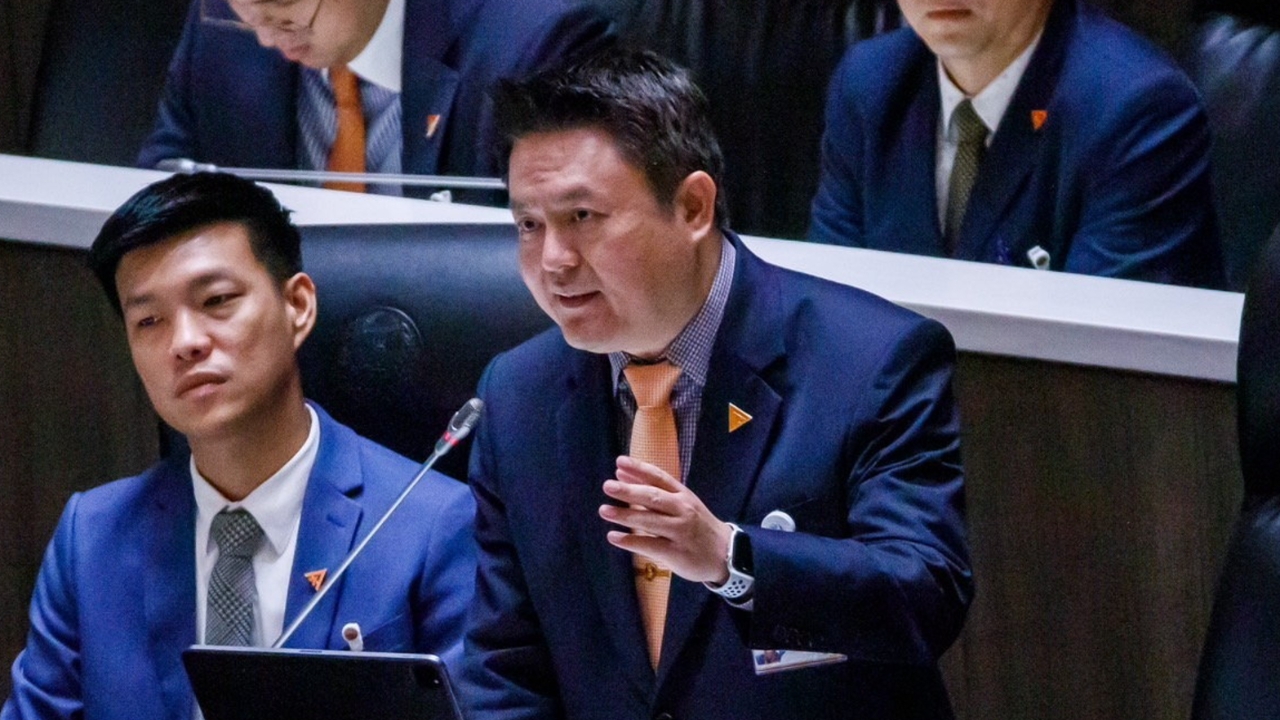
Surachet calls for attention to the Cabinet's decision on implementing a 40-baht all-day train fare, warning it risks benefiting investors while leaving the public to shoulder long-term budget burdens. He recommends a joint fare system ranging from 8 to 45 baht covering buses and trains, stressing that public transport must be for everyone rather than just a single mode.
2 Jun 2026 GMT+7 Mr. Surachet Prawinwongwut, party-list MP of the People’s Party, made observations regarding reports that the Ministry of Transport plans to propose to today's Cabinet meeting the transfer of all metro lines under the Mass Rapid Transit Authority of Thailand (MRTA) management to push forward the “40 baht all-day” fare policy, which the Bhumjaithai Party had campaigned to complete as a New Year 2027 gift to the public.
Surachet stated he suspects the reports may be inaccurate or that the Deputy Minister of Transport might have misunderstood. If the policy truly entails a 40-baht all-day fare covering all metro lines and is completed before the New Year, this will become a major issue likely favoring investors excessively, based on a technical concept called “Induced Demand.”
This means when the government cuts fares to 40 baht all day—not by investors generously reducing prices but by government subsidies taking money from those who don't use the metro to enrich investors—the lower-than-cost price will encourage more people to use the metro. While this may sound positive, the increased ridership does not mean the project will be profitable. The 40-baht all-day fare does not cover the actual operating cost per passenger. Ultimately, the total increased ridership becomes a figure the government must compensate investors for, using taxpayers' money. The more riders, the more investors benefit from government subsidies.
Surachet added he believes the joint fare issue will indeed be brought to the Cabinet, but likely only to review and cancel unreasonable past resolutions that have hindered system progress and failed to solve real problems for the public. Clearing these old decisions would allow the government to tackle the problem of redundant initial fares when transferring between lines, directly reducing travel costs for passengers crossing lines without excessively using tax money to benefit investors.
Regarding this, the Cabinet is expected to cancel the “20 baht all-line” fare plan because the Bhumjaithai Party wants to promote the new “40 baht all-day” fare. Meanwhile, the People’s Party believes a fare range of “15-45 baht all-route” should be applied and expanded to “8-45 baht all-route,” covering both buses and metro trains. This aims to address the hardships faced by citizens who currently bear travel costs even when commuting from home to the metro stations. The government should shift from a parallel approach that heavily subsidizes metro trains while neglecting buses to a truly inclusive public transport system by adjusting buses to act as feeders into the metro system, working together with integrated and systematic joint fares.
Another matter is the cancellation of the resolution assigning the Digital Government Development Agency (DGA) to manage the Clearing House system for financial settlement. It is believed that both the People’s Party and Bhumjaithai Party agree the government should officially implement a Central Clearing House system under the Joint Ticket Act. Furthermore, at the joint ticket policy committee meeting on 22 May 2026, it was forecast that joint fare rates and system development will progress more reasonably, since the Joint Ticket Act approved by parliament is largely based on the People’s Party’s draft, including Section 31 which prevents ministers from setting fares without appropriate rationale—whether 20 baht all-line or 40 baht all-day—that would create excessive future burdens for the country.
As for reports that the Joint Ticket Policy Committee has complied with the Joint Ticket Act framework and might set joint fares between 17 and 45 baht all-route, covering all lines and transfers, although these fares may seem higher than advertised by some parties, they are realistically feasible. The government subsidy this time focuses on solving redundant initial fare problems, not competing on being cheaper, which would violate the Joint Ticket Act and financial discipline principles. In fact, the average operating cost of metro management currently exceeds the average revenue from fares.
Therefore, at present, the Joint Ticket Policy Committee is preparing to announce joint fares ranging from 17 to 45 baht all-route, with related agencies estimating annual government subsidy requirements for the joint ticket system between approximately 3.054 and 4.698 billion baht. This is considered reasonable and differs from previous statements made by ministers.
Surachet also emphasized that the People’s Party fully supports reducing the public’s travel expenses, but the key is that public transport must be for everyone, developing both bus and metro systems in tandem. Fare setting must be based on reasonable grounds without creating excessive long-term budget burdens for the country, because ultimately the people themselves bear the tax and debt burdens.
“I firmly predict the Cabinet will not dare to announce the 40-baht all-day fare for all lines by the end of the year as ministers have suggested. I invite the public to closely watch the outcome of this important Cabinet meeting with me.”