

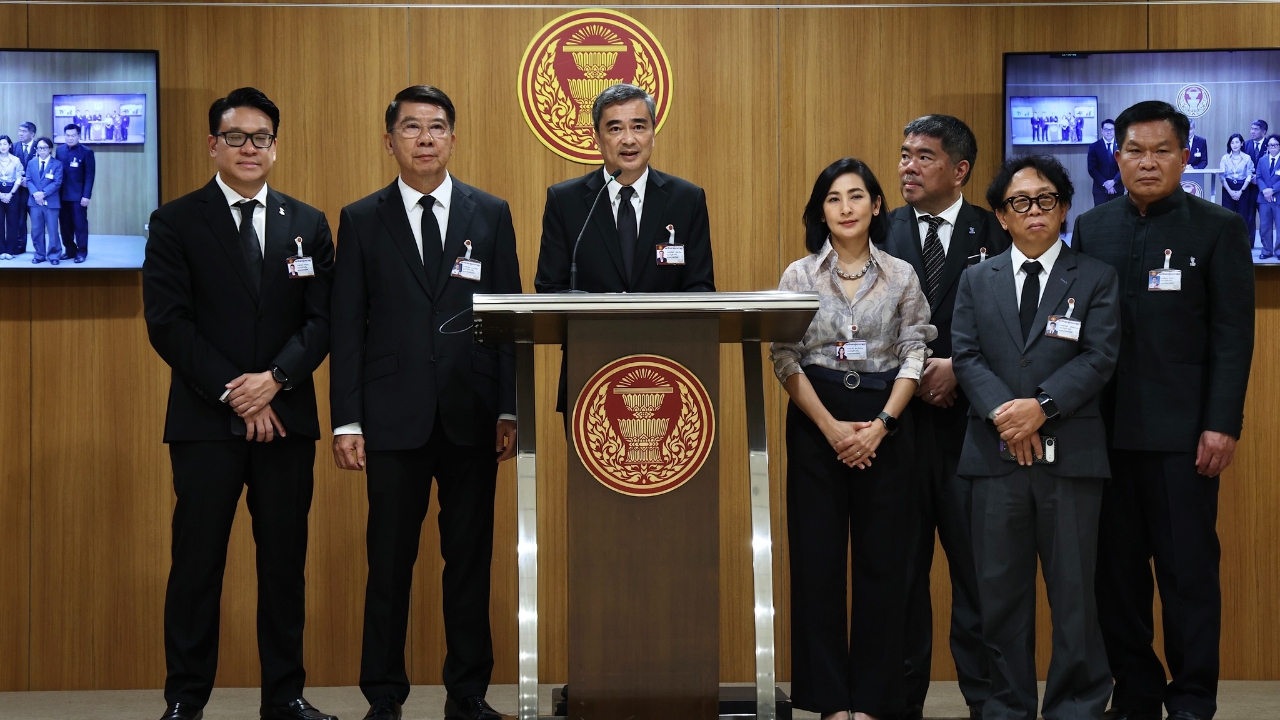
Abhisit pointed out that the 100-billion-baht loan project only serves as a four-month stopgap. He also prepared to challenge the questionable 1.6-billion-baht budget for the “TH-AI Passport” project in parliament on 4 June.
On 2 June 2026, Abhisit Vejjajiva, leader of the Democrat Party, visited Din Daeng Market in Din Daeng district to listen to citizens' concerns about their livelihoods and living costs. He spoke about the government's mega projects and energy management, urging the government to seriously address the root cause of high prices stemming from oil costs. He noted that although the government currently has the “Thai Help Thai Plus” program subsidizing expenses at a 60:40 ratio, this only offers a temporary fix. If product prices continue to rise unchecked and the four-month program ends, the government will have to answer for the use of over 100 billion baht in borrowed funds.
"The government has not addressed the root problem, particularly the refinery margins," Abhisit said, noting that his party raised this issue last week, but the Ministry of Energy has remained silent without any explanation. He added that the easiest immediate action the government could take is to exempt excise tax on oil to reduce oil costs, which would lower production and transportation expenses accordingly. Had the government listened and acted sooner, people might not be facing such soaring living costs today. His party plans to bring up the bill to monitor and investigate the use of the loan money during the parliamentary session on 4 June.
Regarding the irregularities in the budget for the “TH-AI Passport” project worth over 1.6 billion baht, Abhisit said that the public is widely aware and questioning it. He urged the government to reconsider whether this project is truly worthwhile. He also pointed out several other projects that claim to use technology for specific groups but face similar problems, including those under the Ministry of Higher Education, Science, Research and Innovation and the Ministry of Education. He questioned why the government does not reform these projects for efficiency instead of taking on more loans, which become burdens and negative legacies passed on to future generations.