

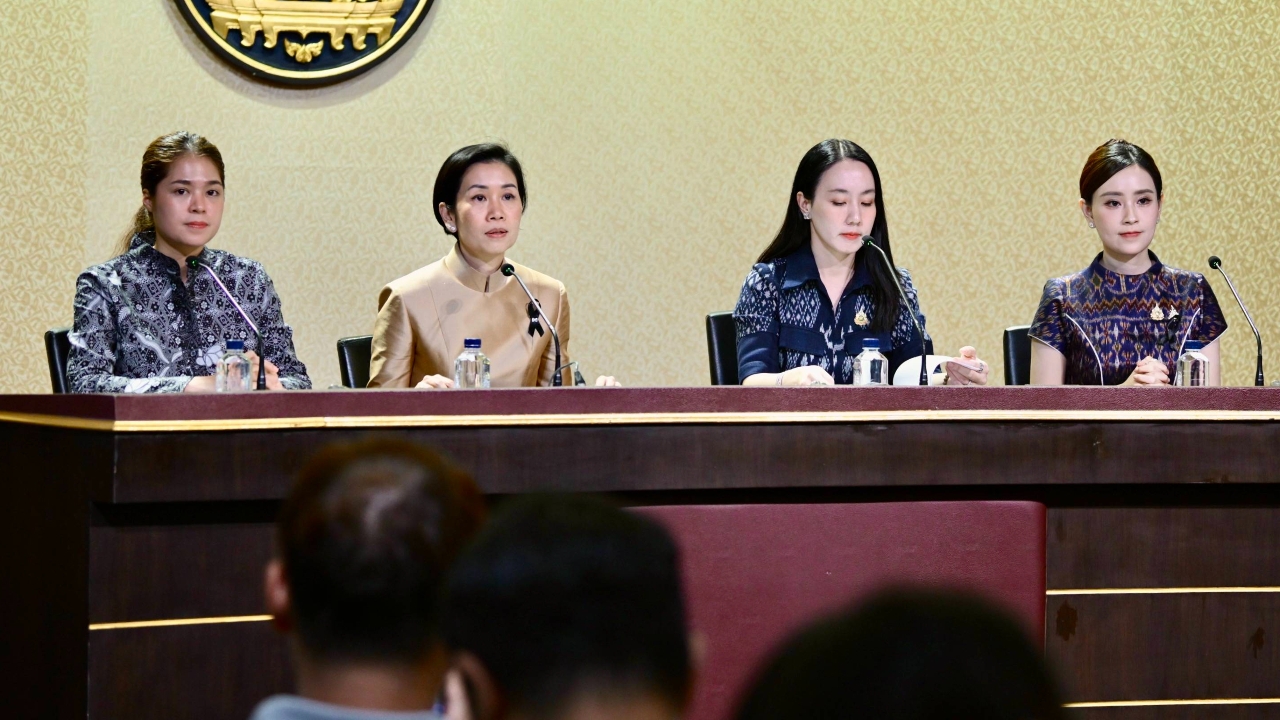
The Cabinet approved the 2027 budget details totaling 3.78 trillion baht, allocating 390 billion baht to local governments. It also moved forward with policies to address the climate crisis and appointed a fund to manage losses and damages from climate change.
On 2 June 2026 GMT+7, Ms. Ratchada Thanadirek, spokesperson for the Office of the Prime Minister, revealed that at the meeting, the Cabinet resolved to approve the detailed expenditure budget for the fiscal year 2027 for budget-receiving units as proposed by the Budget Bureau. The focus is on government policies, achieving national strategic goals, master plans, and development plans that align with public needs. Additionally, considerations included necessity, readiness, cost-effectiveness, spending capacity, fiscal status, economic stability, and social equity, with details as follows.
1) The total expenditure budget for fiscal year 2027 for budget-receiving units is 3,788,000 million baht, consisting of
2) The 2027 expenditure budget of 3,788,000 million baht can be classified into various dimensions including
3) Budget allocations to local administrative organizations amount to 394,966.5942 million baht.

Ms. Lalida Perdvivatana, Deputy Spokesperson of the Office of the Prime Minister, stated that under the leadership of Prime Minister and Minister of Interior Anutin Charnvirakul, the government is concretely advancing climate change policies to enhance Thailand's capacity to handle global warming impacts and improve access to international funding for environmental and disaster issues caused by climate change.
The Deputy Government Spokesperson added that the Cabinet approved the Ministry of Natural Resources and Environment's proposal to name the Fund for responding to Loss and Damage (FRLD) in Thai as “กองทุนจัดการความสูญเสียและความเสียหายจากสภาพภูมิอากาศ” or “FRLD Fund.” The Department of Climate Change and Environment was appointed as Thailand’s National Authority/National Focal Point.
Additionally, the Cabinet approved appointing the Director-General of the Department of Climate Change and Environment as the Designated Authority authorized to sign off on projects or requests for support from the FRLD and other climate funds. This aims to streamline operations, comply with international fund criteria, and expedite Thailand’s access to funding.
The government also approved revising previous Cabinet resolutions regarding climate funds, including the Adaptation Fund (AF) and the Green Climate Fund (GCF), by changing the authorized signatory from the Permanent Secretary of the Ministry of Natural Resources and Environment to the Director-General of the Department of Climate Change and Environment to align with international fund requirements and enhance management efficiency.

Ms. Lalida further explained that the FRLD is a financial mechanism under the United Nations Framework Convention on Climate Change (UNFCCC) established to assist developing countries affected by disasters and losses from climate change. Currently, developed countries have pledged over 731 million U.S. dollars, with the first project proposal round open from 15 December 2025 to 15 June 2026.
For Thailand, officially appointing the national coordinating agency and designated authority will enable more effective project support requests related to disaster management, recovery of affected areas, water management, climate adaptation, and assistance to disaster-affected populations. The government prioritizes addressing climate change comprehensively—environmentally, economically, and in terms of citizens' quality of life—while continuing cooperation with the global community to secure funding, technology, and knowledge vital for sustainable development and long-term resilience building.