

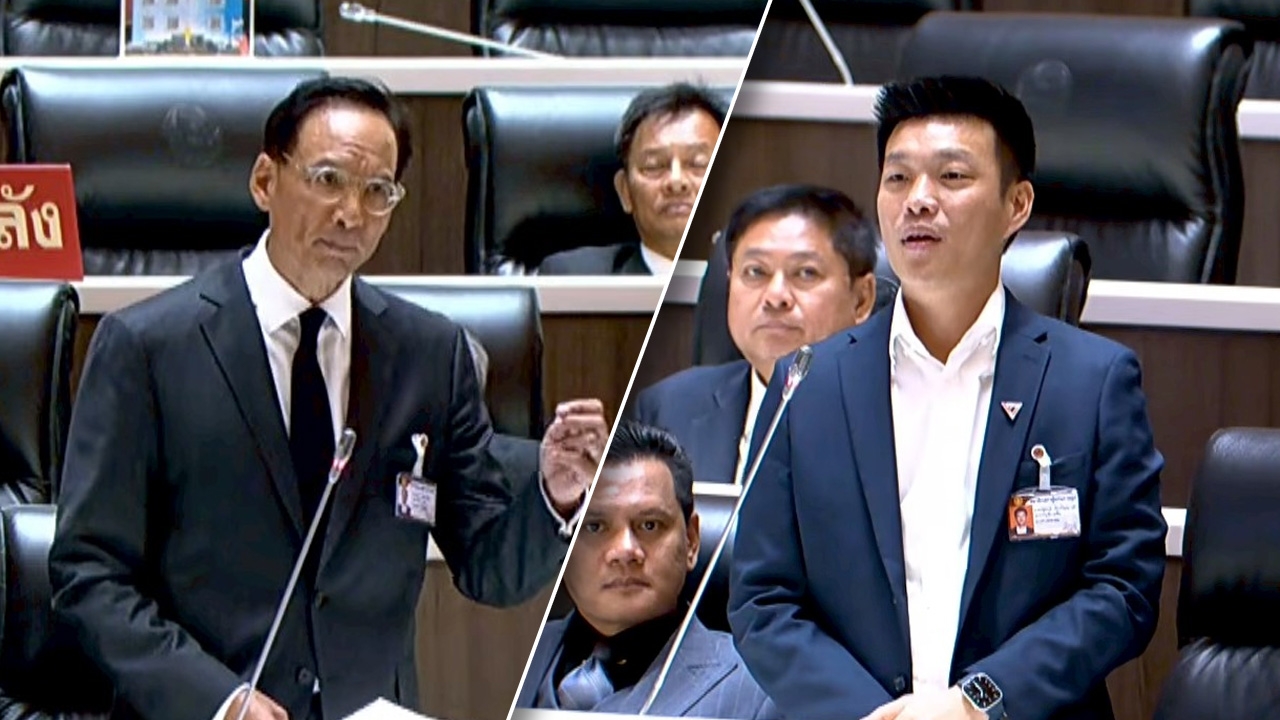
The House of Representatives approved the formation of a special committee to monitor the 400 billion baht loan. Natthapong expressed concern about project specification locking that could result in kickbacks. Meanwhile, Korn presented economic data indicating there is no crisis severe enough to justify borrowing.
At 1:00 p.m. on 4 June 2026 at the parliament, the House of Representatives held a meeting chaired by Sopon Sarum, the Speaker. The session considered a motion to establish a special committee to examine the use of loan funds under the emergency decree authorizing the Ministry of Finance to borrow money to address the energy crisis and support the country’s energy transition in 2026, totaling 400 billion baht. The motion was jointly proposed by the Kla Party, the Prachachon Party, and the Democrat Party. Natthapong Ruangpanyawut, party-list MP and leader of the Prachachon Party, argued that there were suspicious elements in the loan usage. For example, the 18 billion baht loan allocated to the State Welfare Fund for compensation violated the principle that emergency loans should be used only as necessary. The government deceptively diverted this 18 billion baht loan for operations, although the 2027 budget bill had already been considered. This method did not benefit the public; rather, it allowed the government to circumvent the loan decree illegally and against its intended purpose.
Regarding the second loan tranche of 200 billion baht for energy structure transition, it was merely an excuse. If the goal were truly to shift to clean energy, no investment would be necessary, as the private sector is ready to support. However, the government used a special channel to avoid parliamentary scrutiny, exploiting the crisis and conflict to create funds internally, apparently aiming to lock project specifications—similar to some AI projects and the Thailand Passport initiative—that favor companies within certain networks, potentially funneling kickbacks to parties aligned with the Blue Regime.
Korn Chatikavanij, party-list MP from the Democrat Party, stated that tax revenue reports over seven months show collections exceeding targets by 31 billion baht, with nearly 300 billion baht in treasury reserves at the end of April, a 14% increase compared to last year. This indicates fiscal stability, and public debt remains within fiscal discipline limits. GDP figures from two weeks ago show Thai economic growth at 2.8%, surpassing expectations and far from a crisis warranting loans. Foreign exchange reserves stand at a record 10 trillion baht, the highest ever for Thailand. Given these numbers, the situation does not constitute a crisis justifying the emergency loan decree. If the government is concerned about living costs, better alternatives exist, such as lowering oil prices and excise taxes, reducing expenses without increasing national debt. If every government claims economic crisis to justify emergency loans, future fiscal discipline laws will lose meaning, leading to maximum borrowing and additional emergency decrees, stalling economic progress.
Suppachai Jaisamut, party-list MP from the Bhumjaithai Party, noted that although the emergency decree bypasses regular scrutiny, it can still be reviewed by the Constitutional Court. The rationale for issuing the decree is clear: to address urgent economic issues that cannot wait. Large loans must be monitored because they involve public funds. He supports oversight of spending and insists on accountability for inefficient use or corruption. Borrowing is not a blank check, and the parliament must assist in scrutinizing the government’s actions. He endorsed establishing the special committee.
Rakchanok Srinok, party-list MP from the Prachachon Party, expressed concern over the 200 billion baht loan allocated for energy structure change projects, noting a lack of detailed plans. This includes installing solar panels in government agencies and developing electric vehicle charging stations. She worried about contractors involved and whether the contracts would be distributed among contractors linked to the Blue Network.
Abhisit Vejjajiva, party-list MP and leader of the Democrat Party, argued that the House has not had the chance to scrutinize any projects under this emergency decree. Subsequently, these loans will appear in future budgets to cover principal and interest payments, leaving almost no funds for development investment. The opposition believes the decree contradicts the constitution because the crisis can be managed if addressed at its root. Instead, the government decided to borrow, causing citizens to pay higher prices. After four months, prices remain high, but public debt has nearly reached the ceiling. Serious oversight is needed. He questioned whether the Finance Minister can confidently confirm that operations remain within the set principles, as the project targets 25-26 million people. Even the Finance Minister registered to use the app designed for debt repayment by the younger generation. Recently, welfare cardholders’ rights were cut, including those whose parents claim tax deductions for their children. This appears to be a short-term economic stimulus that saddles Thai people with 400 billion baht debt, necessitating the establishment of a monitoring committee.
Reporters noted that after all members finished debating, the meeting unanimously agreed to establish a 25-member special committee to examine the spending of the 400 billion baht emergency loan decree.