

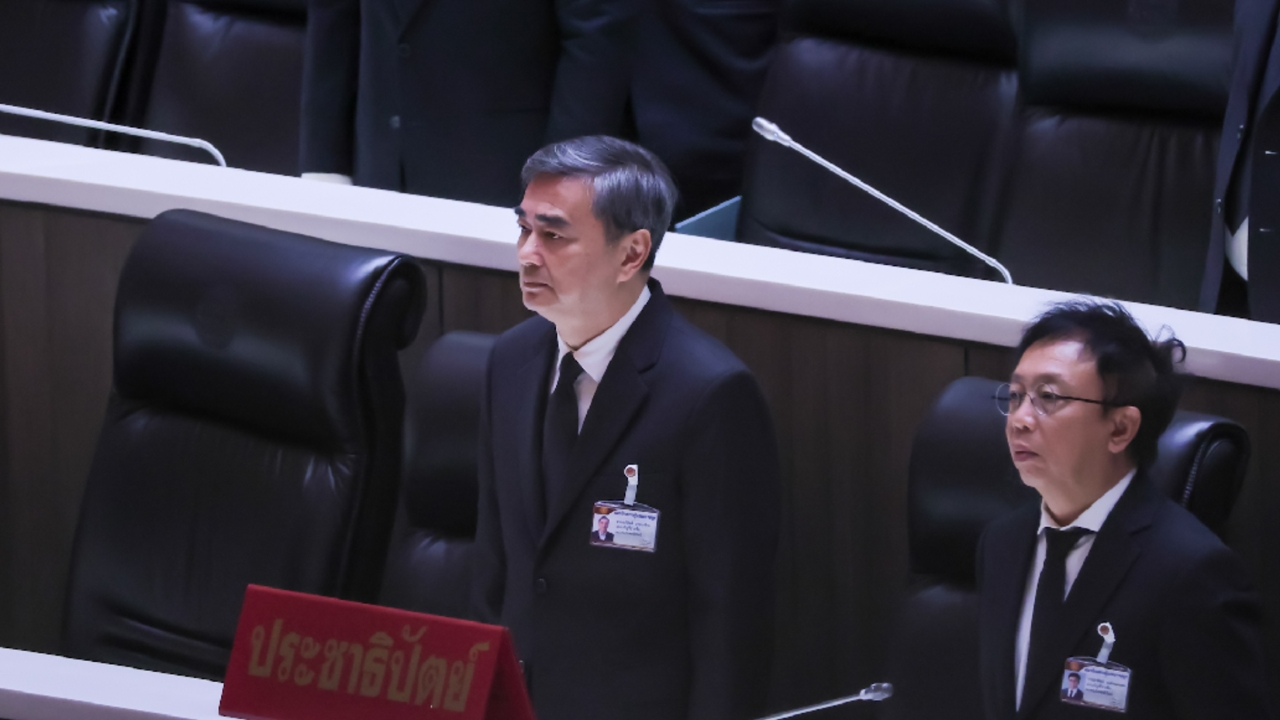
“Abhisit” harshly criticizes the Anutin 2 government for evading parliament, leaving key motions such as the land bridge project, tax reform, and PM2.5 pollution to face silence.
On 4 June 2026, Mr. Abhisit Vejjajiva, party-list MP and leader of the Democrat Party, posted on his personal Facebook page a response to Mr. Krawee Prisananthakul, Ang Thong MP from the Bhumjaithai Party and chairman of the government coalition whip committee (government whip). Krawee had issued a statement rebutting Abhisit’s criticisms regarding the government’s work linked to the House of Representatives. Abhisit emphasized that politics must be based on facts, then presented evidence of the current government’s parliamentary performance, highlighting three main problems.
First, Abhisit pointed out that among various parliamentary motions, only one had a minister come to explain—the case of Mr. Jetsadak Thaiset, a minister who spoke in his capacity as an MP about flood relief in Hat Yai, which Abhisit personally praised. However, other important motions received no ministerial attention or engagement, despite their significant structural impact on people’s lives. These included the land bridge project motion, legal reforms, tax reform, protection of freelance and platform workers, the agricultural product price slump, the climate crisis and PM2.5 issue, as well as oil price problems. Such neglect undermines the effectiveness of cooperation between the government and the parliament.
Next, concerning live question sessions, Abhisit observed that the executive branch never has trouble responding when government MPs question each other. But when opposition MPs ask tough, investigative questions—especially those directed straight to the Prime Minister and Deputy Prime Minister Mr. Pipat Ratchakitprakarn—the executive often sends substitutes or delegates other ministers to answer. Ultimately, these representatives fail to address the real substance, turning the situation into a bitter joke among opposition members that future questions should be limited to topics that the responding ministers can actually answer, to avoid wasting parliamentary time.
Additionally, the Democrat Party leader clarified the issue around setting up special parliamentary committees (subcommittees). He affirmed the opposition does not propose these lightly, but many issues overlap in dimensions that existing standing committees cannot fully cover, and those committees are already overloaded. Regarding the land bridge project, which the government often claims was already reviewed by a committee in the previous parliament, Abhisit revealed that the former committee was highly conflicted, with attempts to rush conclusions, leading minority committee members to protest by resigning.
In closing, Abhisit expressed sympathy for Mr. Krawee in his role as government whip chairman, who must publicly represent the Prime Minister and ministers of the Anutin 2 government. He also praised Krawee’s ongoing work but urged him to have the courage to reflect these problems back to the executive branch, demanding the government respect and prioritize the work of the House of Representatives on behalf of all citizens. This would help make the role of government whip chairman more complete and dignified.