

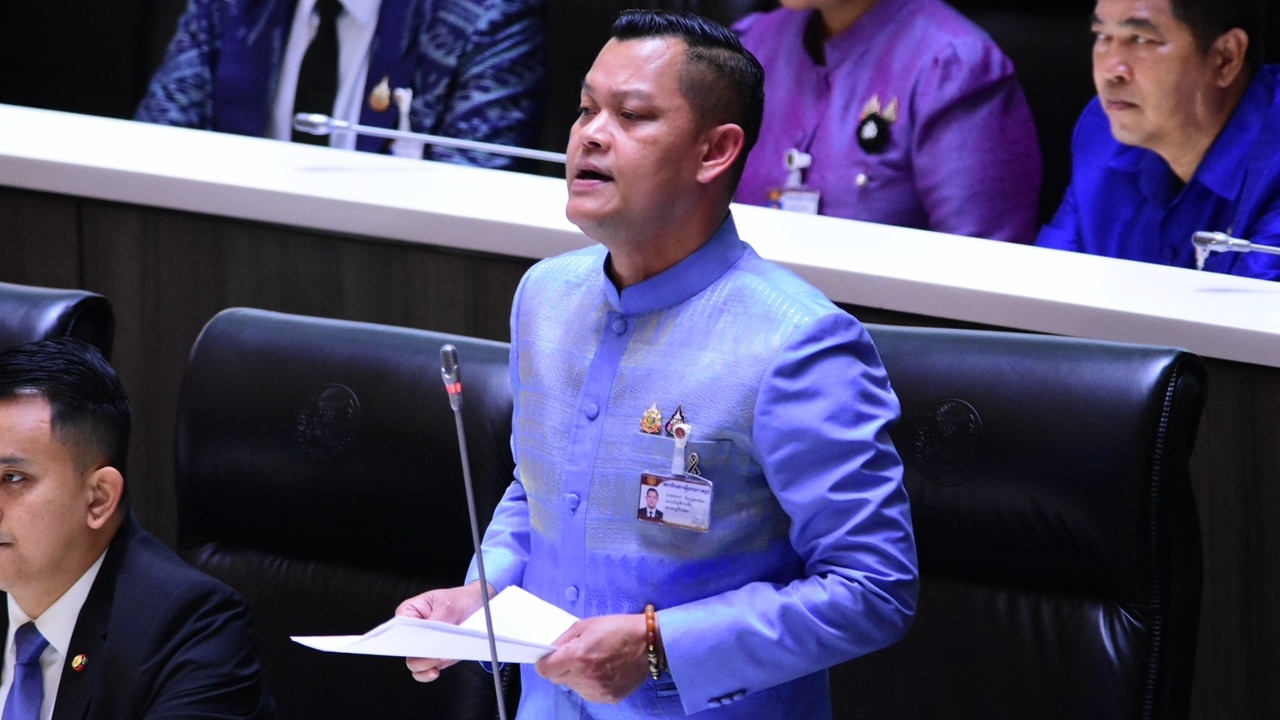
Thanakorn points out that the 400 billion baht loan decree to preserve economic stability includes a 200 billion baht fund for investment in energy transition and economic restructuring, which has raised questions and must be "transparent, cost-effective, and fiscally disciplined."
On 4 Jun 2026 GMT+7, Thanakorn Wangboonkongchana, party-list MP of Bhumjaithai Party and former Minister of Industry, spoke in parliament requesting the formation of a special committee to examine the spending of the 400 billion baht loan authorized by the decree. He agreed with establishing the committee, noting that the loan powers given to the Ministry of Finance are a key measure directly linked to the country's economic and energy security. Currently, Thailand faces geopolitical conflicts, economic polarization, and ongoing severe volatility in global energy markets. The annual value of energy imports is about 1.4 trillion baht, equivalent to roughly 7–8% of the country's GDP. The country imports over 80% of its crude oil consumption and is increasingly importing liquefied natural gas (LNG). These factors raise costs throughout the economy, including transportation, food prices, industrial and agricultural production costs, and place heavy burdens on SMEs. Consequently, the cost of living rises, which ultimately affects purchasing power, employment, and the country's economic stability.
Thanakorn continued that the first 200 billion baht, allocated for short-term relief and reducing living costs, is widely understood as necessary because many people are facing higher expenses. Government support to ease the cost of living and sustain purchasing power at this time is essential to prevent broader economic impacts. However, the more debated issue is the other 200 billion baht intended for investment in energy transition and economic restructuring. Many question why such borrowing must happen urgently, why investment cannot be spread gradually through the normal budget, or why it cannot wait for better economic conditions. He said the government must explain these questions honestly to the public.
"Thailand does not have much time left because what is happening globally is not just an energy shift but a new economic structural competition. Countries are making massive investments to capture future industries. In just one year, global clean energy investments exceeded 2 trillion US dollars, surpassing fossil fuel investments for the first time in history. The United States passed the Inflation Reduction Act, allocating over 369 billion US dollars to attract clean energy and future technology industries. China is investing heavily in clean energy, electric vehicles, batteries, and green technologies. Meanwhile, the European Union is using environmental and carbon measures as trade conditions. These developments reflect that energy costs, clean energy, and new economic structures are becoming key factors in national competitiveness," Thanakorn said.
He added that the IMF forecasts Thailand's economic growth at only about 1.5% in 2026 and around 2.0% in 2027, still lower than many regional countries, highlighting the urgent need for serious economic restructuring. Competitor countries are accelerating investments, investors are deciding on new production bases, and global supply chains are changing. If Thailand delays too long, future costs could far exceed today's investment. Therefore, this investment is not mere spending but a necessary step to maintain competitiveness and long-term economic security. However, it must follow three key principles: transparency, cost-effectiveness, and fiscal discipline. The government must have a clear debt management plan to sustain confidence in Thailand's economy over the long term.
"If the government under Prime Minister Anutin Charnvirakul hesitates to invest to protect the country's future, the long-term damage could be far worse. Therefore, I believe this loan is essential for maintaining economic stability, supporting the people, and laying the foundation for Thailand's future. This is similar to the highly popular 'Half-Half' program under Gen. Prayut Chan-o-cha's administration, and the 'Thai Help Thai Plus' program under Anutin Charnvirakul's government has also received praise," he concluded.