

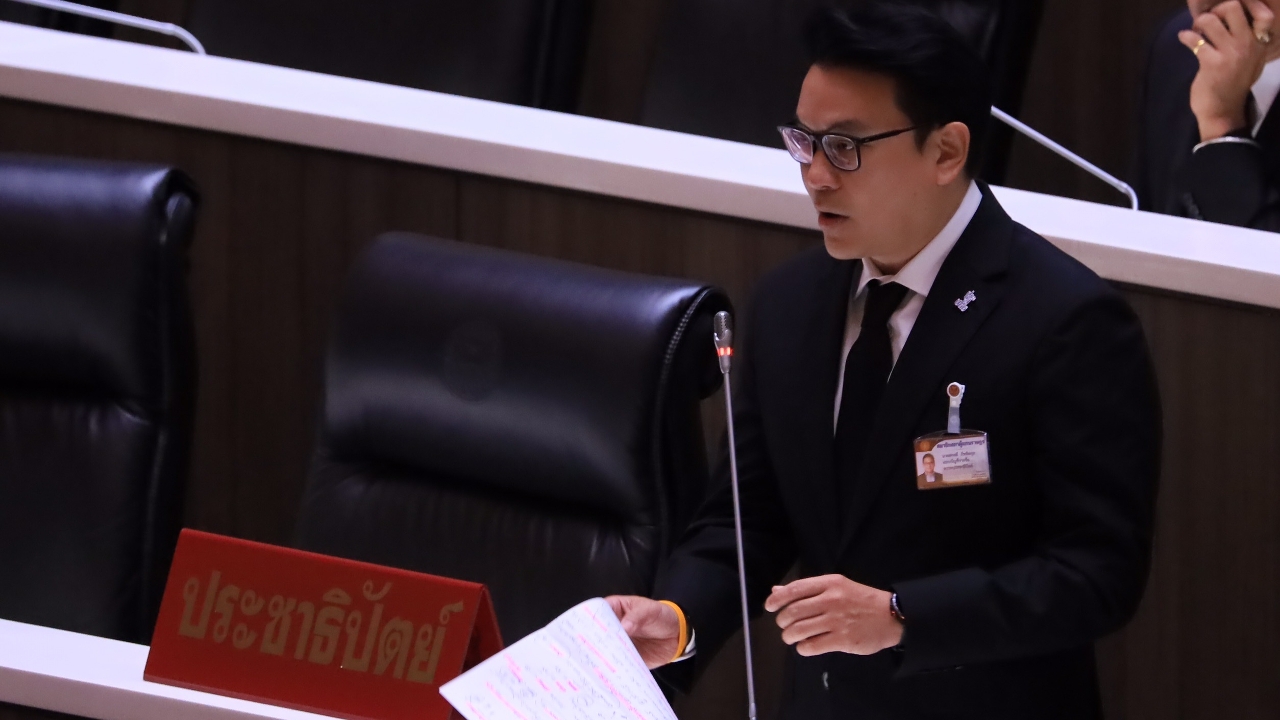
Sakolthee cites lessons from the COVID-19 loan decree, expressing concern about repeating hidden misuses. He proposes establishing a special parliamentary committee to oversee the 400 billion baht loan, stressing that every baht must be used correctly and tightly controlled.
On 4 Jun 2026 GMT+7, reporters reported that the House of Representatives meeting considered a motion to establish a special parliamentary committee to monitor spending of the 400 billion baht loan under the emergency decree. The assembly voted to set up the committee. Sakolthee Phattiyakul, a party-list MP from the Democrat Party, spoke in support of the motion, emphasizing that the government's key duty is to create livelihood opportunities for people and grow the economy. He said loans should only be used when urgently necessary and must go through transparent audit processes.
Sakolthee said that most of the first 200 billion baht loan tranche raised no concerns, but the second 200 billion baht tranche was claimed by the government to be used for energy transition policies. The Democrat Party has consistently advised the government that the issue of high oil prices could be immediately addressed through normal mechanisms, such as adjusting pricing formulas, reducing refining fees, imposing windfall taxes, or cutting excise taxes. However, the government chose not to do so and instead issued this loan decree, which gives the impression that the government is "managing to keep oil prices high and then using public loan money to put out the fire." Reviewing the content of the 200 billion baht energy loan decree, the government specified five objectives: 1. Reducing fossil fuel use, 2. Installing renewable power systems (solar cells), 3. Generating carbon credit income, 4. Promoting EV vehicles and charging stations, and 5. Developing public skills and innovation.
Sakolthee said energy transition measures are strategic and require long-term preparation, not urgent needs justifying an emergency loan decree. Moreover, current mechanisms and regular budgets already support these measures, such as:
- EV support measures already have regular budget approvals since 2023 totaling over 34 billion baht to cover 2024-2027, aiming to increase electric cars and motorcycles by over 830,000 units. The process is ongoing despite the recent statement by the Permanent Secretary of Finance about temporarily suspending support.
- The Energy Conservation Promotion Fund has budget frameworks for 2025 and 2026 that already provide nearly 10 billion baht for solar promotion.
- Low-interest loans: Government Savings Bank has already issued low-interest loans totaling 5 billion baht to support EV usage and solar installation.
Sakolthee also cited mistakes from the 1.9 trillion baht emergency loan decree during the COVID-19 crisis, when the economy contracted by 6%. Unlike today, GDP remains positive. Past results showed funds were used for local-level training projects that were "too sweet" or "phantom training" and overpriced procurement of health equipment. Both the National Anti-Corruption Commission and the Office of the Auditor-General have identified risks and ongoing investigations. The Democrat Party does not want history to repeat with the government citing urgency to force through poorly vetted projects.
He called for the special parliamentary committee to focus on five key points:
1. Verify under Article 172 of the Constitution which projects are truly urgent and necessary. Projects that can be funded through normal budgets should not use loan funds.
2. Set clear key performance indicators (KPIs) before spending, such as how many households will receive electricity, megawatts added, and whether the power transmission system can support the solar projects included.
3. Investigate conflicts of interest. After a special meeting on 11 April approving targeted aid and signaling the loan decree, on 10 April energy and clean power stocks rose sharply across the board. This raises concerns if any companies had insider knowledge or benefited in advance.
4. Require continuous progress reporting to the House of Representatives, not just after funds are fully spent.
5. Ensure full transparency and auditability of every baht spent.
Sakolthee concluded by saying he does not oppose national progress or renewable energy policies but insists that all funds must be used properly and closely monitored. Establishing the special committee will be a crucial tool to promote good governance and transparent politics for the genuine benefit of the people.