

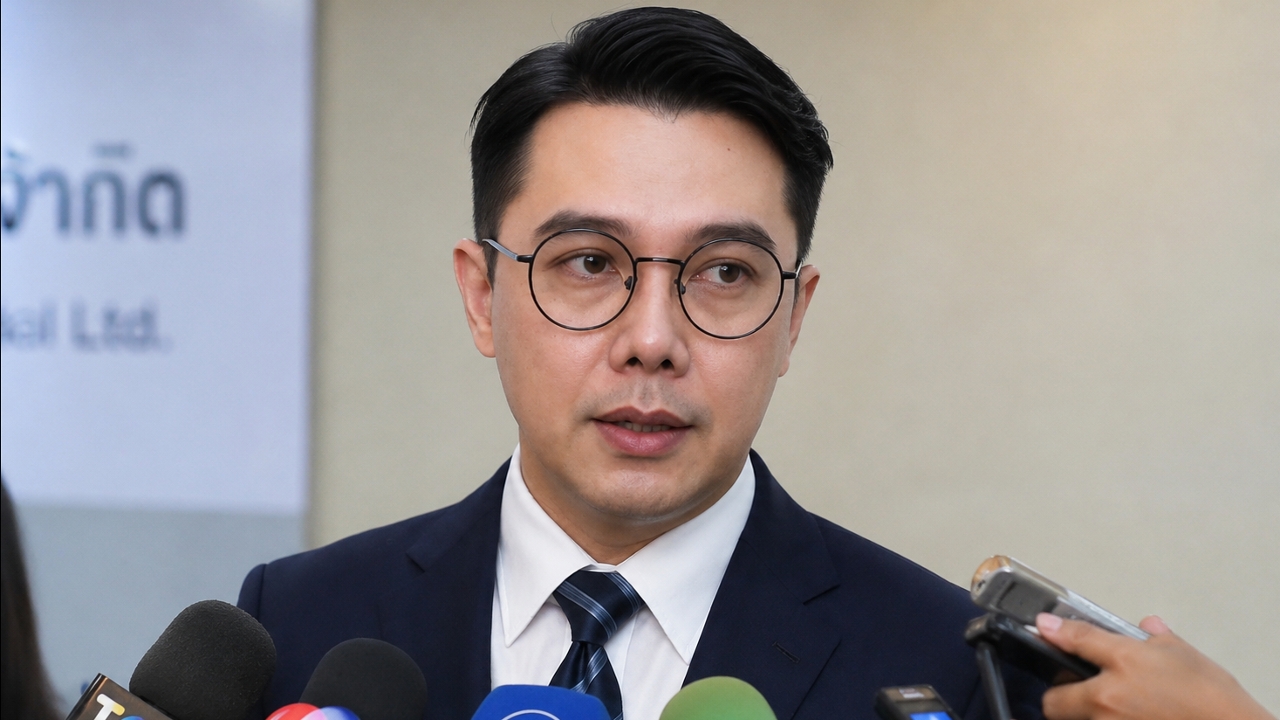
The Department of Industrial Works has approved Xin Ke Yuan Steel to resume operations after the company improved its air pollution treatment system to meet required standards.
On 5 June 2026 GMT+7, reporters reported that Ms. Araya Sailaiphet, Deputy Director-General of the Department of Industrial Works, delegated by the Permanent Secretary of the Ministry of Industry, sent an urgent letter to the managing director of Xin Ke Yuan Steel Co., Ltd., permitting the factory to continue operations. After inspecting the factory to monitor compliance with the ordered improvements, it was found that the company had fully implemented all required corrections. The company complied by upgrading the air pollution treatment system from its operations. On 7 April 2026 GMT+7, air samples were collected from the factory's exhaust stacks for laboratory analysis. The pollution test results showed compliance with the standards set by the Ministry of Industry's announcement specifying permissible contaminant levels in air discharged from concrete reinforcing steel and small billet steel factories, B.E. 2564 (2021 CE). Under the authority of the Factory Act B.E. 2535 (1992 CE), the Deputy Director-General, as assigned by the Permanent Secretary of the Ministry of Industry, ordered Xin Ke Yuan Steel Co., Ltd. to continue all factory operations from the date of this order onward.
Mr. Khemphat Kittipakdikul, manager of Xin Ke Yuan Steel, stated that the company has fully cooperated with government agencies and adhered to fact-based legal processes throughout. The inspections provide important data that helps reinforce confidence in the company's operational standards.
The company considers that the test results from relevant authorities indicate that the steel produced meets industrial standards and that there is no evidence linking the company's steel to the previously publicized building collapse incident.
“We intend to offer standardized steel products at competitive prices to help reduce costs for the construction sector, contractors, and Thai businesses, while fostering fair competition in the domestic steel market,” the company manager said.
Mr. Khemphat added that the company remains committed to industrial product standards, environmental oversight, and continuous production technology development to support the country's construction and industrial sectors, operating sustainably with a long-term goal of achieving net zero greenhouse gas emissions.
Regarding investigations by the Department of Special Investigation (DSI) under the Consumer Protection Division, case number 54/2568, concerning possession of hazardous materials or “red dust,” the company stated that the DSI Director-General ordered the investigation to be terminated due to lack of evidence indicating wrongdoing. The company is preparing to receive back the seized samples following legal procedures.
Meanwhile, the Industrial Product Standards Office (IPSO), together with the Automotive Institute and the Thai-German Institute, randomly collected 56 sets of concrete reinforcing steel samples from trial production runs for engineering and forensic testing.
Test results showed that round steel bars meeting TIS 20-2559 standard, quality grade SR24, and deformed bars meeting TIS 24-2559 standards, quality grades SD40T and SD50T, in all sizes from DB10 to DB32, met all specified criteria. These results were forwarded to the Department of Industrial Works for legal consideration.
The company also explained its use of induction furnace (IF) technology, widely used globally in the steel industry, noted for precise metal quality control, accurate production processes, energy efficiency, and air pollution management.
According to the company, more than 11 steel factories in Thailand currently employ IF technology, representing an accumulated investment exceeding 400 billion baht and accounting for about 70 percent of the domestic reinforcing steel market. This technology also supports production of special-grade steel for the automotive, electrical appliance, and advanced industries.

