

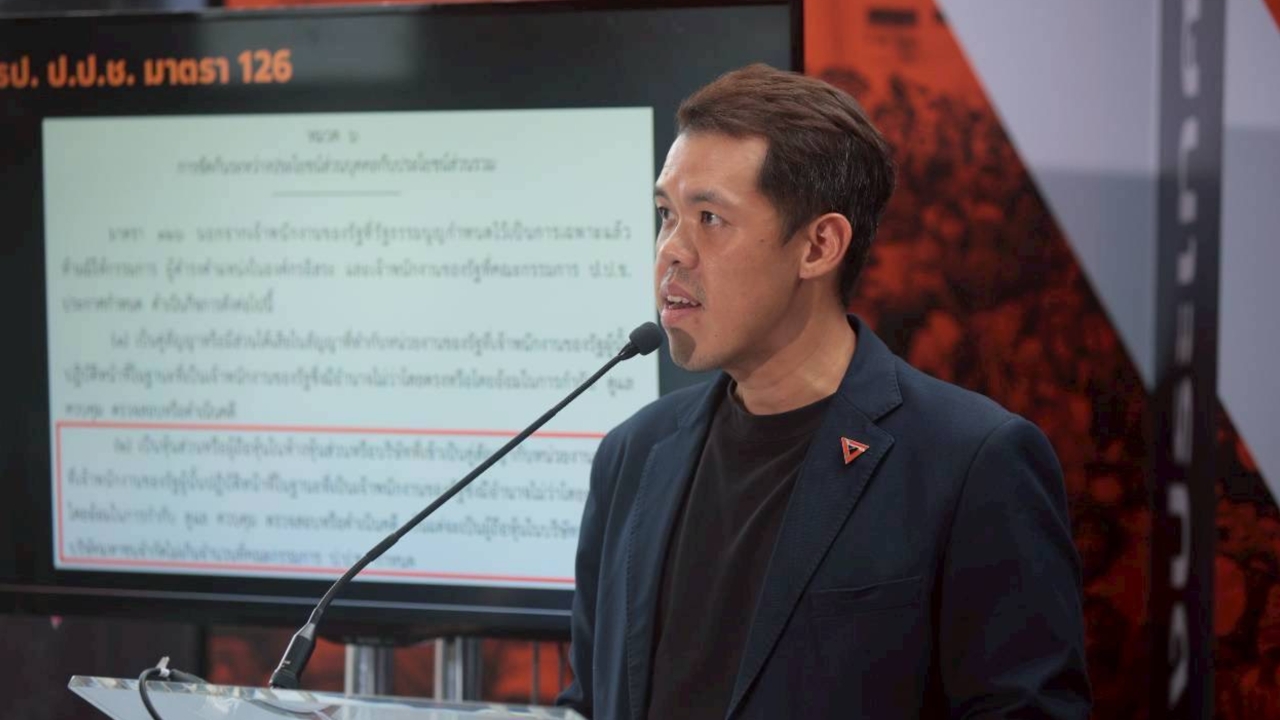
Pakornwut highlights three loopholes in the National Anti-Corruption Commission (NACC) decision clearing Sak Siam. He insists that holding just 5% shares already constitutes a conflict of interest. He also criticizes the NACC for never summoning the complainant for clarification. Ice Cream can't help but wonder if Sia Oh is defending or protecting Namngern.
At 10:00 a.m. on 7 June 2026 GMT+7. Mr. Parit Watcharasindhu, party-list Member of Parliament (MP) and Deputy Leader of the Prachachon Party. , together with Mr. Pakornwut Udompipatsakul, party-list MP and Deputy Leader of the Prachachon Party, held a press conference at the Prachachon Party headquarters, emphasizing details about the opposition coalition and a group of independent senators submitting a petition to the President of Parliament, who forwarded it to the President of the Supreme Court to appoint an independent investigation committee to examine the National Anti-Corruption Commission (NACC) ’s dismissal of the case filed by Mr. Sak Siam Chidchob, former Minister of Transport, regarding the hidden shares case.
Mr. Pakornwut stated that he previously participated in a no-confidence debate against Mr. Sak Siam over the hidden shares case involving the limited partnership Buricharoen Construction in 2022, highlighting the company’s connection to Sak Siam. When the NACC decided to dismiss the complaint, he identified three suspicious behaviors by the NACC, namely:
1. Termination of the false asset declaration case: The NACC press release on 23 April 2026 mentioned only the case related to holding partnership shares. What the NACC did not address was that on 25 July 2023, he submitted additional documents regarding loans given to a director, who was Mr. Sak Siam, amounting to 28 million baht outstanding until December 2019. Furthermore, documents the limited partnership submitted to the Constitutional Court showed that auditors had questioned this loan, and were told to retain it and would adjust it later. The question is, since the NACC documents only mentioned shareholding, did the NACC investigate the debt Mr. Sak Siam owed to this limited partnership? What was the result of that investigation?

2. In the NACC’s explanation regarding conflict of interest, they gave two reasons: (1) The NACC said that since Mr. Sak Siam held shares and managed the limited partnership, there was no evidence he directly used his official authority or any related power regarding the partnership’s contracts. But under the Anti-Corruption Act, Section 126 (2), simply holding over 5% shares in a partnership or company contracting with a government agency under one’s supervision constitutes a conflict.
(2) The NACC stated there was no evidence that Mr. Sak Siam, as Minister of Transport, interfered with procurement processes of agencies under the ministry. Approval authority rests with agency heads, not the minister. However, he found an NACC infographic explaining Section 126 (2) that differs from Sak Siam’s case. It appears the NACC did not determine whether Sak Siam still held shares when assuming ministerial office, but instead investigated whether he was involved in the partnership’s operations, which is irrelevant to the legal standard under Section 126 (2).
3. Since submitting the initial complaint with the opposition coalition, he has never received any summons to provide statements or information to the NACC. There has been no progress notification, no case closure or updates. This reflects a problem of selective treatment by the NACC regarding whose information they consider or which direction the investigation takes. It also shows a lack of transparency, as no information was disclosed publicly throughout the process, and even the complainant was never informed.

Meanwhile, Mr. Parit emphasized four suspicious points in the NACC’s misconduct in handling Mr. Sak Siam’s case:
1. The NACC conducted the investigation with procedural flaws.
2. The NACC made clear errors in discretion. The facts the NACC should have considered align with those used by the Constitutional Court, including share transfers, financial flows, questionable receipts and bills, and company addresses—facts the NACC cannot deny. These are solid enough for the NACC to conclude there was share concealment, and the complaint should not have been dismissed.
3. There was concealment of information related to the investigation.
4. The NACC neglected to investigate other related charges, and there is no sign the NACC has ruled on the conflict of interest allegations.
Mr. Parit also stated: “One cannot help but suspect that the NACC’s failure to rule on the conflict of interest violation or whether Mr. Sak Siam still holds shares in the company is an attempt to protect him or to help Namngern. The NACC must know that if it were to decide on this charge or shareholding based on all the evidence, it could only conclude that Mr. Sak Siam still holds shares in the company and violated Section 126 of the Anti-Corruption Act.”

