

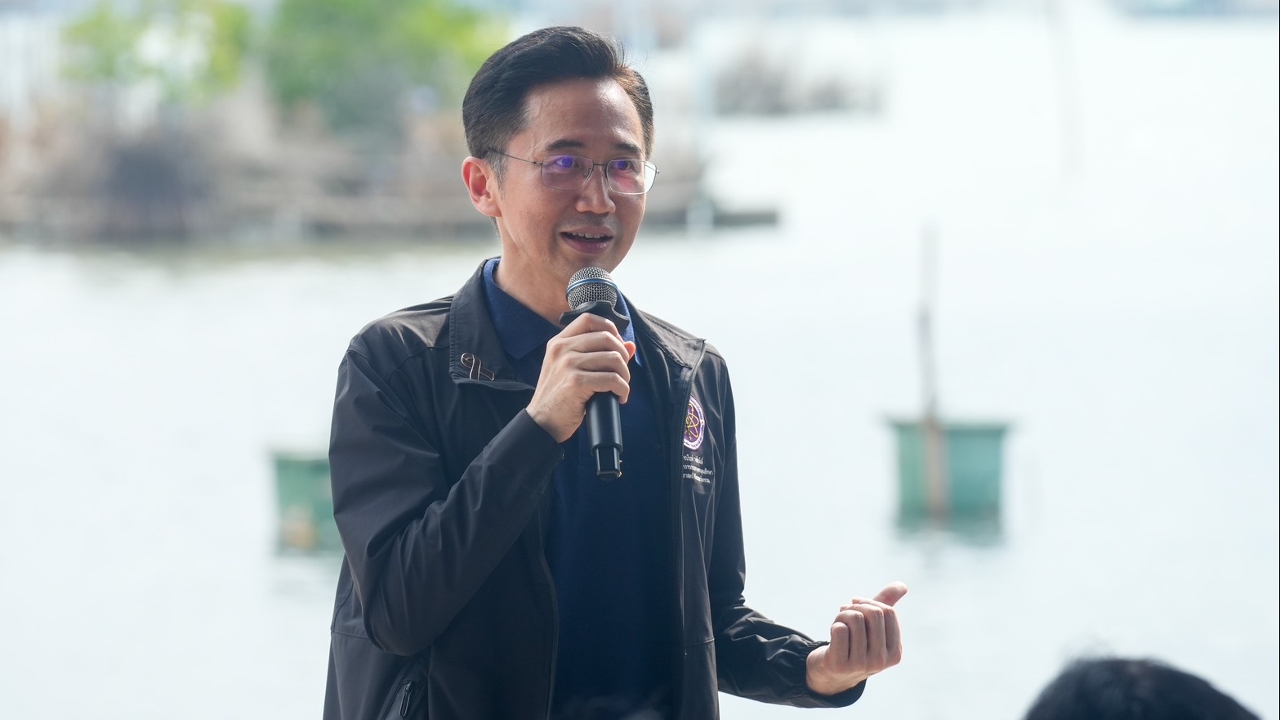
Yoschanan leads the Ministry of Higher Education, Science, Research and Innovation (MHESI) team on a boat to restore Fish Habitat No. 9, promoting innovation to enhance coastal communities. The Southern Wellness project supports integrated fisheries and agricultural innovations.
On 7 Jun 2026 GMT+7, Dr. Yoschanan Wongsawat, Deputy Prime Minister and Minister of Higher Education, Science, Research and Innovation, along with executives, conducted a field mission in Songkhla Province from 7 to 8 June. Their third stop of the day was at Fish Habitat No. 9 in Sathing Mo Subdistrict, Singhanakhon District, Songkhla, to inspect marine conservation, local fisheries, and efforts to upgrade the coastal community economy. The site featured exhibitions of community innovations divided into two main sections.
Highlighting the “Bang Kaeo Model”
The first section focused on local fisheries and coastal resource conservation, presenting the “Bang Kaeo Model” to elevate household economies based on traditional fisheries, the Living Fish Habitat project, and conservation of three-water fish species in the Songkhla lake basin using technology and social innovations. This was combined with alternative livelihood creation, gender equality promotion, and support for Irrawaddy dolphin conservation. Notable projects included isolating probiotics from the intestines of whiteleg shrimp to inhibit Vibrio spp., constructing fish habitats and planting sea pandan to increase beach area and develop woven products, as well as a spatial disaster management system featuring solar-powered emergency electric boats and real-time water level monitoring with alerts.
Agricultural Innovations
The second section focused on elevating the economy of communities around Songkhla Lake, showcasing agricultural innovations such as a salinity monitoring and forecasting system for managing "rice by the sea" in Phatthalung Province, designed to handle flooding and drought. It also included development of salt-tolerant rice varieties and production technologies for saline-intruded areas to increase efficiency in producing fragrant rice seeds. Additionally, prototypes for grassroots economy innovations were developed by enhancing the value chain of “large leaf liang” and promoting “emerald honey from stingless bees” as high-value products to sustainably increase community income.
Concluding the field mission, the executives boarded a boat to observe the actual environment of Fish Habitat No. 9 and jointly released fish fingerlings into the water.

Supporting Southern Wellness
Dr. Yoschanan then emphasized the importance of using research and innovation as tools to solve problems and improve the quality of life for local people, particularly through sensor technology for weather forecasting and real-time water level monitoring for early disaster warnings. He noted these as key to preparedness and emergency response for communities.
He reiterated the policy to promote the southern economy through the Southern Wellness project, which integrates cooperation among multiple educational institutions and local agencies. Professor Dr. Yoschanan expressed his vision on this matter:
“The South is extremely important. We support the Southern Wellness project, which we hope will serve as a key milestone to grow the southern economy—not only economically but also in terms of beauty.”
Revamping Research Funding
Furthermore, the Ministry of Higher Education, Science, Research and Innovation has plans to revamp research funding by focusing on comprehensive economic value chain expansion—from upstream to midstream and downstream—to create new economic engines from existing local resources. Examples of successful research with practical multi-dimensional applications include upgrading marine and fisheries economies and promoting the cultivation of feather algae for serving in Michelin-starred restaurants.
Increasing the value of sea cucumbers, breeding pink snapper and giant sea perch, as well as the highlight innovation “Living Fish Habitat” which restores ecosystems, replenishes marine abundance, and sustainably generates income for fishermen. Agricultural and community product innovations include installing sensors to alert salinity levels to assist rice farmers by Songkhla Lake, researching salt-tolerant rice varieties, processing local crops such as large leaf liang into dried snack products, upgrading Robusta coffee, and promoting high-collagen Betong and Songkhla chicken breeds.
International natural resource conservation includes driving the Irrawaddy dolphin conservation project, co-funded equally with the World Bank to preserve ecosystems alongside maintaining traditional community lifestyles.
At the end of the first day’s field visit, Dr. Yoschanan summarized the core of research work for national development by stating that the best research starts from real problems in Thailand, is anchored in local areas, and involves local people as the core. If research support can be effectively provided from upstream to downstream, Thailand will have a new growth engine originating from the country’s own resources without needing to look elsewhere.