

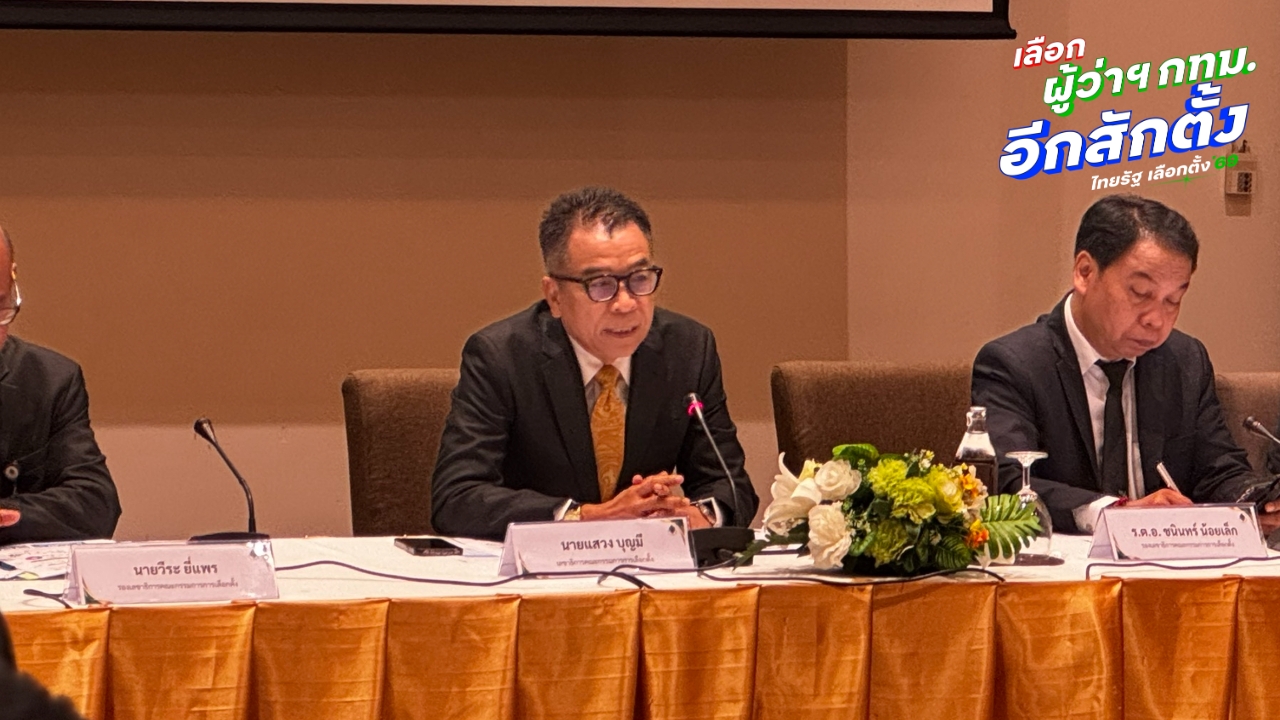
The Secretary-General of the Election Commission praised Thailand’s electoral system as the best, designed to involve the public and allow thorough monitoring. He expressed confidence that elections will be transparent, stating that transparency does not depend on the EC staff but on citizens working together to safeguard election results, which is everyone’s responsibility.
8 June 2026 GMT+7 Mr. Saewang Boonmee, Secretary-General of the Election Commission, said at the 3rd Media Relations event, where he gave a lecture titled “The Mission of Public Participation in the Election Process for Members of the Bangkok Metropolitan Council, Governor of Bangkok, Pattaya City Council Members, and Mayor of Pattaya” that Thailand’s election system is the best, but having a good system requires transparency. He affirmed that the system is designed so that eligible voters and the media can observe and verify every step. However, these outcomes cannot be achieved without public participation. The election system is designed to ensure citizens take part, which aligns with general principles of participation.
Mr. Saewang continued that on election day, each polling station has nine official election committee members and two security officers, all volunteers. The EC’s role is to train them sufficiently and provide materials so each member can perform their duties correctly. Nevertheless, news frequently reports that some committee members have failed to follow regulations, such as in the recent parliamentary elections, partly because committee members rotate regularly.
. What truly ensures election transparency and integrity is the participation of eligible voters themselves, not just the committee members. Doubts about election fairness diminish when the public actively observes the process. This level of public observation has been lacking in every election. Citizens should monitor whether committee members make mistakes and immediately raise concerns or file complaints. The system is designed to be visible to the public because the EC has only 2,500 staff nationwide, fewer than 1,000 staff in regional areas, while there are 600,000 polling stations, making it impossible for the EC to oversee all comprehensively.
“Committee members are likely sincere in their duties but may sometimes make mistakes due to habit or forgetfulness. When someone raises an objection, they must exercise caution in their work both inside and outside polling stations. Elections belong to the people — candidates, voters, and committee members are all citizens. The election results belong to the public. The EC’s role is to monitor and prevent vote-buying, but the true value of the system depends on citizens helping prevent vote-buying and observing committee members’ conduct from 8:00 a.m. until the election concludes.”
The EC Secretary-General also emphasized that elections truly do not belong to the EC. The EC acts as the host to bring people together to vote. The results reflect the people's will. Citizens must collectively safeguard the election outcome. Vote counting is done not by the EC but by district committee members, who are the public. The EC does not tally votes itself. The EC learns the results simultaneously with the media, so it wants the public to share in overseeing the process. Ensuring election transparency is the duty of every Thai citizen. While the EC, as host, inevitably faces criticism, such criticism helps identify problems. All Thais must jointly care for the election process. The EC accepts responsibility but encourages cooperation both inside and outside polling stations.
Regarding the election of the Bangkok governor or Pattaya mayor, although serious errors have been few, this does not guarantee transparency or legitimacy. Allegations of relocating or appointing district committee members to favor certain parties must be addressed by public observation to ensure transparency.