

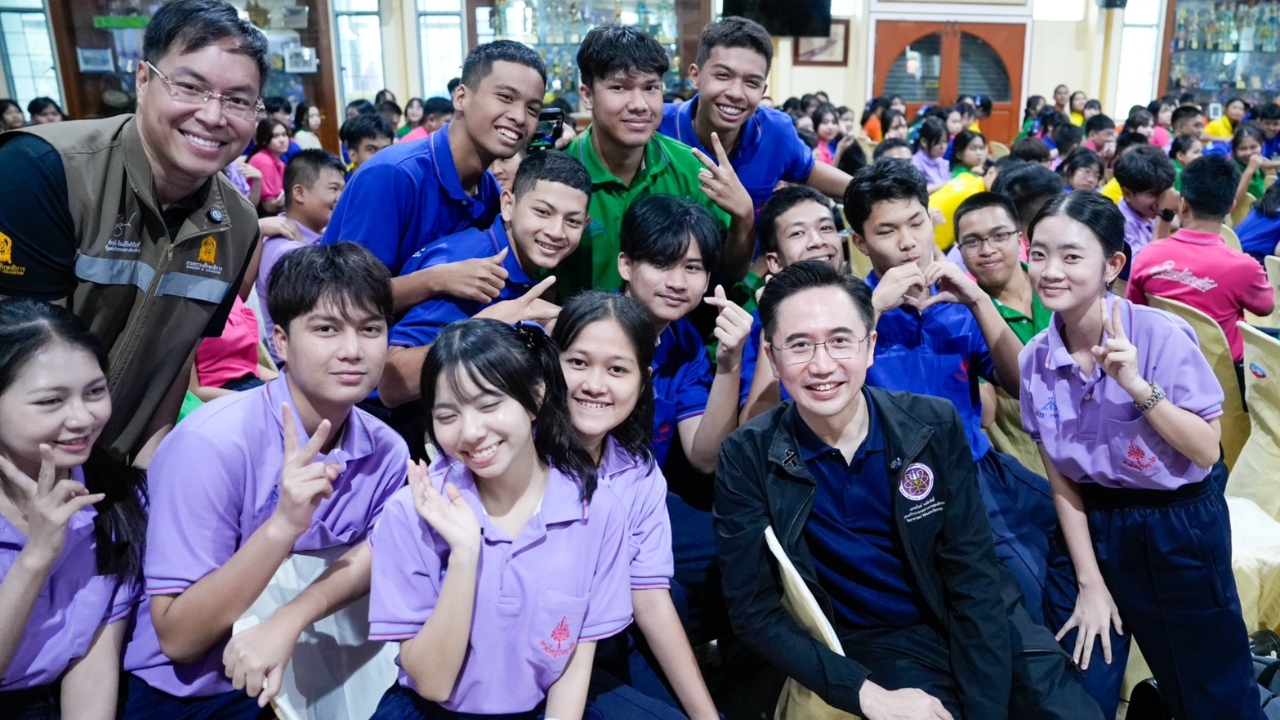
Yotsanan cited Elon Musk, Obama, and Colonel Sanders to inspire grade 11 students at Hat Yai Witthayalai School, empowering ordinary people to change the world. He emphasized that exam results are not the end. Students and teachers eagerly gathered to take selfies, creating a lively atmosphere throughout the school.
On 8 June 2026 GMT+7, Mr. Yotsanan Wongsawat, Deputy Prime Minister and Minister of Higher Education, Science, Research and Innovation, along with Mr. Akkranun Kankittinan, Deputy Minister of Education, and senior officials from both ministries conducted fieldwork in Songkhla Province from 7-8 June. Today, they visited Hat Yai Witthayalai School (Rachawadee Auditorium) to deliver a special lecture titled “Guidance and Inspiration for University Admission,” greeted by applause and cheers from grade 11 students. Before the talk, students and teachers enthusiastically surrounded them requesting selfies and waved from classrooms, creating a vibrant scene across the school.
Yotsanan began his lecture by sharing good news about the approved budget for constructing a new school building, assuring that Hat Yai students will have access to education—a hope for Thailand’s future—before posing a reflective question on whether university admission equates to life success.
He explained that success is not always 100% linked to university admission; for some, it may represent just 10-20%, while for others it could be 70-80%, depending on individual life paths. He shared his own career journey, starting in engineering and science, becoming a university professor, and eventually entering politics despite not graduating in political science. This illustrates that the formula for success depends largely on mindset and perseverance.
To clarify, Yotsanan cited three global figures with vastly different life paths. First, Elon Musk, who was not born wealthy and faced childhood bullying but used self-driven learning in libraries to develop software sales systems. He then reinvested earnings to build SpaceX rockets and Tesla electric cars, applying First Principles thinking to solve core problems.
He also mentioned Barack Obama, who succeeded by applying the Circle of Competence principle—starting from his strongest skills to build confidence and prove himself before expanding his achievements.
Finally, Colonel Sanders, founder of KFC, exemplifies that failure is not life’s end. Whether failing exams or making mistakes, these are merely "new data" to help find one's path to success. What these individuals share is determination and refusal to give up.
Towards the lecture’s end, Yotsanan advised students on choosing their university courses: do not decide based on prestige or popularity, but deeply examine the curriculum from year one to four to see if the subjects are enjoyable. He also shared an important thought:
“Don’t worry about the course name because careers will change. When careers shift, what remains with us is foundational knowledge—calculus, sets, physics, chemistry, biology, and even social sciences, history, civic spirit, and empathy. This foundational knowledge stays with us forever, enabling us to create new careers.”
Yotsanan concluded by emphasizing timing in success: “Don’t compare with friends about who will succeed first; it varies. Some achieve quickly, others slowly. Just focus on pursuing your true dreams, and success will come. Perhaps one of you here will be someone I reference in 10-20 years to inspire others.”
He pointed out that life success depends not on the starting point but on proper mental models. He ended saying, “The formula for success is not to give up. The world doesn’t need a second Elon Musk, Barack Obama, or Colonel Sanders—it awaits your own unique success.”
Deputy Minister Akkranun added that he was raised to become a police officer to meet his father’s expectations for a stable life, which forced him in high school to study science-math despite his own preferences. He shared this to inspire grade 11 students facing future decisions, stressing: “Choose what you like, not what your parents want, because when you succeed, your parents won’t be there—you live your own life.” He also warned against choosing a faculty just because friends suggest it or others direct you, as following someone else’s dream means it is no longer your own.
Akkranun further encouraged that success isn’t limited to science-math fields or becoming doctors and engineers. Whether studying arts-social sciences, languages, or even his own path—ultimately studying non-formal education (NFE)—one can still become a Member of Parliament and minister by pursuing and responsibly managing one’s dreams. At the lecture’s close, he announced good news to reduce educators’ workloads by canceling unnecessary projects and evaluations, such as the White School project, freeing teachers to focus more fully on student care.