

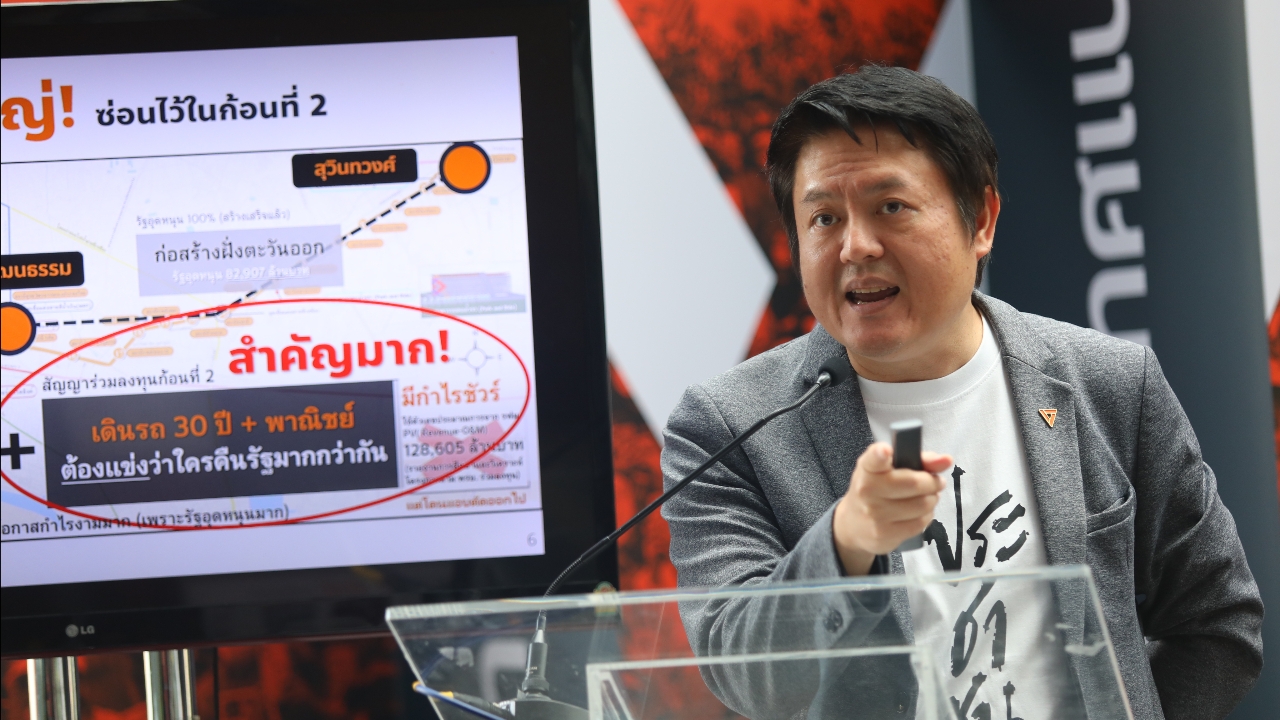
Surachet, a Prachachon Party MP, challenges the government to stop selling the dream of a 40-baht all-day electric train fare and urges the Cabinet to set fares between 17-45 baht based on realistic grounds instead.
On 8 June 2026, Surachet Praveenwongwut, a party-list MP from the Prachachon Party, addressed reports from last week that the Ministry of Transport planned to push the “40 baht all-day” policy to the Cabinet. This would cap electric train fares across lines at 40 baht per day as a New Year 2027 gift. He said he had anticipated that the Cabinet would not dare to announce this policy, even if documents from various agencies were incomplete. The real reasons are limits imposed by state power mechanisms, budget systems, concession contracts, and financial discipline. Considering the country's overall interests, this policy cannot be feasible.
Surachet added that reviewing the figures and facts, the approach aligned with the country's interests is the fare rates the Prachachon Party previously campaigned on: 8-45 baht for the full route, or 15-45 baht if subsidizing only electric trains. Recently, the Joint Ticket Policy Committee's consideration has become clearer, suggesting joint electric train fares set between 17-45 baht for the full route, with projected subsidies of 3.054 to 4.698 billion baht annually, a reasonable figure. However, this differs greatly from what the government coalition party previously promised. He questioned whether ministers dare to change the committee’s findings, warning that enforcing a baseless policy would clearly favor private investors through buybacks or switching contracts from Net Cost to Gross Cost.
The key issue with joint fares lies in Section 31 of the Joint Ticket Act, which the House and Senate passed unanimously. It clearly states that integrating joint fare rates must consider proportionality and balance according to differing costs. Thus, the 17-45 baht range is reasonable. Advertising slogans like “20 baht all-line” or “40 baht all-day” are baseless pricing set only by referencing minimum wage without regard to other constraints. They underestimate reality, making the policy unfeasible. Even if possible, it should not be done, as private investors would unlikely lower prices without hidden conditions.
Surachet also noted that misleading people to dream of ultra-low fares and purchase suburban condominiums based on that belief is very wrong. When the truth emerges, people cannot reclaim the money already spent. Moreover, every baht subsidizing cheaper travel comes from the hard work of people living far from and unable to use the electric trains, who must subsidize through taxes. Meanwhile, investors grow wealthier from increased passenger numbers (induced demand) and hold the concession contracts. Without improved agreements, they will refuse to renegotiate contracts.
What the government should do now is to face reality, admit that the 40-baht all-day policy by the end of this year is impossible, and avoid borrowing funds to waste on this issue. He urged the government to promptly cancel the Cabinet resolution on the 20-baht all-line fare, accepting it as baseless pricing that hinders public transport development. Also, cancel the Cabinet resolution assigning the Digital Government Development Agency (DGA) to develop a “fake ticket” Clearing House system, and instead focus seriously on implementing the “joint ticket” system according to the Joint Ticket Act. The government should urgently fix card reader issues, which require less budget compared to subsidizing fares.
At the same time, the government must quickly set clear joint fare rates, reportedly 17-45 baht for the full route, acceptable as a reasonable price range, along with clear plans and timelines. This will help resolve overlapping entry fee issues caused by past government failures to view electric trains as an integrated system. To aid people burdened by long travel and multiple transfers, the government should promptly announce a Cabinet resolution clearly, stop selling unrealistic dreams and delays, and start by implementing the 17-45 baht fare by New Year. Then, work together to improve it to 8-45 baht, integrating fare calculation between buses and trains to rebalance the system so buses feed passengers into trains, pushing for truly inclusive public transport. “Stop selling dreams, stop losing direction, and urgently make real progress in the right way.”