

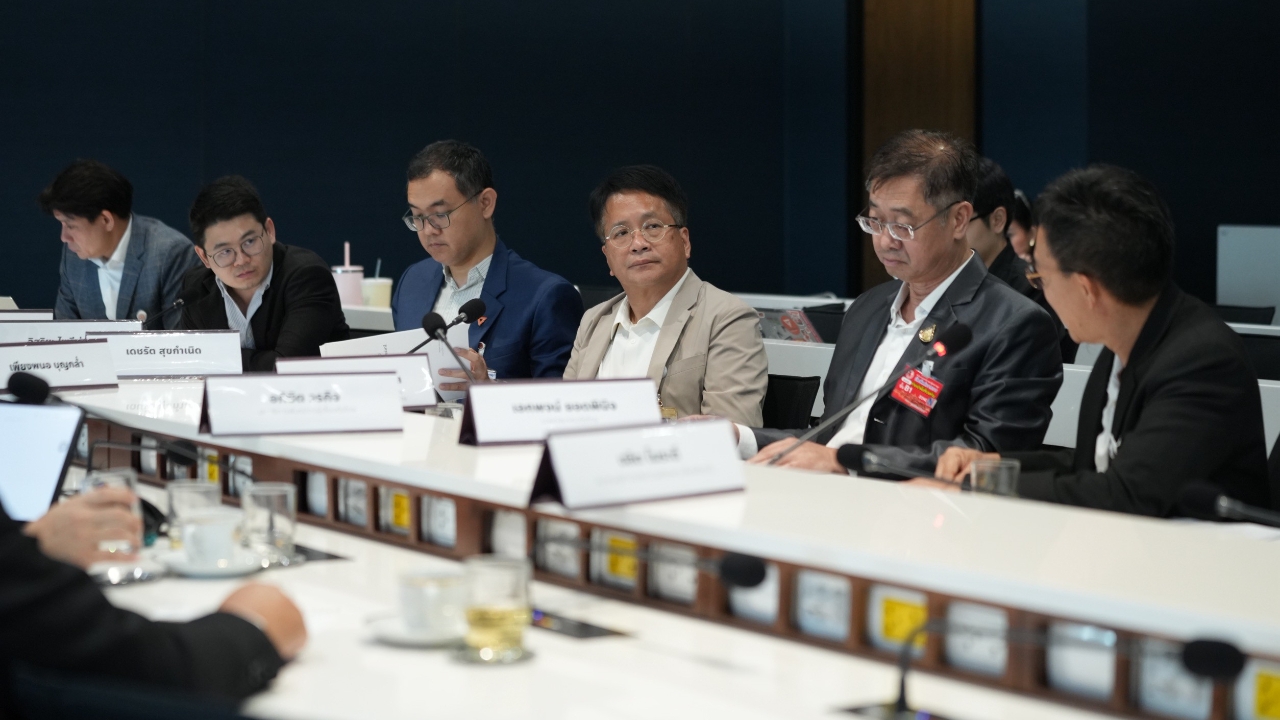
The People's Party shadow cabinet urges the government to support the Thai shrimp industry to overcome the crisis caused by Malaysia's import ban, alongside calls to review welfare card eligibility criteria and stop pollution flowing through border rivers.
On 8 June 2026, the People's Party shadow cabinet held a meeting to discuss urgent agendas and issued demands directly to the government to address four critical national issues. The first issue calls on the government to accelerate negotiations with Malaysia regarding its suspension of shrimp imports of five Thai breeds since 1 June 2026, which has severely impacted shrimp farmers in southern Thailand. The People's Party demands the government successfully reopen the border checkpoint within 10 days before shrimp market prices collapse and the entire market system breaks down.
The second issue concerns responding to accusations and the Section 301 tariff framework from the U.S. Trade Representative (USTR), related to overproduction and forced labor. The People's Party states that the Thai government must transparently refute claims that it subsidizes production to dump products on export markets, while also expediting the upgrade of import laws to include forced labor standards aligned with the new European Union Forced Labour Regulation, set to be enforced in 2027.
Regarding negotiations on the America Reciprocal Trade (ART) agreement with the U.S., the government must adjust exchange terms to reflect the current reduced tariff rates of 10% or 12.5%, publicly disclose the negotiation framework, and submit binding trade and investment agreements to parliamentary review as mandated by Article 178 of the Constitution. The party emphasizes that tariff reduction figures should not be used as a key performance indicator (KPI); instead, the government must prioritize long-term impacts on Thailand's economic structure.
The third issue involves the People's Party calling for the government to reconsider the Cabinet resolution dated 2 June 2026 about revising eligibility criteria for State Welfare Cards to protect vulnerable groups. The party proposes replacing the single-indicator approach with a weighted scorecard system to more accurately reflect the overall hardship and economic needs of affected citizens, ensuring comprehensive coverage and preventing eligible individuals from losing benefits.
The final issue addresses the urgent resolution of water pollution crises in border rivers, including the Kok, Sai, Ruak, Mekong, Salween, and Kraburi rivers, caused by mining activities in neighboring countries. The People's Party proposes three main approaches: 1) People—multilateral negotiations among Thailand, China, Myanmar, and Laos, establishing an Action Plan to monitor water quality, soil, and public health using standardized methods; 2) Legal—accelerating the enactment of secondary legislation under the Mineral Act, Section 104, to require permits before importing key minerals and banning imports from mines unable to prove no environmental harm; and 3) Budget—allocating funds to compensate farmers and businesses damaged by pollution. The party affirms it will push these four agendas through legislative mechanisms, including parliamentary sessions and relevant committees, to closely monitor government actions.
Additionally, Pisan Manawapat, shadow Minister of Foreign Affairs for the People's Party, commented on the ongoing USTR investigation into new tariff rates. He advised Deputy Prime Minister and Commerce Minister Supachai Sutthumpan to 1) have a clear plan on whom to meet to achieve objectives; 2) understand that power in Washington is centralized solely with the President, as nearly all Republican Congress members, Cabinet, and Senators seek to please and avoid upsetting Trump; and 3) focus Washington visits on individuals with direct access to Trump, noting that in early May, Supachai met only one appropriate person while others failed in lobbying efforts.
Pisan further recommended that during the next Washington lobbying trip, Supachai should schedule meetings with three key figures directly involved: 1) Howard Lutnick, U.S. Commerce Secretary and a close friend with direct access to Trump; 2) Peter Navarro, former university professor and Trump's key White House advisor responsible for tax policies; and 3) Scott Bessent, U.S. Treasury Secretary, whom Supachai can request to meet as Deputy Prime Minister. He emphasized the necessity of meeting Bessent, a pivotal figure in Trump's economic Cabinet and tax matters, especially as Bessent is scheduled to attend the World Bank annual meeting in Thailand this October. The government should prepare to impress in advance.
He also advised Supachai to avoid meetings with Democratic Congress and Senate members, particularly Senator Tammy Duckworth, as Trump will not listen to Democrats. Instead, lobbying efforts should focus on Republicans and committees directly overseeing tax and trade issues. Furthermore, Pisan called on Deputy Prime Minister and Foreign Minister Sihasak Puangketkaew to skillfully leverage old alliances to demonstrate to Washington how the U.S. benefits from its longstanding partnership with Thailand.