

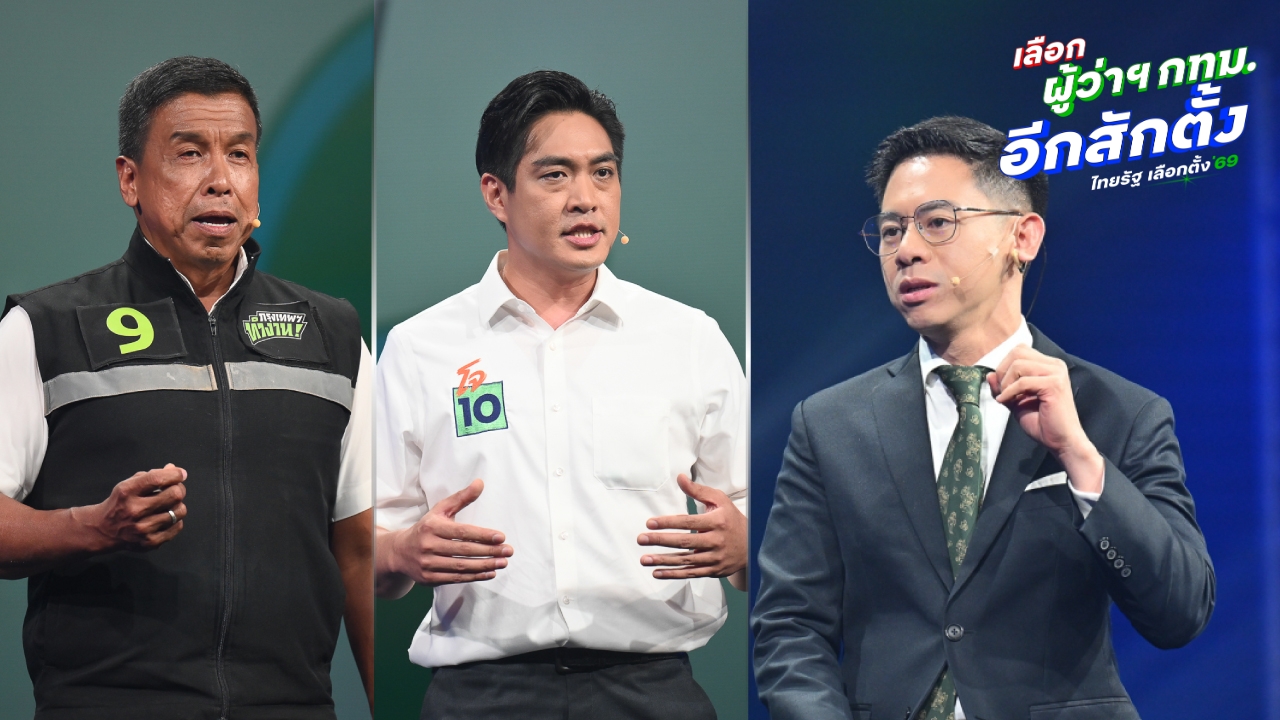
"City Control Game" A question from the King Prajadhipok's Institute: How can Bangkok eliminate the overflow of abandoned buildings? "Chadchart and Chaiwat" Propose structural problem-solving and urge cutting the extortion cycle, while "Anucha" Suggests a comprehensive discussion to ensure benefits fall to Bangkok residents.
On 8 Jun 2026 GMT+7, Thairath TV Channel 32 and Thairath Online broadcasted a special program titled "City Control Game," challenging the visions of prospective Bangkok governor candidates to decisively resolve the capital's issues. The show delved deeply into their visions through demanding missions including intelligence puzzles, city crisis tier lists, and tough questions for candidates, hosted by Pa Toy and Kai Pongsakorn.
Candidates presenting their visions and problem-solving skills for Bangkok residents included Mr. Anucha Burapachaisri of the Democrat Party, Mr. Chadchart Sittipunt running as an independent, and Mr. Chaiwat Stavarawijit of the Prachachon Party.

During the segment "Tough Questions for the Governor" Associate Professor Dr. Issara Seriwatthanawut, Secretary-General of the King Prajadhipok's Institute, asked: We see a problem larger than Bangkok stemming from the global situation, where oil, a fundamental cost for everything including construction, is affected. Statistics on procurement show at least 24 large government buildings under contract management where contractors request budget increases. If you were governor, how would you prevent abandoned buildings caused by contractors walking away since we cannot approve contract budget increases?
Mr. Chaiwat Stavarawijit said handling the rising costs caused by the Middle East war involves Bangkok compensating to create offsets, as numbers are roughly comparable. He mentioned the issue of "extortion" in Bangkok's licensing processes. Although electronic service systems exist for construction permit requests, Bangkok’s back-end operations remain non-digital and rely on officials' discretion, potentially enabling extortion worth about 2% of project costs.
He stated that if he were governor, he would solve the problem of extortion in licensing to reduce contractors' costs. This is a structural solution aiming to lower the overall construction industry's costs in Bangkok.

Mr. Anucha Burapachaisri explained that impacts from the war are unavoidable for both public and private sectors. As a former businessman, he understands the challenges businesses face under uncontrollable events.
If elected governor, he would understand the context and recognize that continuing old methods means no progress and economic stagnation. He would discuss these problems with his superiors—the Ministry of Interior’s minister responsible for Bangkok, whose identity is currently unknown—and convene all relevant agencies and the private sector to find solutions. They would assess whether budgets, whether from the central government or other agencies, can address the issue. If necessary, they would present the problems to the Prime Minister to ensure progress continues. Denying responsibility would be abandoning the problem. Currently, about 15-20% of cost increases relate to oil. They would seek balance so that benefits reach Bangkok residents without unfairly favoring any agency.

Mr. Chadchart Sittipunt said government construction projects have long had issues, but the Comptroller General’s Department issued measures before he left office. Contracts awarded recently cannot be signed if prices are unreasonable, which is a problem. Budgets are set, but contractors may refuse work, forcing higher budget preparations.
If contracts have not started but bidding is complete, contractors may cancel contracts without fault, causing the government to lose money recalculating projects. This is a problem the next governor must address, as many projects remain stalled due to contractors refusing to sign per Comptroller General’s orders.
For contractors already working but outside Comptroller General jurisdiction, Bangkok must ensure fairness, reduce their expenses, and eliminate "extortion." Paying progress payments quickly as per law helps contractors’ cash flow and reduces interest burdens. Delays in inspection and contract amendments must be accelerated to support contractors’ cash flow. The worst outcome is contractors abandoning projects, leading to unused buildings and lawsuits. Solutions must be legal and fair to both parties.