

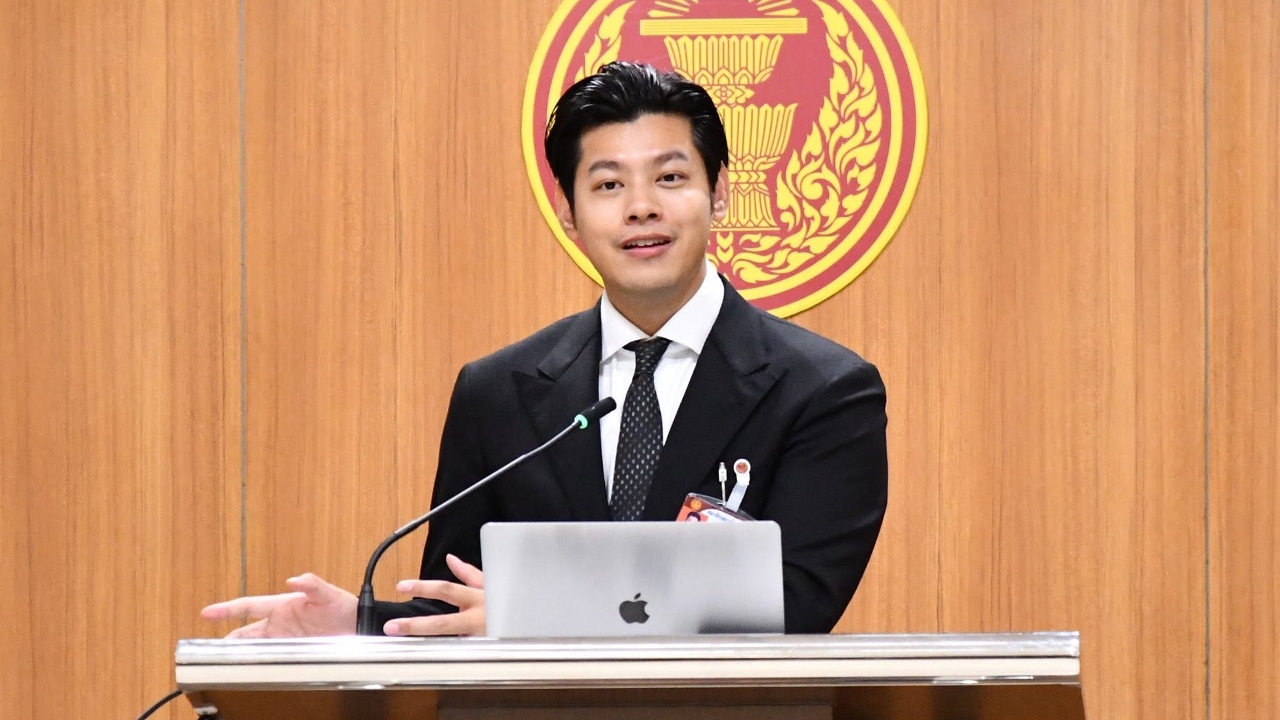
Suphanat remains unfazed by online attacks from supporters of Governor Chatchat, firmly stating he will not accept Bangkok's whitewashing of the corruption case involving exercise equipment. The city imposed a mere 600 baht fine and ordered investigations into only 7 of 24 projects, failing to identify the main perpetrators.
On 8 June 2026, Mr. Suphanat Meenachainan, Member of Parliament for Bangkok from the Prachachon Party, posted on Facebook stating that, as expected, the entire gang involved in the Bangkok corruption case for overpriced exercise equipment, including a treadmill priced at 750,000 baht, escaped punishment. Each person was fined only 600 baht, and the case was closed. On the second anniversary of this overpriced exercise equipment scandal, he made a declaration. “The clear results of the investigation” by the disciplinary committee appointed by the Bangkok governor examined 32 officials. They ruled 20 officials “not guilty,” while 12 were found guilty of minor offenses and fined 2% of their salary (only 600 baht each), then the case was closed.
Suphanat said he cannot accept this outcome because the Bangkok Metropolitan Administration (BMA) suffered losses amounting to hundreds of millions, yet the committee appointed by the governor whitewashed the investigation. Their goal was only to have the word “guilty” to respond to the media quickly, claiming “punishment was imposed.” In reality, the penalty was just a 600 baht fine, and those involved continue working at the BMA. This effectively confirms that the case is treated as “not corruption,” merely a mistake of overpaying 5-10 times the normal price, while Bangkok residents must accept being robbed of hundreds of millions in plain sight, even though everyone clearly sees it as fraud.
Whether it was “specification rigging,” “qualification locking,” “performance locking,” “inflating the benchmark price,” or “collusive price-fixing among the same group,” the entire process was filled with fraud. Yet, in the eyes of the committee appointed by the governor, such clear corruption was considered a minor offense with only a small fine.
Suphanat added that he warned last year that everyone would escape punishment, but the BMA claimed investigations were ongoing, and in the end, this prediction came true. This is an expensive lesson for him for trusting the BMA and underestimating their willingness to slap Bangkok residents in the face, as if knowing about the fraud means nothing. To him, this investigation by the committee is the most disgraceful, especially when compared to other cases like borrowing friends’ watches, hiding shares in Sak Siam, EV garbage truck rental fraud, or other scams, which are far more complex than the exercise equipment case.
The BMA’s investigation is not just a “case dismissal” but an insult to Bangkok residents and sets a precedent for other agencies to imitate. If even the BMA, which portrays itself as clean and transparent, considers these acts not wrongdoing, other agencies will copy the BMA's fraudulent methods nationwide, causing massive harm to the country. The investigation details show the governor-appointed committee used discretion to split the inquiry into two parts: the price issue and the specification rigging issue.
1. Regarding price, the committee checked whether the exercise equipment was overpriced by sending letters to seven fitness equipment companies, mostly fitness centers like Fitness First and We Fitness, asking for quotations. These companies do not sell exercise machines and would never carry the OEM brand the BMA locked specifications to purchase, as these are not sold on the open market.
More seriously, instead of asking other companies in the market, including private complainants alleging the BMA’s TOR was corrupt and locked specifications, the BMA’s committee (feigning ignorance) asked only the companies that won the overpriced treadmill contracts. These companies should have been suspects for collusive price-fixing, yet the BMA still asked them for prices. As expected, no company returned any quotations.
With no responses, the BMA’s investigation committee staged a superficial procedure by visiting two treadmill stores to ask if they had exercise machines matching the BMA’s specifications. Since neither store stocked equipment matching those specs, the committee concluded that they could not determine if the BMA’s purchase price was overpriced or not. They then ruled the offense “minor,” imposing only a 2% salary cut (600 baht) and closing the case.
2. Regarding specification rigging, the committee gave few details, merely summarizing that the officials who drafted the product specifications (TOR) deliberately wrote exclusionary terms. However, the committee deemed this a “minor offense,” fined the officials only 2% of their salary, and ended the case.
Most seriously, Governor Chatchat “acknowledged” and “approved” the investigation report without ordering a new inquiry. It is unclear whether the governor believed the committee’s investigation was adequate. To Suphanat, the committee overlooked many points and whitewashed corrupt officials blatantly. (He has a confidential summary of the investigation available to the media, but the BMA prevents him from posting it.)
Summary of five whitewashing points
The committee’s investigation missed and whitewashed several issues, which Suphanat disputes in five key points.
1. Intentional locking of product specifications by writing highly specific requirements that only one brand could meet. The committee considered this minor and fined 600 baht, but Suphanat argues that since the committee’s site visits found no equipment matching the BMA’s specifications, this clearly shows the specs were rigged. Under procurement law, this is a serious offense. The committee should have questioned the officials about the origin of these specs and whether any brand met them or if private companies drafted the specs.
2. Intentional setting of an inflated benchmark price. The committee asked six companies and visited two stores but got no answers, thus concluding it could not determine if prices were inflated, yet still fined only 600 baht. The committee should have considered why officials abandoned the previous benchmark price. During Governor Aswin’s tenure in 2020–2021, BMA purchased treadmills at 250,000 baht—still expensive but not as high as now. Under Governor Chatchat in 2023, the benchmark rose to 750,000 baht, although the specifications barely changed, which violates procurement laws.
Pointing out committee negligence in investigation
3. Intentional price inquiries made only with the same few companies. The committee neglected this. Details show officials consistently inquired prices from the same private companies, some newly registered with no prior sales history to the BMA but claiming to sell exercise equipment. The BMA officials knowingly accepted this, a clear collusive behavior between officials and private firms.
4. Intentional writing of TOR to lock qualifications, excluding other bidders by requiring a certificate proving appointment by the manufacturer or authorized distributor in Thailand.
Suphanat said the committee neglected this major issue. Writing such terms effectively locks the right to sell to only specific representatives or manufacturers, who control who can be appointed to sell to the BMA. This prevents competition. Even if other private companies import the same products from abroad at cheaper prices, they cannot bid because the BMA requires such certificates.
5. Intentional writing of TOR to lock bidder performance by specifying past contracts that match only certain companies, excluding others. The committee did not detail this, but it is clear the TOR required unrealistically high prior experience, such as having completed 2-3 previous contracts. Even massive construction projects worth billions do not require such conditions, yet the committee only investigated 7 of 24 projects, ignoring the other 17 corrupt projects.
Suphanat wrote to the governor on 14 March 2025 requesting investigation of the remaining 17 projects, but until the governor resigned, he never responded whether a committee would be formed. If the governor allowed investigation of all 24 projects, the pattern of systemic corruption would be clearer, and the investigation would not whitewash officials as it has now.
Suphanat insists he posted this to protect national interests but has faced online attacks from supporters of the governor who overlook corruption, focusing only on the governor and attacking him despite clear evidence. He accepts this backlash but will not allow Bangkok residents to be robbed of hundreds of millions without action.