

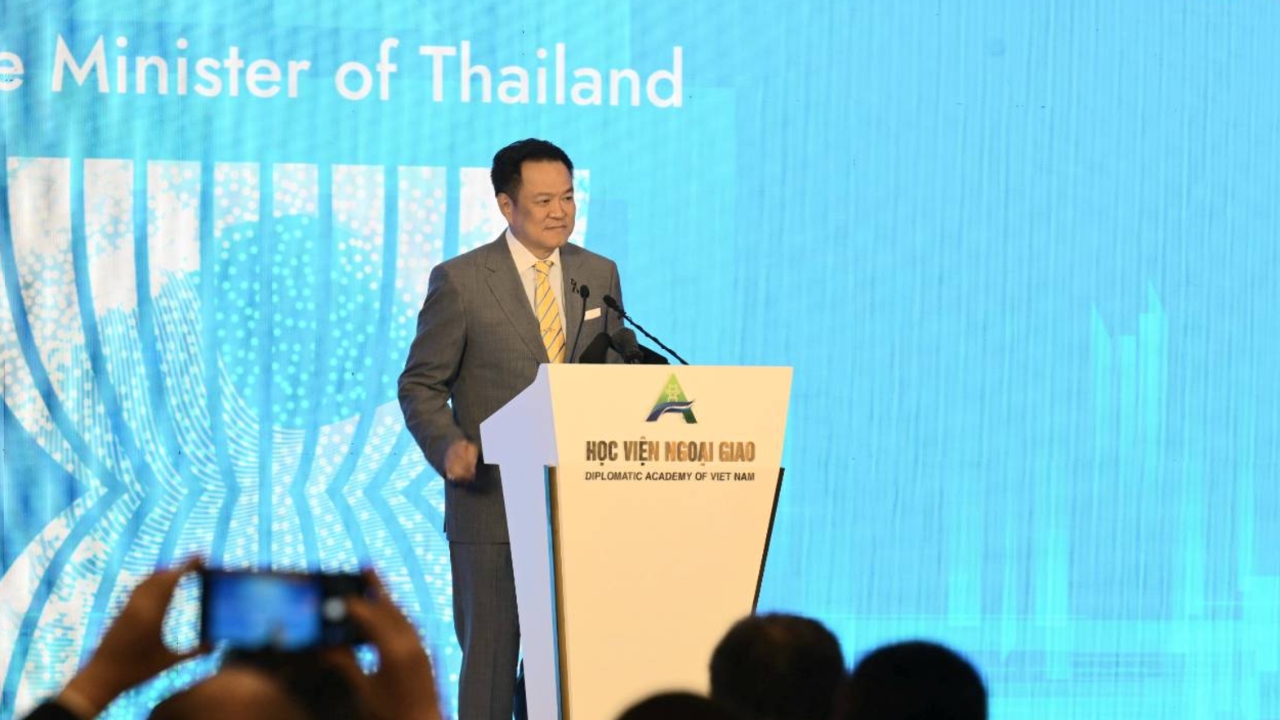
Prime Minister Anutin showcased his vision at the ASEAN Future Forum, laying the foundation for peace and security, highlighting Thailand’s southern land bridge. He revealed that resolving Thai-Cambodian issues peacefully requires mutual trust and sincerity between the two countries.
At 08:30 on 9 June 2026, at the Melia Hanoi Hotel in Hanoi, Socialist Republic of Vietnam, Ms. Ratchada Thanadirek, spokesperson for the Office of the Prime Minister, disclosed that Prime Minister and Minister of Interior Anutin Charnvirakul attended the opening ceremony of the 3rd ASEAN Future Forum under the theme “Shaping our Future Together: Peace, Prosperity, People-Centered.” The event, hosted by Vietnam, was joined by ASEAN leaders from Laos, Cambodia, and Timor-Leste. The Prime Minister made a statement at the meeting, with key points summarized as follows.

The Prime Minister praised Vietnam as the host of the ASEAN Future Forum 2026, which has become a vital platform for exchanging views on the region’s future amid significant global changes, including geopolitical divisions, shifts in global trade patterns, rapid technological advances, and climate change impacts. These factors indicate that regional and global systems are transitioning toward a new order, presenting ASEAN with both risks and important opportunities simultaneously.
In a world facing volatility in many regions, ASEAN has the potential to be one of the most stable regions globally and a key destination for future investment, growth, and innovation. The future will be shaped by the collective decisions of member countries today. ASEAN must leverage its long-standing strategic strengths by adhering to principles that align national and regional interests to maintain ASEAN Centrality in promoting peace, security, trust-building, and creating space for cooperation with all parties amid an increasingly divided world.

The Prime Minister emphasized that “resilience” will be a crucial foundation for ASEAN’s future prosperity, calling for accelerated economic integration and connectivity in all dimensions, both physical and digital. He expressed satisfaction that ASEAN aims to sign the ASEAN Digital Economy Framework Agreement (DEFA) within the year to unlock the region’s digital economic potential. Additionally, Thailand is promoting its southern land bridge project as an alternative route to enhance global supply chain security, reduce vulnerabilities caused by maritime bottlenecks, and is prepared to support regional food and energy security. Thailand has offered to supply aviation fuel to ASEAN members from its existing surplus production capacity.

The Prime Minister also stated that ASEAN must prioritize creating tangible benefits for its people, noting that ASEAN’s success is not measured by the number of meetings or joint documents but by the quality of life, safety, and confidence in the future of its citizens—especially the younger generation facing both opportunities and challenges from technological changes and artificial intelligence (AI). Therefore, cooperation must be strengthened to address everyday issues such as online fraud, cyber threats, public health risks, and natural disasters, alongside investments in education, skill development, healthcare systems, and social protection.

In conclusion, the Prime Minister expressed confidence that ASEAN has sufficient capacity to address challenges and seize opportunities from global changes, as it retains key strengths lacking in many regions: stability, connectivity, and trust. These factors are vital for attracting investment, supporting economic growth, and creating opportunities for people. He affirmed that Thailand is ready to work with ASEAN members and all partners to realize this vision concretely.
The Prime Minister also spoke about Thai-Cambodian relations, noting that both countries are at a critical juncture where decisions made today will influence future relations. He stressed the necessity of jointly facing challenges and opening a new chapter in their relationship. Achieving peaceful and sustainable solutions requires political will, commitment, trust, and sincere dialogue. Although there is no easy path, he expressed confidence that both sides can move forward together through building trust and constructive talks.