

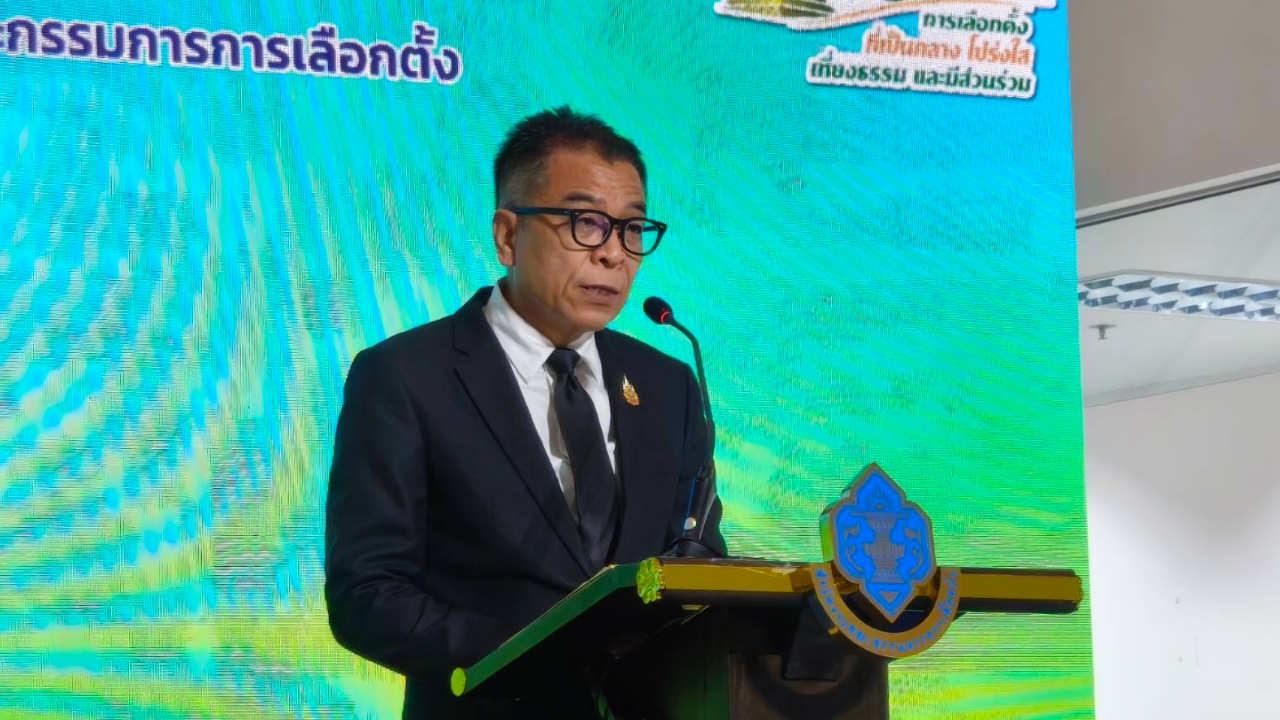
Sawang affirms he is not discouraged following reports that he failed the evaluation for the EC Secretary position. He proclaims pride in being an Election Commission member and highlights the EC's approach to its 29th year by advancing election standards through digital means and enhancing public access to information.
On 9 June 2026 at the Election Commission Office, Sawang Bunmee, Secretary-General of the Election Commission (EC), presented a summary of the EC and its office's achievements on the occasion of the EC's 28th anniversary. Under the theme "Neutral, Transparent, Fair, and Participatory Elections," he emphasized that this address is not merely a report of past work but a commitment to the public about what society will observe from the EC going forward.
Sawang expressed gratitude to all sectors—including government agencies, civil society, academia, network partners, the media, and citizens nationwide—for their support of the EC's work over the past 28 years. Their collective efforts have helped sustain and uphold the democratic system under the constitutional monarchy, ensuring its steady continuation. He noted that all feedback, suggestions, and societal scrutiny are vital forces that have continuously advanced Thailand's election management and enabled the EC to perform its duties fully for the nation and its people.
He stated that in a rapidly changing world, public expectations for government organizations extend beyond merely conducting elections according to the law. Citizens also demand transparent, swift, and convenient election processes, with easy access to information and genuine opportunities to verify the election procedures.
The EC recognizes that its future success will not be measured solely by the number of elections completed within set timeframes, but by the degree of public confidence in the election process and the democratic system overall.
Sawang noted that over time, the EC has organized elections at both local and national levels, including parliamentary elections alongside referendums. These are crucial mechanisms reflecting the people's will and serve as indicators of the quality of Thailand’s democratic system.
The EC's operational principles adhere to 28 years of neutral, transparent, fair, and participatory elections. This reflects past working approaches and remains a key goal in developing the organization for the future.
He added that although the EC's core mission remains unchanged, societal contexts have shifted significantly—including digital technology, citizens' political behaviors, information access, and societal expectations of government bodies. Consequently, the EC must transition from merely managing elections to becoming an organization that concretely and sustainably builds and drives democratic confidence.
Therefore, the EC has set a development direction to become a trusted democratic institution in the digital era, based on integrity, transparency, neutrality, and fairness, and is driving five key transformative areas:
First, enhancing election standards through digital technology to make election management more accurate, rapid, transparent, and verifiable; reducing steps and errors; and facilitating public access to EC services anytime, anywhere.
Second, increasing data transparency, improving communication with the public, and amplifying citizen voices by developing accessible, understandable, and verifiable public information systems. This aims to enable public participation in monitoring and improving election processes, including organizing “Think Before You Share” activities to promote digital information literacy and reduce misinformation during elections.
Third, developing an efficient, modern, and fair political oversight system by leveraging technology to support investigations, monitor political expenditures, and manage complaints, ensuring law enforcement is equitable and accepted by all parties.
Fourth, cultivating new democratic citizens by promoting accurate understanding of governance under the constitutional monarchy and encouraging civic duties among all age groups, especially youth and new generations, to build a strong and sustainable democratic culture.
Fifth, transforming the organization into a high-performance digital entity by reviewing workflows to reduce complexity and increase agility, enhancing staff capabilities in technology and digital data, and adopting modern management systems to respond effectively to societal changes.
Sawang emphasized that good elections cannot be achieved by any single organization alone but require cooperation from all social sectors. A strong democracy arises when citizens trust that every vote counts, all processes are transparent, and all parties are treated fairly and equally.
On the EC’s 29th anniversary, he reaffirmed the commitment to carry out duties with integrity, transparency, neutrality, and fairness. The EC remains open to feedback from all sectors and is ready to adapt into a modern, transparent, and citizen-centric digital organization, ensuring elections and EC operations earn public trust, which forms a vital foundation for the constitutional monarchy democracy.
When asked how the EC plans to boost public confidence moving forward, Sawang said that the slogan "Integrity, Transparency, Neutrality, and Fairness," derived from the UN’s Universal Declaration of Human Rights on elections, represents the democratic minimum standard for all nations and elections. He assured that all staff strive to adhere to this slogan, affirming there will be no corruption scandals and all efforts will be made more tangible through ongoing project plans submitted for EC approval.
Regarding the EC’s Facebook publicity page remaining with comments disabled despite the stated openness to public feedback, Sawang explained he would prefer to enable comments, but most content is abusive rather than constructive criticism or suggestions. The EC welcomes genuine feedback and will consider it accordingly. Although such behavior is undesirable in a democracy, he promised to possibly reopen comments to test how long they can withstand abusive remarks.
Sawang cited an example where his words were misinterpreted to suggest the EC shifted election responsibility onto citizens. He clarified that he intended to invite public participation because transparency must be paired with citizen engagement. He emphasized that the EC continues to fulfill its duties but wants citizens to take ownership of their country. In other countries, citizens participate at every election stage, helping monitor and safeguard the process. Even if citizens do not oversee it, the EC must still perform its role.
On whether the EC can complete investigations into over 2,000 election fraud cases within this year, Sawang acknowledged past criticism of polling station officials’ conduct. He reiterated that citizens should participate from the start of officials’ work to resolve issues promptly. However, if cases progress to only witness testimony after delays, evidence is scarce, making investigations difficult and time-consuming.
He reiterated that the EC does not intend to shift responsibility but noted that when citizens vote and then leave, doubts and accusations about election transparency arise. He suggested that to improve, citizens should observe and monitor elections, which the EC welcomes and supports. This is an expression of ownership. He affirmed that the election system is designed to be transparent, but the people involved must also be trustworthy.
Responding to questions about rumors of failing the annual performance evaluation process, Sawang said the EC Chair has already addressed this, and he had no further comment as it is a committee matter. He only expressed positive feelings about working with all previous EC teams.
Regarding whether the evaluation news affects his morale, Sawang insisted it does not. He had no comment as it concerns contractual matters and ongoing legal discussions. He urged not to judge whether they have done their best but said they strive to do so within the given context. He concluded by saying he remains encouraged and feels good about everything here.
When asked what he is most proud of, Sawang simply replied, "Better not say yet," before concluding, "I am proud to be a member of the Election Commission."