

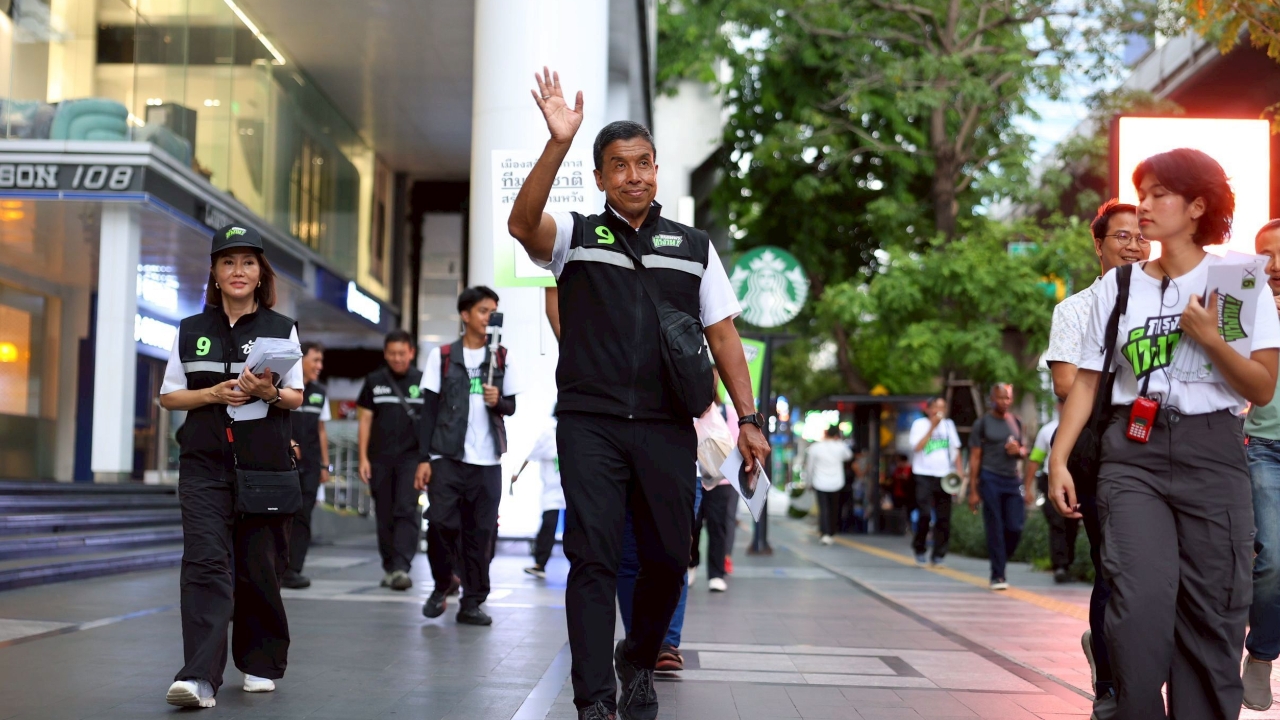
Chadchart promotes an economic policy to boost the “Street Economy,” unlocking access for small vendors to capital, space, and skills, while upgrading four main festivals—Songkran, Loy Krathong, Bangkok Pride, and New Year's Countdown—to global standards.
On 9 June 2026 GMT+7, Mr. Chadchart Sittipunt, candidate for Bangkok governor number 9, along with the “Bangkok Works” team including Mr. Jakkapan Phiwngam, Associate Professor Dr. Tawida Kamolwetch, and Mr. Sanan Wangsrangboon, former Bangkok deputy governor, campaigned in the Silom area around the ITF building’s back market, Lalay Sap Market, Park Silom Shopping Center, Central Park Shopping Center, and along Silom Road. They presented an economic policy emphasizing the concept of the Street Economy, promoting street-side commerce alongside driving Bangkok to become a World Festival City.
Chadchart said the city is an economic space, and Bangkok’s economy is not just about large companies but also includes many small entrepreneurs, street vendors, and small businesses that are vital forces for the city.
“A city is an economic space with two parts: the large companies—in Bangkok, about 1,400 companies employing roughly 3 million people—and the MSMEs or Micro SMEs, numbering over 500,000, employing another 3 million. Both systems support the city’s continued growth,” Chadchart stated.

Regarding the Street Economy policy, Chadchart identified a key approach: enabling small vendors to access three main opportunities—capital, space, and skills. The Bangkok Metropolitan Administration (BMA) will design and manage trading spaces and connect vendors with formal financial sources. Currently, there are over 700 informal vending points, which create gaps exploited by corrupt practices against vendors.
“Illegal vending spots cause extortion and bribery because they exist outside legal zones, creating loopholes. Therefore, we need better organization to bring vendors into authorized zones and find spaces for them to sell,” Chadchart explained.
Chadchart noted that currently the BMA has 59 authorized vending zones and is proposing 61 more, expected to accommodate about 7,000 to 10,000 vendors. Additionally, 51 community identity points and markets are proposed, potentially supporting another 2,000 vendors. Over the next four years, Chadchart’s team plans to establish food centers in all 50 districts to increase selling spaces for vendors and small businesses in each community. He emphasized that organizing street vendors must not mean pushing them out of the city but rather systematizing spaces, gradually transitioning so vendors and pedestrians can coexist.
“We must prioritize the public interest. The city needs order and mutual respect of rights, but we are not harsh—we give vendors time, find spaces for them, and gradually help them move,” Chadchart said.
Chadchart stated that the BMA has previously organized several problematic areas such as Bobae, Talat Lao, Silom, and Sukhumvit, improving conditions. Sidewalks are now more walkable, and many vendors have proper selling spaces.
“The key is not to violate others’ rights and to strive to improve vendors’ quality of life,” Chadchart said.
Furthermore, in the next four years, the BMA will upgrade Bangkok’s four major festivals—Songkran, Loy Krathong, Bangkok Pride, and New Year’s Countdown—to global standards in terms of space and routes, infrastructure, safety, public restrooms, water refill stations, public transport, and coordination among government, private sector, and communities for joint planning.
Chadchart said that in the future, the BMA may develop festivals into a continuous Festival Circuit linking Silom with nearby areas such as Pathumwan, Khlong Toei, Ratchaprasong, and Charoen Krung to facilitate smoother movement, accommodate more people, and distribute income to surrounding areas. Upgrading festivals requires preparing infrastructure including safety systems, CCTV cameras, pedestrian crossings, water refill points during Songkran, waste disposal, restrooms, and public transport to enable the city to hold large-scale events consistently without rebuilding systems each year.
“Festivals stimulate the economy both at large and street levels combined. This is a key charm of Bangkok,” Chadchart said.
Chadchart concluded that the goal of the city’s economic policy is to make Bangkok a city where small vendors can easily make a living, with accessible selling spaces, formal capital, necessary skills, and city festivals serving as economic engines that distribute income widely to shops, markets, communities, and local businesses.
