

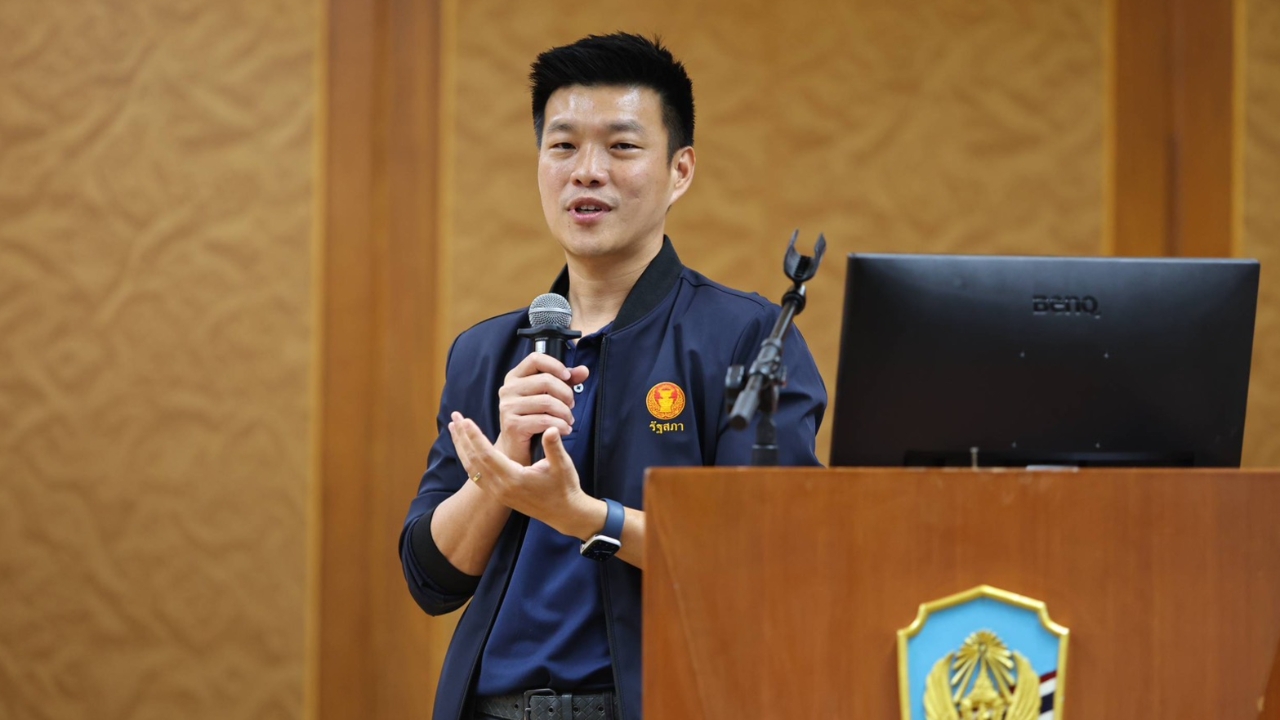
Nattapong Ruangpanyawut made his first visit to the National Defence College (NDC) to lecture the 68th student cohort. He said he was fully committed and aimed to communicate with military officers and business leaders about the dynamics of global politics. He emphasized three strategic pillars for Thailand in the new world order and stressed that the constitution must be democratic. He also underscored that a professional military should not interfere in politics.
On 10 June 2026, Nattapong Ruangpanyawut, leader of the People’s Party, posted on Facebook a topic titled "The Dynamics of Central Great Powers and the New World Order." He stated that he was honored to be invited by the National Defence College, an academic institute for national defense, to participate in a seminar with the 68th course students on "Political Dynamics in an Era of Global Transition." He said he was fully committed to engaging in this discussion with military officers responsible for various security dimensions, as well as civil servants, independent government officials, private sector businesspeople, and the general public who make up the student body.
Nattapong further stated that his lecture topic was "The Dynamics of Central Great Powers and the New World Order, and the Strategic Security Survival of Thailand." He proposed that under the collapse of the old order (a unipolar superpower led by the United States) and the rise of a challenging new power (China), Thailand must find its own path. He cited a former prime minister who once said, “Although we are a small country, we must negotiate to benefit both sides with America.” He believes that such thinking is no longer applicable.
He explained that amid a changing world marked by the Russia-Ukraine war, the US-China trade war, and the Hormuz Strait crisis, perspectives on security and world order have shifted. Uncertainties in supply chains, transnational crime, scam centers, drug trafficking, and cyber threats have increased. Defining Thailand as a “small country” only disadvantages its bargaining power.
He stated that although Thailand is not a great power, it is certainly not a "small country," considering its territory, strategic importance, population size, and economy. Thailand needs to view itself as a middle state with middle power influence in both the global economy and politics. He gave examples of such countries, including Turkey, Indonesia, Brazil, Saudi Arabia, South Africa, South Korea, Australia, and Singapore. He also noted that the world today is not only about large global stages but also smaller forums focused on specialized issues, such as security (led by the US), trade (China), technology (Japan), and green economy (EU).
Nattapong further predicted Thailand’s future over the next 10–20 years: 1) The world order will be multipolar, with middle powers playing greater roles; 2) New security issues will be directly linked to the pace of technological change; 3) Politics and economics will be deeply intertwined, making technology not just an innovation but a "sovereignty competition arena."
Therefore, he emphasized the importance of Thailand having its own technology or at least being part of the supply chain. He cited Brazil, a middle power that has aligned itself in new security frameworks by cooperating with Sweden, particularly SAAB, the manufacturer of Gripen fighter jets. Brazil is not only a buyer but also part of the production process. This has been a consistent priority for them. When formulating policies, from local issues like potable water to national defense technology, the old Cold War-era policies that shifted with those in power (who sided with the US) hoping for national benefit are no longer viable in a multipolar world where the US is no longer the sole superpower. Thailand must shift from passive neutrality to a more proactive stance. Being neutral does not mean silence or having no stance; rather, it means refusing to be a tool of any superpower while keeping diplomatic doors open without unnecessary closures.
Nattapong cited Singapore’s Defence Minister Chan Chun Sing’s remarks at the 2026 Shangri-La Dialogue: "The world has enough troubles. If ASEAN just stays out of trouble, we will distinguish ourselves." He emphasized that ASEAN should avoid being pro- or anti-U.S. or China but instead be firmly "pro-ASEAN." Thailand’s key strategy should be to serve as ASEAN’s anchor—not to dominate but to prevent ASEAN from being dominated. Thailand must be a bridge connecting ASEAN with other middle powers. In summary, survival alone in today’s world is nearly impossible for a single country. If Thailand has breathing space but ASEAN does not, Thailand will ultimately lack breathing space as well.
Thailand’s three main strategic pillars in the new world order are: First, internal strength and proactive diplomacy, grounded in a democratic constitution that connects with the people, covering the origin of power, accession, and peaceful transition. The military should be modern, professional, politically non-interfering, highly efficient, and possess its own technology, adopting a proactive neutrality. Second, small-group multilateralism and the new global ecosystem that integrates security and the economy, shifting from buyer to part of the supply chain, and developing effective personnel. Third, expanding policy space and options by creating diverse alternatives that resist pressure from great powers, and building flexible supply chains in areas like food and clean energy. The more options available, the more stable the country will be.
Nattapong concluded on geopolitical dimensions by presenting the 14% of the world’s land covering South Asia, Southeast Asia, and East Asia, with Thailand at the center, home to over four billion people—half the world’s population. He said Thailand can do much more than before. As an example, he mentioned the smart grid, an intelligent electrical network, where Thailand could become a regional hub. However, this requires opening energy markets in the region, driven by domestic political will, which would then attract global investment to transform ASEAN’s electrical energy into affordable, clean, and equitable power with Thailand as the regional center.
The reporter noted that Nattapong is the first member from the People’s Party to lecture in the National Defence College program.
