

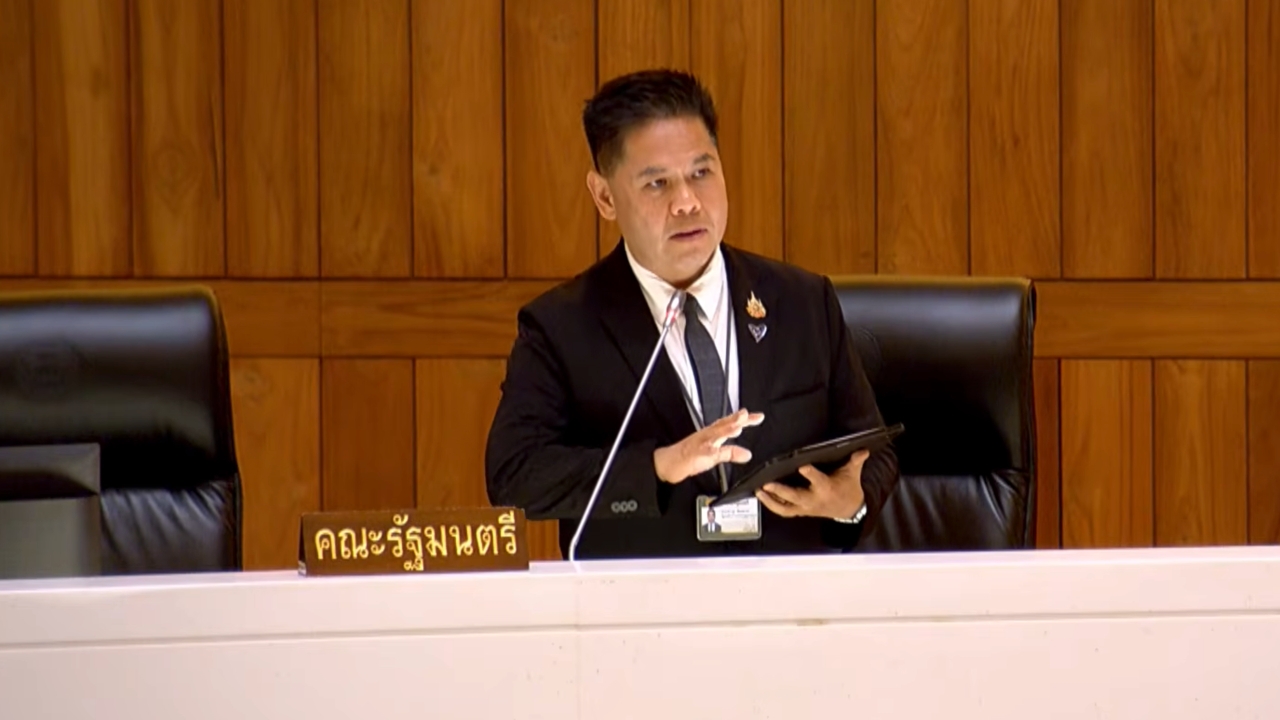
Kritch, a Rayong MP from the Prachachon Party, raised a live question regarding the reopening of Sin Keo Yuan Steel Factory. He expressed concerns about whether the factory meets standards. Worawut revealed that inspections were passed and ordered steel quality testing twice a month. He also invited members to join the inspection team on site.
At 11:00 a.m. on 11 June 2026, Lertsak Patanachayakul, Deputy Speaker of the House of Representatives, presided over the parliamentary session during the live question period. Mr. Kritch Silpachai, Rayong MP from the Prachachon Party, asked Mr. Worawut Silpa-archa, Minister of Industry, about the case in which the Department of Industrial Works allowed the factory Sin Keo Yuan Steel to resume steel production after it had been shut down previously due to the collapse of the Office of the Auditor General building.
He wanted to know what standards the Ministry of Industry required Sin Keo Yuan Steel Factory to improve and whether all improvements had been completed. Especially, he asked if the steel refining furnace used to control the steel melting furnace was present at this factory, and how they could be confident that the inspection process by the Department of Industrial Works and the Thai Industrial Standards Institute (TISI), which allowed the factory to reopen, was truly up to standard—not just spot-checking some furnaces. He also inquired about the policy to replace the IF (Induction Furnace) system with the EF (Electric Furnace) system to upgrade steel production standards, and what the transition period would be.

In response, Mr. Worawut explained that the minister does not have the authority to order factory closures or openings; legally, this is the responsibility of the permanent secretary. The Department of Industrial Works and the Thai Industrial Standards Institute had inspected the factory and found that the randomly sampled steel met the required standards. He affirmed that the inspections were thorough, not superficial, and once passed, the factory must be allowed to operate.
“Please trust that the inspections were thorough. To further ensure the steel meets standards, the Department of Industrial Works and TISI will conduct quality checks of steel at the factory, distribution centers, retailers, and various sites twice a month. If the steel does not meet standards, corrections will be required. If non-compliance persists, the factory will be ordered closed again to ensure confidence in the steel’s quality.”
Meanwhile, Mr. Worawut invited Mr. Kritch to join the inspection team to verify the steel production standards at the factory. He pledged that if it is found not to meet standards, the factory will be closed again. Regarding the policy to phase out IF furnaces in favor of EF furnaces, which have higher standards, the timeline depends on global conditions and technology that meets the standards. Regardless of the technology used, the steel produced must meet quality standards.
