

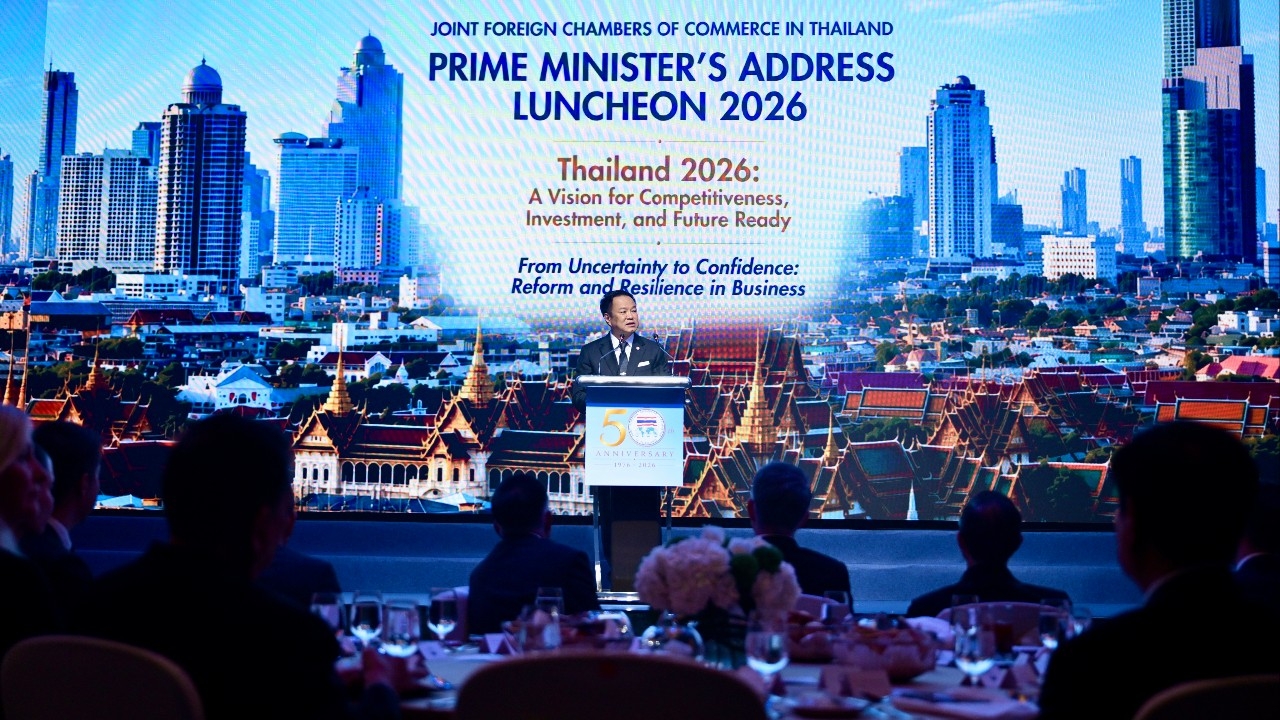
The Prime Minister delivered a keynote speech at the JFCCT 2026 forum to business leaders, emphasizing regulatory reform, human development, connecting Thailand to the global economy, and building investor confidence. He acknowledged that investors are looking for trust and stability in their decisions.
At 11:20 a.m. on 12 June 2026 at the Crystal Hall of The Athenee Hotel, Ms. Lalida Pertviwatana, Deputy Spokesperson of the Prime Minister's Office, reported that Prime Minister and Minister of Interior Anutin Charnvirakul attended the JFCCT Prime Minister’s Address Luncheon 2026, organized by the Joint Foreign Chambers of Commerce in Thailand (JFCCT). The event was attended by cabinet members, foreign chamber chairpersons, business representatives, and ambassadors from JFCCT member countries, totaling around 400 participants.
On this occasion, the Prime Minister met informally with the foreign chamber chairpersons, event sponsors, and representatives from various countries' chambers of commerce before joining a group photo. He then participated in the event's opening ceremony, where Ms. Vibeke Lyssand Leirvag, Chairperson of the Joint Foreign Chambers of Commerce in Thailand, delivered the welcome address.
Following that, the Prime Minister gave a special keynote titled “Thailand 2026: A Vision for Competitiveness, Investment, and a Future-Ready Economy: From Uncertainty to Confidence – Reform and Resilience in Business.” He congratulated JFCCT on its 50th anniversary and praised the organization’s role in connecting Thailand with international business sectors and supporting the country’s economic development over five decades.
The Prime Minister stated that everyone present is a key partner driving Thailand’s economic growth and a close friend to the country.
He noted that from participating in economic forums and discussions with global business leaders in recent months, the most frequently mentioned word has been “uncertainty,” relating to supply chain restructuring, technological changes, and geopolitical tensions—all factors influencing investment decisions. Meanwhile, countries worldwide compete fiercely to attract capital, skilled personnel, and innovation.
The Prime Minister said that today’s investors seek confidence, predictability, and strong partners ready to handle change. Thailand is committed to being a trusted, stable, and highly resilient destination for long-term investment.
The government understands that current competitiveness is measured not only by cost but also by reliability and adaptability to the rapidly changing global context. He then outlined the government’s economic strategies as follows.
1. The government aims to make Thailand more business-ready by improving ease of doing business through regulatory reforms, expanding digital public services, reducing investment procedures, and integrating public agency operations to increase speed, transparency, and certainty for the business sector.
The Prime Minister cited the Thailand FastPass mechanism, which accelerates investment approvals and licensing processes across multiple agencies. Currently, 25 investment projects valued at over 223 billion baht benefit from this measure. He also said the government continues to update laws and regulations related to business operations to align with the new economic environment, notably revising the Foreign Business Act to reduce unnecessary restrictions and duplication, creating a more conducive investment environment.
2. The government prioritizes investment in future industries by strengthening ecosystems in high-potential sectors such as advanced electronics, semiconductors, AI, digital services, automation, robotics, clean energy, electric vehicles, and biotechnology to propel Thailand as ASEAN’s future industry hub.
3. The government emphasizes developing human resources alongside technology, believing that while AI plays a key role in changing work patterns, technology is most beneficial when paired with skilled, adaptable personnel. The government is promoting collaboration among public agencies, educational institutions, and the private sector to develop workforce skills aligned with future industry needs, enabling companies investing in Thailand to access qualified talent, supporting business growth and success.
4. The government focuses on enhancing Thailand’s connectivity with the global economy. ASEAN remains one of the world’s fastest-growing economic regions, with over 700 million people and a steadily expanding middle class. Thailand’s strategic central location is a key advantage for linking trade, investment, and supply chains regionally and globally.
Thailand’s strengths also include the ability to connect investors with business opportunities throughout ASEAN and globally. The government is advancing high-standard trade agreements and strengthening international economic partnerships, including negotiating the Thailand-European Union Free Trade Agreement and promoting Thailand as ASEAN’s logistics hub.
The Prime Minister said these efforts will expand economic opportunities, enhance the country’s competitiveness, and reinforce Thailand’s role as a trusted investment gateway linking ASEAN with major global economic regions.
Toward the end, the Prime Minister acknowledged that while Thailand cannot eliminate all global uncertainties, the government can build confidence through governance, structural reforms, and close collaboration with the business sector. This commitment is also reflected in Thailand’s pursuit of OECD membership, which will elevate governance, competitiveness, and international standards.
He said this foundation is central to Thailand’s future vision, which will be realized through cooperation among the public sector, business community, and society. He emphasized that over the past two decades, Thailand has faced various internal and external challenges, all of which have strengthened the country’s resilience, experience, and readiness for the future.
After delivering the keynote, the Prime Minister joined a group photo with cabinet members, foreign chamber representatives, event sponsors, and JFCCT member country ambassadors. He then attended a luncheon and engaged in discussions with international business delegates to strengthen economic cooperation and promote Thailand’s investment climate.