

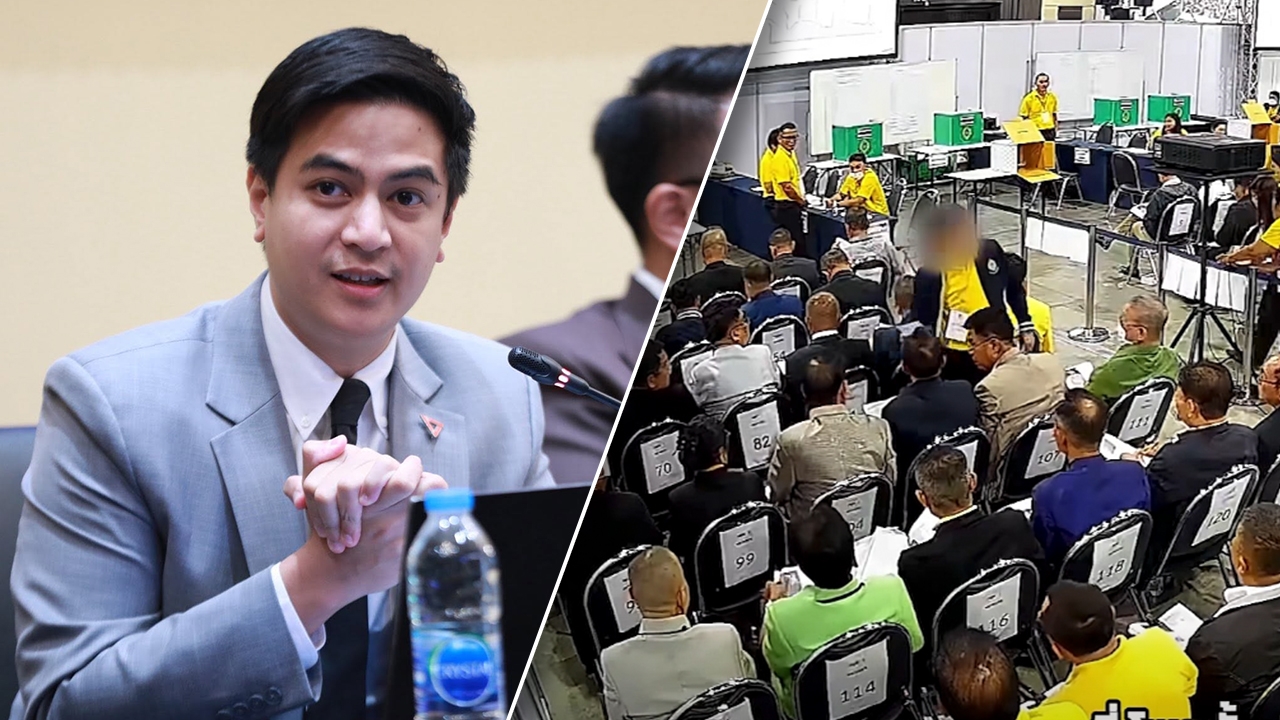
Parit Watjanasin released a video revealing evidence of collusion in the Senate election, claiming he saw Election Commission officials collecting bet slips from candidates on the national election day. He questioned what was seen in the slips that prompted the plea, “Please, let’s have an honest Senate election.”
On 13 June 2026, Mr. Parit Watjanasin, party-list MP from the People’s Party, posted on Facebook a clip of evidence regarding the Senate election collusion case, accompanied by the statement: “Please, let’s have an honest Senate election” — words spoken by an Election Commission committee member while collecting bet slips from Senate candidates on the national election day.
Parit explained that the clip is part of information he received from a complainant who submitted a letter to the parliament last week. He and his team enhanced the audio to clarify important conversations and blurred the faces of those involved.
The footage shows the national Senate election on 26 June at 7:00 p.m. (the cross-round). In the clip, one woman (an Election Commission official) and one man (initially identified as one of the seven Election Commissioners) are seen inspecting and collecting “bet slips” from candidates. They also make remarks implying acknowledgment of the risk that the election might not be conducted honestly (listen to the Election Commissioner’s conversation at the clip’s end).
Parit stated that while taking notes on candidate numbers to prepare for voting at the booth is not necessarily illegal, the questions raised by this clip include:
1. What did the Election Commissioner see in the bet slips or what behavior during the election day led to the comment, “Please, let’s have an honest Senate election” while collecting the slips?
2. After collecting the slips, did the Election Commissioners immediately convene a meeting to review the evidence and consider actions under Senate Election Act Section 59, which allows the Commission to suspend, halt, amend, change, or cancel the election and order a new one if there is reasonable suspicion the election was not honest or fair?
3. After the Senate election results were announced, how did the Election Commission handle the collected bet slips? Did they further investigate the evidence, such as linking the numbers on the slips to other evidence related to the collusion case (e.g., witness testimony, appointment records, financial trails)?
4. Were these bet slips and any verification results included in the investigation dossier of Committee 26, and are they being used to help the Election Commission decide soon whether to send the case to court?
Previously, the Election Commission issued a statement in 2025 clarifying that bringing documents with candidate numbers into polling stations is not inherently illegal. However, that statement did not address the preliminary questions raised in this post.
Parit noted that broadly, the Election Commission’s role directly impacts the fate and justice process of the Senate election collusion case.
As is well known, after Committee 26 found at least 229 people guilty (over 130 Senators and more than 90 linked political network members, including some MPs and cabinet ministers), the group with the power to decide whether to approve sending the entire case to court or dismiss the complaints of all 229 individuals or some key persons to prevent the case from reaching court is the Election Commission, composed of seven members.
Many in society have begun questioning how much they can trust the Election Commission to investigate and rule on the Senate election collusion case impartially because
1. Of the current seven Election Commissioners, four were appointed with the Senate’s endorsement, most of whom appear in this case dossier. This raises public concern about potential conflicts of interest and whether their appointment came with hidden conditions to "support the blue side."
2. The current Election Commission created a special Subcommittee 36 specifically to screen the Senate election collusion case instead of using one of the existing 35 subcommittees. Since Subcommittee 36 includes members accused of corruption and political partiality and has ruled to dismiss all 229 complaints (contradicting Committee 26’s findings), the public worries this mechanism may be an attempt to whitewash those accused.
3. If the Election Commission cannot clearly address the additional questions raised by this new evidence clip, the current Election Commission—especially the members appearing in the clip—will face increased public scrutiny over whether they neglected their duty to thoroughly investigate the Senate election collusion.
Parit concluded that if the Election Commission wants to clear these allegations, it should approve Committee 26’s proposal to send the entire case to court, allowing the judiciary to determine whether the 229 individuals committed offenses.