

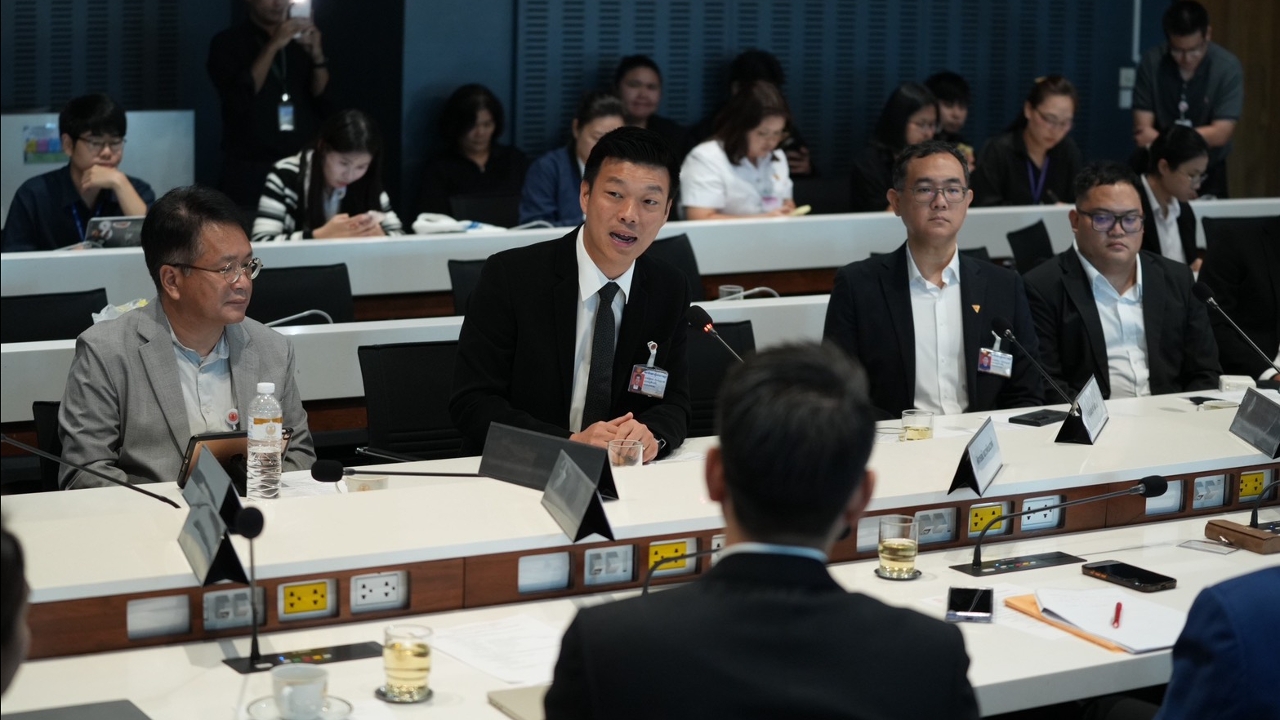
The People's Party teamed up to challenge the TH-AI Passport project. "Teng" accused the government of political business, while "Ice" revealed new evidence to be submitted to the National Anti-Corruption Commission, finding that a company prepared the TOR before the bidding officially began. Meanwhile, "Teerachat" expressed concerns about changes to the new specification documents.
On 15 June 2026, after the Shadow Cabinet meeting of the People's Party concluded, the group issued a summary statement led by party leader Natthapong Ruangpanyawut. He said that today they would reveal previously undisclosed information showing suspicious coincidences suggesting the government has conflicts of interest, raising questions and doubts about whether this constitutes political business.
Confused by repeated specification changes.
Teerachat Todtrakool, advisor to the opposition leader in the House of Representatives, said that after hearing opinions last week, time was insufficient and three questions remain: details about the token, numerous issues with the TOR details, and the TOR stating capacity for 500,000 users per hour, while the Ministry of Digital Economy's permanent secretary said 5 million per second. He seeks confirmation whether the TOR can be changed at will.
He also questioned whether past procurement processes were efficient enough to allow the winner to adjust specifications to the ministry's needs without restrictions. The public consultation period required registration within 30 days, but he doubts the feasibility of completing a 1.621 billion baht project within that time.
There is another document detailing the TH-AI Passport project proposal submitted to the Economic Cabinet on 10 November 2025, which lacks three key points: originally, registration was to be within 90 days, but on 15 December the TOR was amended through public consultation to reduce this to 30 days; the service start was shortened from 120 to 90 days. This indicates a limited timeframe to launch the project quickly. Also, the convenience store advertising screen, frequently discussed publicly, was not included in the Economic Cabinet document but appeared in the TOR during public consultation, raising questions about why the TOR details changed when a caretaker minister was anticipated.
"We found a suspicious timeline and a significant date before and after changes occurred: 12 December 2025, the day the previous government dissolved the parliament. This suggests that the limited timeframe was suspiciously imposed. Why was the Economic Cabinet's original document changed to a new specification possibly for a caretaker government? This is a question for the minister," said Teerachat. .
"Completed last year," he slammed.
MP Rakchanok Srinok of the People's Party emphasized that the government must cancel the project, as it is unrelated to AI's future or cost-effectiveness beyond the locked specifications in the TOR. She explained slides presenting evidence that "It was completed last year." She cited a presentation from Human Intelligence showing the company's work timeline starting 1 October 2025, including the term TH-AI Passport, even though the project was not yet known in the public sector on that date.
Focusing on a slide from a company abbreviated as B, the project began public consultation on 15 December 2025 and opened bidding for the TOR at the end of December. However, the TOR was created on 27 October 2025, meaning they knew in advance they would be awarded the TH-AI Passport project, though bidding started later in December. "This means our suspicion that contractors already knew they would get the contract and that 30 days during bidding was insufficient is supported. This evidence shows they worked beforehand, even before the bidding was announced," said Rakchanok. .
Rakchanok also referred to a list, partially redacted, believed to contain names of people involved in the project who still work at company B. She noted testing during bidding indicates the company already knew it would win. The Ministry of Digital Economy's permanent secretary once stated that if there is evidence of corruption, the project would be canceled. This strongly suggests the project is not only locked in specifications but was prepared since last year.
Calls to review the TOR.
Rakchanok said that all information revealed today was provided by whistleblowers who worked on the project but do not want it to proceed. They oppose being part of stealing the future of the industry and IT professionals nationwide. Locking the winner and eliminating competition steals the future of the entire sector, concentrating it in a single group. The TH-AI Passport project overlaps TORs with the National Credit Bank project and two other projects—Skill Credit Portfolio—under the Ministry of Higher Education and Ministry of Education, totaling about 10 billion baht, of which 2 billion have been completed.
Rakchanok urged the two responsible ministers—whose ministries have reviewed the TOR—to urgently reconsider the TOR or suspend the project and allocate budget next year. The new evidence disclosed today, never before revealed, shows the project indicates not only corruption suspicion but actual misconduct. She vowed to submit the evidence to the National Anti-Corruption Commission.
Calls to cancel the project and let Thais handle it.
Party-list MP Pawut Pongwitthayaphanu of the People's Party said the proposal to cancel the 1.6 billion baht TH-AI Passport project budget is significant. Redirecting these funds to support Thailand's technology industry could shift the country from being a user to building infrastructure and supporting existing AI providers. Thailand already has its own AI, but funding should support Thai people. While foreign AI use is necessary, buying through intermediaries is unacceptable. Instead, direct government-to-government negotiations should be pursued to gain benefits and cooperation from foreign companies.
He added that skills development is crucial, involving the general public. The previous government partnered with Gemini Google to provide free AI access, which was effective. Further cooperation with other AI companies to bring technology to the public is planned. SMEs and startups should receive digital training coupons to learn and apply AI. AI should also be used in government to improve efficiency and transparency, such as detecting fraud. Bangkok's projects have adopted such technologies, aiming to develop a government platform that enhances capabilities through technology.
Developing digital careers requires encouraging companies to open offices in Thailand through BOI mechanisms, increasing employment in digital professions. The TH-AI Passport project is small compared to future AI projects, which could consume large government budgets. The Ministry of Digital Economy should step back from direct AI development and focus on setting frameworks and standards to control AI projects nationwide. Such projects should be assigned to relevant agencies like the National Science and Technology Development Agency, which has expertise to reduce duplication and ensure maximum efficiency.
Accuses political business.
Natthapong said today's content is incomplete; they have much more information. All suspicious elements presented remain uncorrected by the government. They will continue to expose these issues so the public can see how the government under the Blue regime is exploiting the country through political-business networks. He said this matter is bigger than the permanent secretary or digital economy minister, directly questioning the Prime Minister on how a good government should resolve these suspicious issues.
Exposing more than two suspicious projects.
Suspicion 1: The project was completed last year. While the Digital Economy Minister claims to prioritize AI, the Prime Minister has never convened the AI board, despite claims of AI importance.
Suspicion 2: Numerous irregularities in the TOR. The TOR was both copied and locked. The TH-AI Passport is not the only similar project; others have similar wording locking advertising screens to benefit certain investors, changing wording from 'screen' to 'point' but otherwise similar.
Suspicion 3: There are more than two projects involved. Today, the billion-baht figure is believed incomplete. They are ready to reveal more information continuously. They question whether these personal relationships extend to attending each other's birthdays, facilitating access to government procurement processes, allowing copying and locking of TOR specifications, and channeling public funds to certain groups running political business.
Suggests Prime Minister has only two choices.
Given these three suspicions, the Prime Minister has only two options.
1. Immediately halt all these projects to prove commitment to tackling corruption and preventing political business from exploiting the country further.
2. Avoid the problem by ignoring these projects, possibly due to deference to the Digital Economy Minister, who may be someone's son, or because these political-business groups support the Blue regime government, making the Prime Minister reluctant to intervene.
Today, there are many off-budget public spending issues. The 1.6 billion baht Digital Economy Fund for this project is a large sum for startup entrepreneurs. The same money could better build a new industrial economy. To solve this problem long-term without recurring projects, reform of the Digital Economy Fund is needed for transparency, and budget allocation should change.