

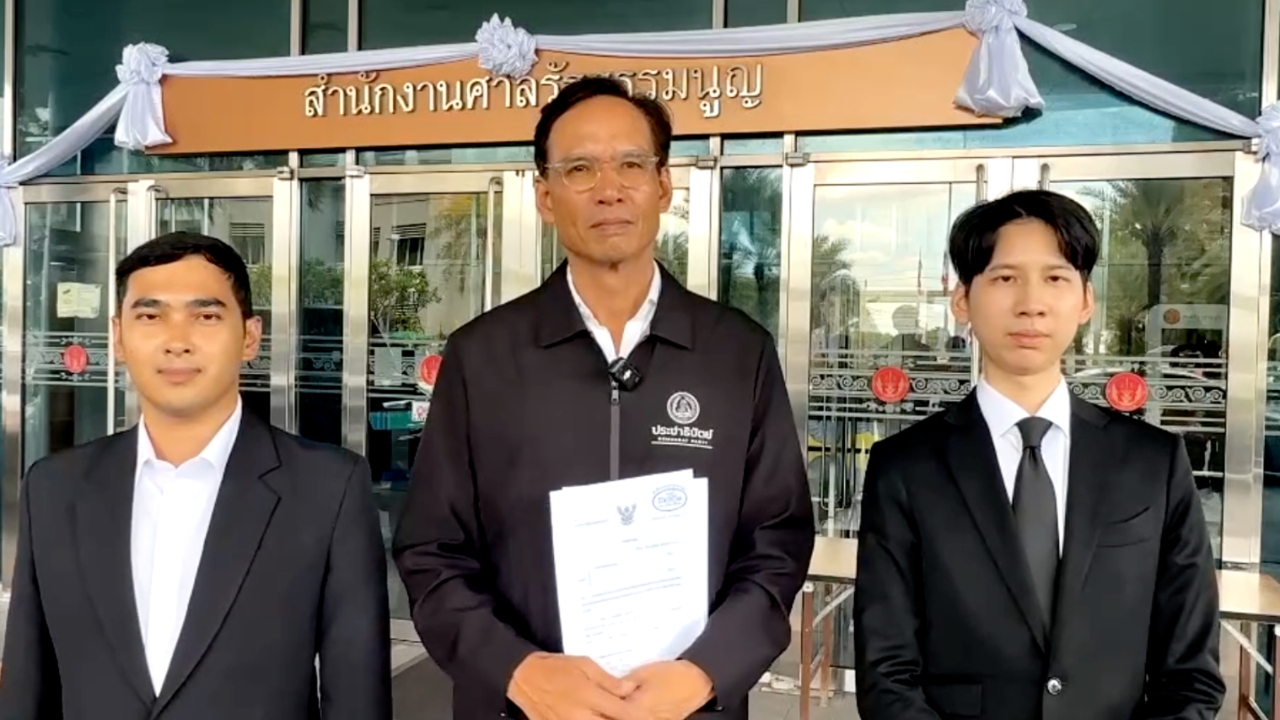
The Democrat Party has sent Korn to submit an objection to the Constitutional Court opposing the 400 billion baht loan decree, emphasizing the preservation of fiscal discipline and preventing risky lessons that could endanger the country's economy in the future.
On 16 June 2026, Korn Chatikavanich, Deputy Leader of the Democrat Party, went to the Constitutional Court office to submit an objection against the Cabinet's explanation regarding the issuance of a royal decree granting the Ministry of Finance the authority to borrow funds to address the energy crisis impact and facilitate the country's energy transition in 2026, known as the 400 billion baht loan decree.
Korn stated that the Cabinet's explanation failed to clarify how the decision to issue the loan decree meets the constitutional criteria under Section 172, since the drafters emphasized the importance of maintaining fiscal discipline. All previous governments have prioritized fiscal discipline, meaning that while governments can borrow money, it must be in accordance with the Public Debt Act.
"The usual budget deficits, which this government has nearly maxed out, allow some flexibility. The Constitution permits the government to borrow additionally via a royal decree in cases of threats affecting the country's economic security. The constitution clearly defines what qualifies as an economic crisis impacting national economic security."
Korn added that historically, several governments have issued royal decrees during crises of that magnitude. For example, during the 1999 Asian financial crisis, the country faced threats to economic security. In 2009, the subprime mortgage crisis caused a sharp economic downturn, reducing tax revenue by nearly 200 billion baht, threatening economic stability. Most recently, during COVID-19, two royal decrees were issued as the economy sharply contracted and citizens were unable to work. These justified additional borrowing beyond normal annual budget deficits.
In comparison, the current loan differs as economic growth remains normal. In the first quarter of this year, growth even exceeded targets at around 2.8%. The economy is forecasted to grow over 2% this year. International reserves, once a problem during the Asian financial crisis, are now at record highs. Tax revenue collection has surpassed targets in the past seven months, and public debt remains within the 70% limit set by the Fiscal Discipline Act.
Therefore, considering all indicators, it cannot be claimed that the economy is in a crisis that threatens national economic security. Other reasons the government cited for issuing the loan decree are inconsistent with constitutional provisions and the Fiscal Discipline Act, which the Constitution prioritizes in Section 53.
"The Democrat Party believes that allowing the government to issue loan decrees under the current normal economic conditions risks undermining the country's fiscal discipline. It would open the door for future governments to cite routine economic challenges as reasons to issue loan decrees, causing severe impacts on economic security by increasing national debt."
Additionally, Korn said the government should not be allowed to issue loan decrees at will. The war shows signs of ending, and oil prices have been falling daily. If the government wants to reduce fuel prices to ease living costs for citizens, there are other available measures. The Democrat Party has repeatedly recommended reducing excise taxes to immediately lower pump prices or adjusting the current pricing method, which still references Singapore prices, despite government acknowledgments that this calculation method is unfair to citizens.