

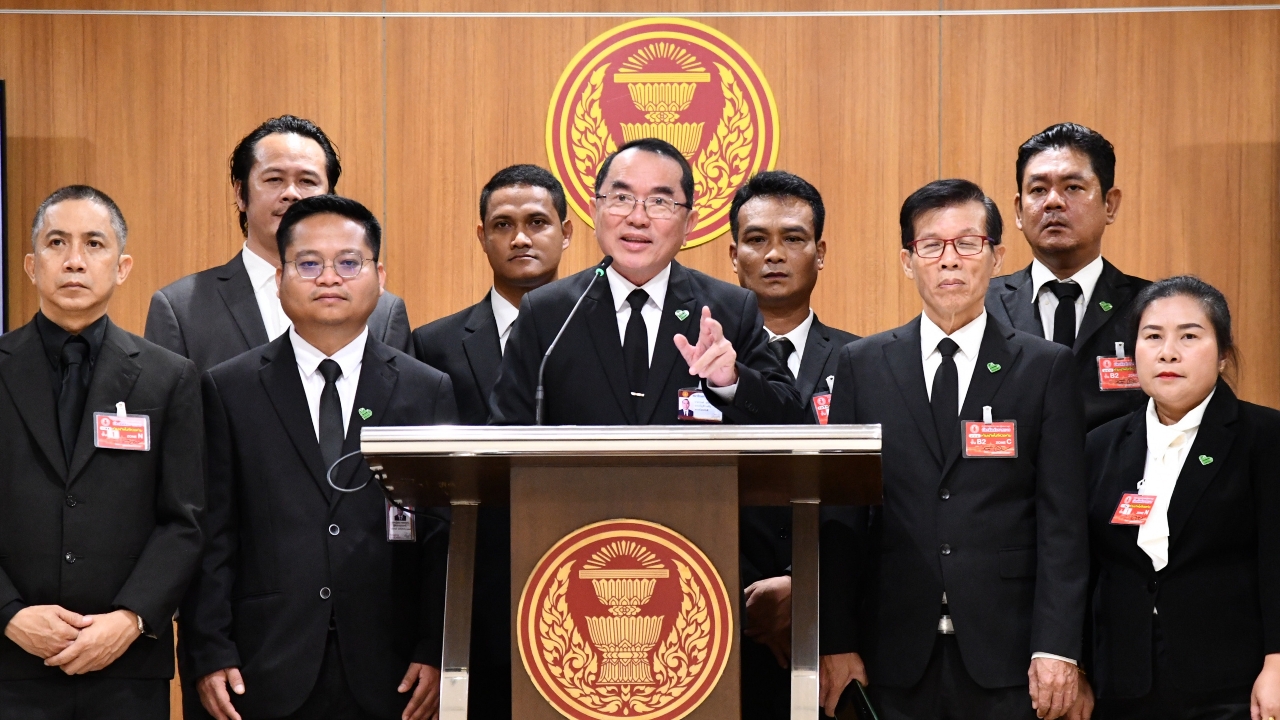
Dr. Warong opposes the Parliamentary Committee on House Affairs' decision to maintain pensions for former MPs and 8 assistants, emphasizing it unfairly burdens the public by using tax money to support those who failed elections, exposing the local political patronage system as a form of dictatorship.
At 10:30 a.m. on 17 Jun 2026 GMT+7 at the parliament, Dr. Warong Dechgitvigrom, party-list MP and leader of the Thai Pakdee Party, addressed the Parliamentary Committee on House Affairs' decision to maintain lifelong pensions for former MPs with at least 48 months (4 years) of total service, and to keep the number of MP assistants at 8. He expressed disagreement, asserting that most MPs and Senators who claim to represent the people ultimately serve their own and their allies' interests—whether from major parties, older or newer generations. He said these benefits stem from entrenched local political patronage that influences politics to manage vote banks. Even sitting MPs are supported monthly by local political backers, leading them to vote according to those backers' instructions rather than the people's wishes. He challenged whether anyone could deny that powerful patrons still pay monthly stipends to sitting MPs, but when MPs lose their seats, they must beg for support, thus requiring the use of taxpayers' money to maintain a fund to support former MPs who no longer serve, granting them unnecessary benefits.
Dr. Warong further stated that maintaining the allowance of 8 assistants per MP is another result of local political patronage, where these assistant positions serve as quotas allocated by central party elites to support candidates who lost elections, avoiding direct payments by using taxpayer funds instead. Even Senators aligned with various factions have had their assistants reassigned to local political elites to avoid expenses. He opposes this, calling the local patronage system a form of dictatorship unresponsive to the people, despite elections claiming to represent them. Since the patronage funds come from political parties, he urged all MPs to sacrifice for the public they represent and questioned why they fail to respond to public needs. He criticized the Parliamentary Committee's plan to form a subcommittee with MPs to study this issue as unfair and a conflict of interest. The best solution, he said, is to ask the public directly. He called on the Speaker of the House to survey public opinion on whether MPs should have lifelong pensions and be allowed 8 assistants. He noted some MPs, including himself, appoint no more than 3 assistants, showing greater awareness. He also recommended the committee allocate a budget to provide meals for parliamentary staff without linking it to the cancellation of MPs' meals, especially dinners during late parliamentary sessions, emphasizing the need to support staff separately. He agreed that MPs' meals should not be mixed with staff meal provisions.