

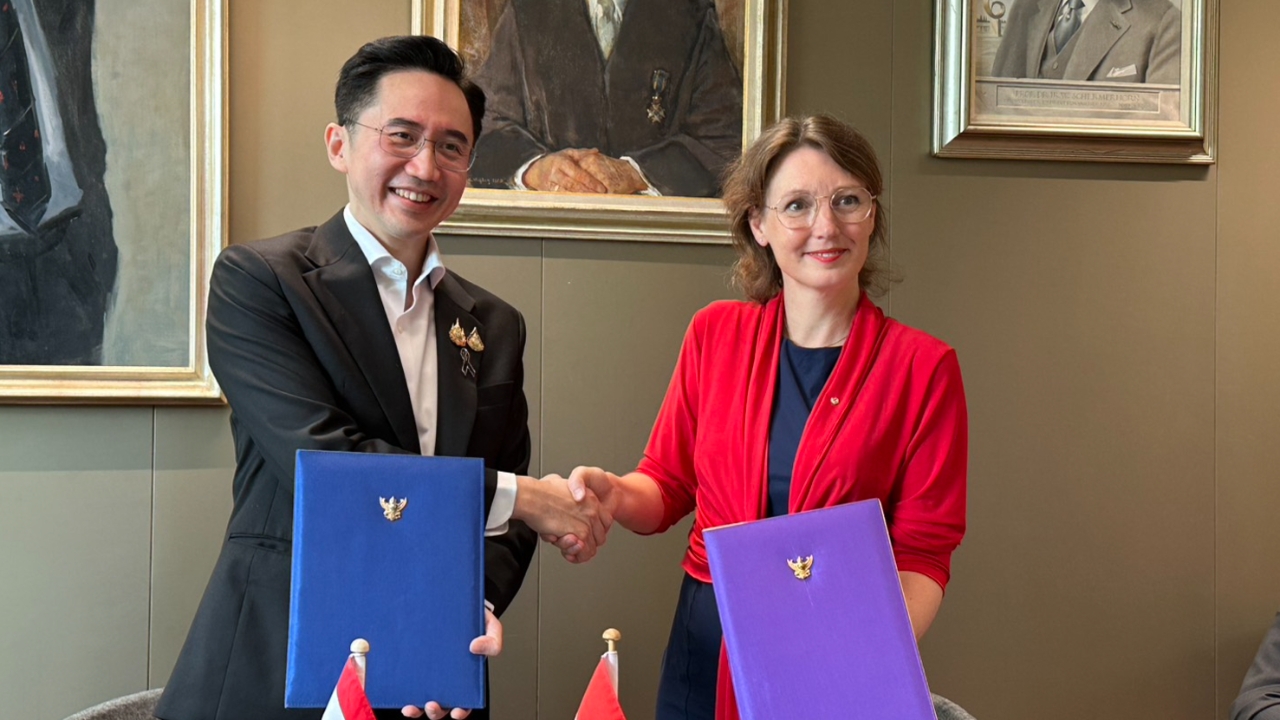
Yossanan signed six cooperation frameworks with Delft University of Technology to elevate Thailand's semiconductor industry, develop 84,000 talents, close workforce gaps within five years, and target the photonics chip market to position Thailand as an ASEAN hub.Tags: [Semiconductor Industry, Talent Development, Photonics Chips, ASEAN Hub, International Collaboration]
On 17 June 2026, in the Netherlands and Belgium, Prof. Dr. Yossanan Wongsawat, Deputy Prime Minister and Minister of Higher Education, Science, Research and Innovation, witnessed the signing of a cooperation framework between the ministry and Delft University of Technology to drive collaboration in workforce development, education, and semiconductor research between Thailand and the Netherlands. The core of the discussion involved six areas of cooperation.Tags: [Cooperation Agreement, Ministry of Higher Education, Delft University, Semiconductor Research, Thailand-Netherlands Relations]
1. Human capital and workforce development: Master's scholarships for two-year programs plus one year of research/thesis; combined MSc and PhD scholarships (five years) for outstanding students; specialized training by distinguished lecturers; the "Beethoven" six-month semiconductor technology course for industry; online training and mentoring; and an entrepreneurship incubation program.Tags: [Human Capital, Scholarships, Training Programs, Semiconductor Technology, Entrepreneurship]
2. Joint research and innovation programs covering TU Delft's strengths: microelectronics and integrated circuit (IC) design, signal processing and DSP, electromagnetics/sub-THz and RF, quantum/cryogenic and astronomical instrumentation, sensor technology, radar and space-related technologies, advanced packaging and heterogeneous integration, and bioelectronics.Tags: [Joint Research, Innovation, Microelectronics, IC Design, Advanced Packaging]

3. IC Design Ecosystem Development: TU Delft proposes establishing a fabless chip design center, training in design methodologies, and adjusting university curricula to meet current and future Thai industry needs.Tags: [IC Design, Ecosystem Development, Fabless Design, Curriculum Development, Industry Needs]
4. Advanced packaging innovation, a high value-added area, along with establishing joint research laboratories to elevate Thailand's position in high-value products and enable intellectual property creation within the country.Tags: [Advanced Packaging, Joint Research Labs, Value Addition, Intellectual Property, Innovation]
5. Industry partnerships and technology transfer by connecting with global players in the semiconductor ecosystem of the Netherlands and Europe, such as NXP, ASML, and imec.Tags: [Industry Partnerships, Technology Transfer, Semiconductor Ecosystem, Global Players]
6. Entrepreneurship and startup ecosystem focused on translating research and innovation into new businesses that address future industrial demands.Tags: [Entrepreneurship, Startup Ecosystem, Innovation Commercialization, Future Industry]
Prof. Dr. Yossanan said, "Human capital development is the foundation of Thailand’s semiconductor strategy. The first phase of workforce development (2026–2030) aims to produce about 84,900 highly skilled workers and around 1,780 researchers to close the gap of over 226,000 personnel needed in Thailand's smart electronics and robotics industries over the next five years."Tags: [Human Capital, Workforce Development, Semiconductor Strategy, Thailand Industry]

Earlier, during his mission from 13 to 16 June, Prof. Dr. Yossanan met with Thai professionals and students in Eindhoven to broaden perspectives that the global ecosystem is key to laying foundations and driving the country forward—transforming Thailand from merely a "buyer" into a full-fledged "deep tech creator" partner.Tags: [International Mission, Knowledge Exchange, Ecosystem, Deep Tech, Thailand Development]
During this visit to the Netherlands after more than 10 years, the senior official studied the Brainport model, negotiated with ASML and TU/e to anchor Thailand in the global supply chain, and led BOI and embassy teams to attract 30 Dutch startups and scale-ups via an Open Innovation model to make Thailand a new Southeast Asian deep tech hub. Discussions were also held with AXELERA AI, an open-system chip processor developer, whose executives plan to visit Thailand in early July to kick off projects and explore applications where Thai talent can contribute.Tags: [Brainport Model, Supply Chain, Startups, Open Innovation, Deep Tech Hub, International Cooperation]
Additionally, a memorandum of understanding was signed with the University of Twente, a world-leading research institute in nanotechnology and photonics. Mahanakorn University of Technology was assigned as the primary operator to establish a joint laboratory to drive research toward commercialization and meet workforce development goals.Tags: [MOU, University of Twente, Nanotechnology, Photonics, Joint Laboratory, Commercialization]
The visit concluded with a tour of SMART Photonics, a leading global photonics chip factory. The Deputy Prime Minister offered an insightful perspective: "Instead of competing in fields where we are at a disadvantage, why not lead in areas where we have opportunities?" The photonics chip factory requires around 5.6 billion baht in investment, which is 30 times less than the 160 billion baht needed for traditional semiconductor plants—making it a cost-effective and feasible investment for Thailand.Tags: [Photonics Chips, Investment, SMART Photonics, Competitive Strategy, Semiconductor Industry]
