

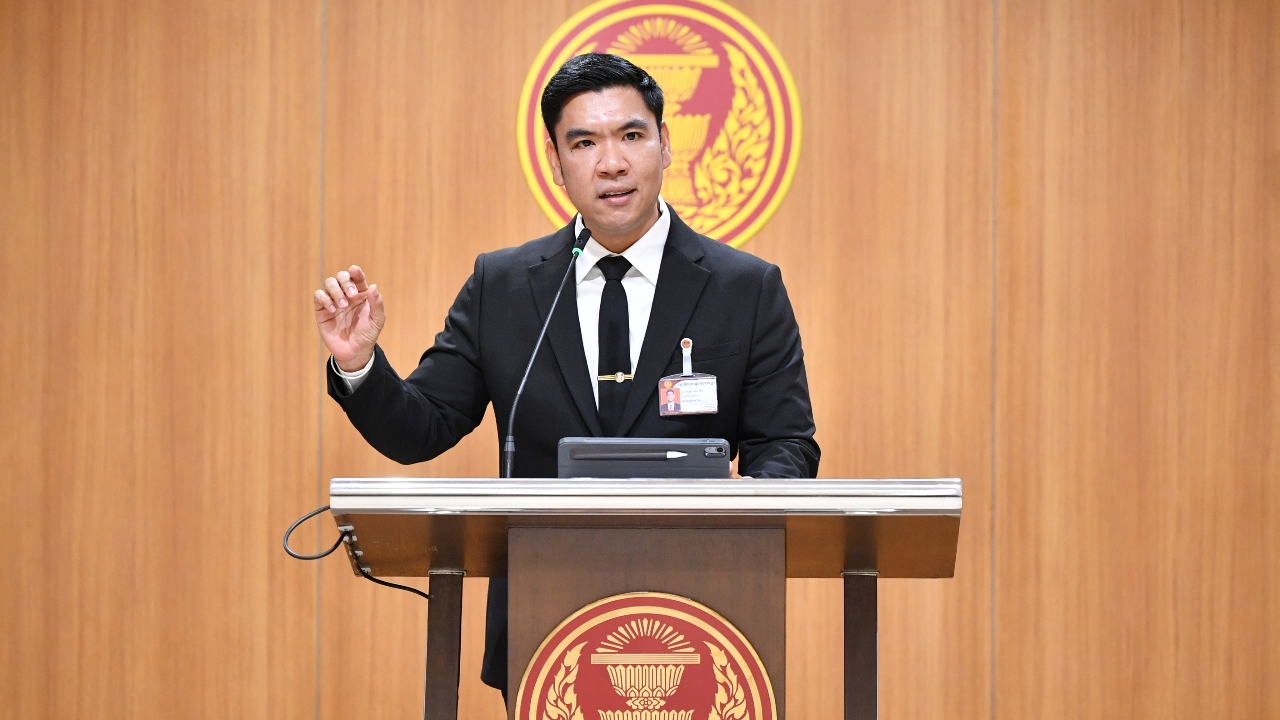
Rayong MP from the Prachachon Party points out that the Xin Ke Yuan steel plant’s resumption of production still raises several societal doubts and unclear issues. He urges the Industry Minister to investigate and clarify the facts.
On 18 Jun 2026 at 09:30 GMT+7, at the Parliament, Mr. Krits Silapachai, Rayong MP from the Prachachon Party and 4th Deputy Chair of the Industry Committee, together with Mr. Chutipong Phiphopinyo, former Rayong MP from the same party, held a press conference concerning the reopening of the Xin Ke Yuan Steel Company Limited in Rayong province, authorized by the Department of Industrial Works. The Industry Committee held a meeting yesterday, and its chairman announced that the factory’s reopening complies with Section 39, paragraph two of the Factory Act B.E. 2535 (1992), meaning that once a closure order is issued and the operator has made improvements under the conditions, the plant may resume operations legally.
However, he believes that the Department of Industrial Works’ approval for reopening still involves many doubts and unclear aspects, especially regarding the department’s explanation to the committee about the order to improve the steel quality control system in the production process. He questioned whether the company had actually carried out the improvements as ordered by the Ministry of Industry.
The Department of Industrial Works explained only that the company had submitted production process data consistent with the Environmental Impact Assessment (EIA) report for review. The department also consulted the Thai Industrial Standards Institute (TISI), which confirmed that the production process met the required standards. Therefore, the production process improvements were deemed to have passed the relevant criteria.
Nevertheless, he still doubts that the production process presented is the original one which previously produced problematic steel, yet it was affirmed as correct. This raises the question whether the department’s order to improve the production process was genuinely implemented, particularly regarding the steel refining furnace, which was neither installed nor upgraded, but instead they claimed to add certain substances into the steel melting furnace as a substitute.
A key observation is that in steel production, if certain substances are below standard levels, they can be supplemented. However, if they exceed the standard, their levels cannot be reduced without a steel refining furnace. Hence, he believes the Department of Industrial Works has not provided detailed clarification on this issue, and it remains unclear how the production process, improvements, or future operational methods will proceed.
There is also an issue concerning inspections by TISI in collaboration with the Iron and Steel Institute of Thailand. After the fire incident, initial inspections found the steel did not meet standards, prompting TISI to order the seizure of all steel due to doubts about compliance.
Subsequently, the steel was divided into several batches. He received information from the head of the inspection team at that time that during the seizure there was no batching, raising questions about who conducted the batching.
More than 40,000 steel bars were seized. The first inspection results were released in April 2025, and the seizure was lifted around September 2025, coinciding with a government transition and ministerial change. At the same time, the TISI Secretary-General who signed the lifting order retired that year, prompting suspicion whether these events were coincidental or influenced by other factors.
From yesterday’s committee meeting, explanations by related agencies lacked sufficient technical detail and mostly summarized the event timeline. Meanwhile, the more than 40,000 seized steel bars have already been sold. Thus, it is TISI’s duty to follow up and verify whether the steel meets quality standards and track where it was sold.
Another issue not addressed by TISI to the committee concerns inspections of steel from the debris of the Office of the Auditor General’s (OAG) building. The inspection found the steel did not meet standards, yet this information was absent from TISI’s explanation, raising questions about why this data disappeared.
Additionally, issues about the lifting of the red dust seizure and the relocation of provincial industries remain under continuous investigation. He has requested the committee’s resolution to gather missing documents and information from all relevant agencies for comprehensive reconsideration. He urged the Industry Minister to thoroughly examine these matters and clarify the facts to dispel public doubts, expressing concern over the committee’s recent review and press briefing. He does not want the committee to be viewed merely as a rubber stamp endorsing matters still fraught with questions.
