

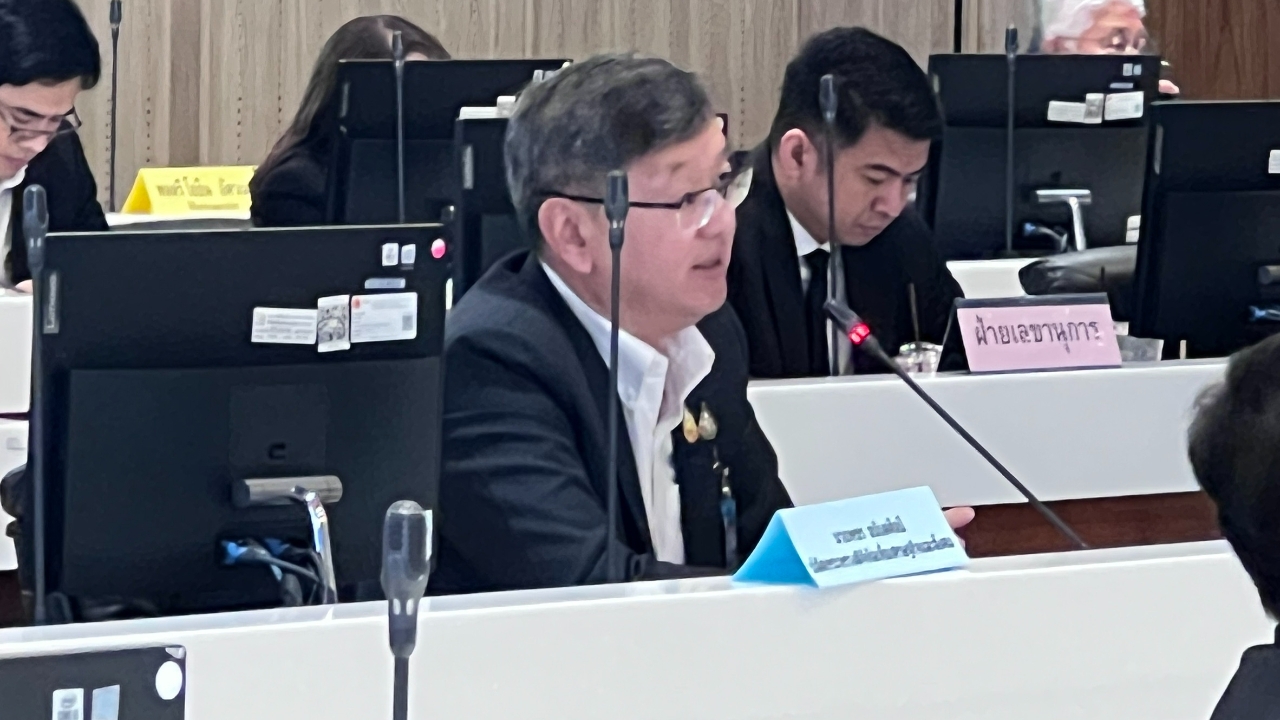
The Permanent Secretary of the Ministry of Digital Economy explained to the parliamentary committee to clear allegations about the "TH-AI Passport" project, affirming that all steps comply with the law and warning that cancellation might lead to counter-lawsuits by private companies.
On 18 June 2026, Mr. Patchara, Permanent Secretary of the Ministry of Digital Economy, presented a detailed timeline to address public concerns that the project was unusually fast-tracked. He stated that the target of enabling 20 million citizens to access AI systems was not hastily set by the current government but was part of a plan discussed and developed since May 2022 during the tenure of General Prayut Chan-o-cha, through the National AI Operational Steering Committee, with continuous work until 2024.
Later, on 1 May 2025, under the leadership of Mr. Srettha Thavisin, the steering committee set a proactive goal for 20 million AI users or acquainted individuals by 2027. To ensure continuity amid government changes, the Ministry of Digital Economy proposed restructuring the AI committee into a permanent national committee under the relevant law, established in 2026, while maintaining the original target of 20 million users.
The Permanent Secretary confirmed that the project was based on an existing foundation developed over time, culminating in contract signing on 14 April 2026. The total period from study, drafting to signing was nearly a full year, not a rushed 31-day process as misreported in various media outlets.
Regarding questions about why funds outside the regular budget were used from the "Digital Economy Development Fund" (DE Fund), raising transparency concerns since it bypassed parliamentary approval, Mr. Patchara explained that when the new government took office on 1 October, the ministry's regular budget was almost depleted. Therefore, the ministry relied on the DE Fund, which had nearly 2 billion baht readily available, to design the project and conduct price benchmarking according to government regulations.
"The process of using the fund is not simple; it must pass strict multi-level scrutiny. The approval committee is not ministry officials but includes representatives from central agencies and external IT experts who thoroughly review before drafting the TOR and conducting procurement in full compliance with the law," the Permanent Secretary affirmed.
Meanwhile, Ms. Rakchanok Srinok questioned the project timeline, noting that Minister Chaichanok Chidchob had proposed the project in the previous government. She raised concerns about the promotional methods being very specific and compared the TOR to that of the National Credit Bank project from the Ministry of Higher Education, Science, Research and Innovation (MHESI), suggesting possible copy-pasting.
"If you say it’s not copied, I would be shocked, because the details are identical in 7-8 lines, with 99.99% matching text, differing only in the words ‘screen’ and ‘point.’ Is this the general principle for writing two TORs for projects with different objectives?" Ms. Rakchanok questioned.
Additionally, Ms. Rakchanok highlighted suspicious aspects regarding the event budget, which required at least 200 attendees, and the connection between the winning bidder’s representatives and a major advertising media company (Plan x), suggesting they are the sole ultimate beneficiaries. She also pointed to suspicious timing of the app testing and the removal of an app with the same name.
Reporters noted that during questioning, Mr. Supachai Jaisamut, a list MP from the Bhumjaithai Party, attempted to oppose and disagree with Ms. Rakchanok’s statements, leading Mr. Rangsiman Rome, chair of the Legal Committee, to intermittently mute him until Ms. Rakchanok agreed to remove the phrase “blue is the auspicious color of the government sector” from the meeting minutes to end the dispute.
In response, the Permanent Secretary shot back that the TOR contains 40 pages, and only a few points overlap, none of which are standard requirements. Regarding doubts about why the ministry did not procure directly from AI developers but signed a large-scale contract including screen advertising budgets, he explained that government agencies cannot split procurements of the same work among multiple providers. The project's success is measured by user numbers and public awareness.
Concerning the use of promotional screens in convenience stores, the TOR drafting team explained that they used criteria and standard pricing from previous procurement by MHESI as a guideline to create offline media accessible to all groups daily, targeting 20 million people, while allowing other bidders to compete.
Towards the end, Ms. Rakchanok reiterated her position that while the committee understands AI’s benefits, she urged the Minister of Digital Economy to cancel the 1.6 billion baht project for now and propose a regular budget next year to clear allegations of corruption, specification rigging, and collusive bidding, rather than blindly pushing forward. The Permanent Secretary concluded sharply that the ministry has listened to all concerns and has also submitted this project in the 2027 budget. He challenged Parliament, saying: "You accuse us of corruption or misconduct, but we insist that we followed every process legally. So what else should we do? And suddenly ask us to cancel without reason? If ordered to cancel without cause, private companies will sue the ministry. What do you want us to do? You must understand the government context. If I say cancel now, you must first answer why. We have followed every legal step correctly," Mr. Patchara said.