

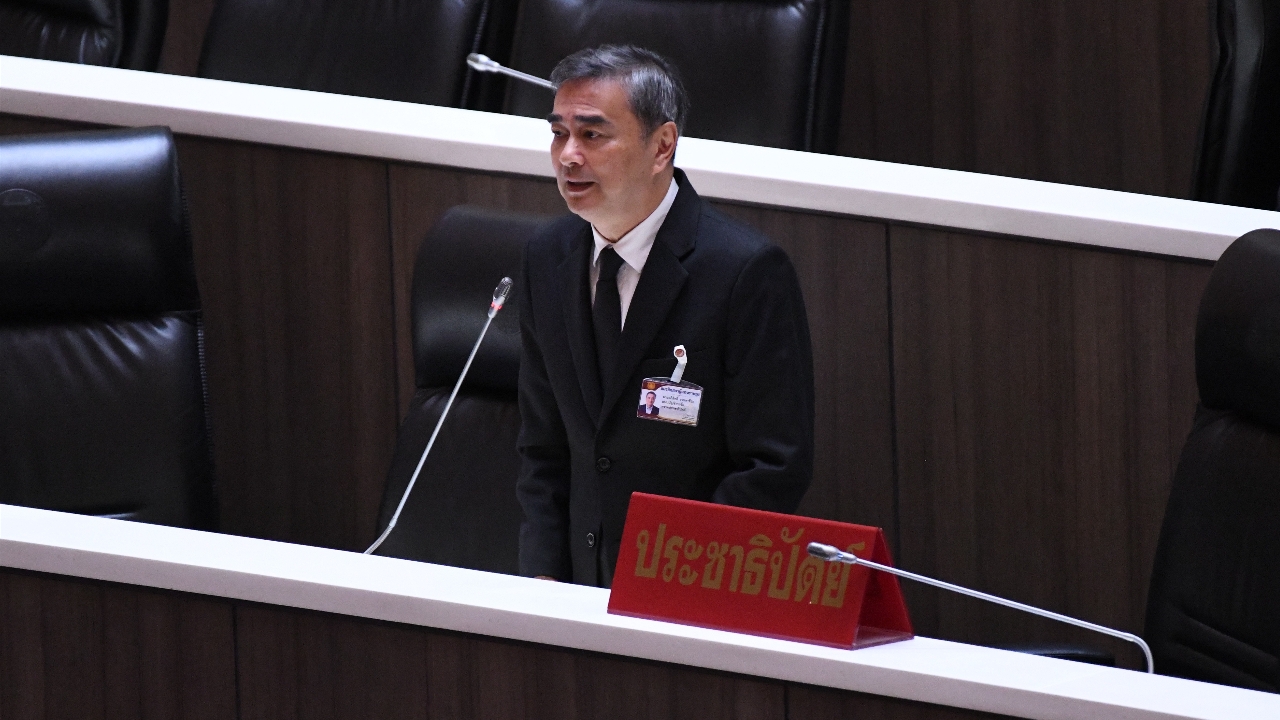
Abhisit urges the Equitable Education Fund to submit reports to the Cabinet, pressing the government to solve educational inequality by proposing "education coupons" delivered directly to children to integrate them into the education system.
On 18 June 2026 at the Parliament, Abhisit Vejjajiva, Member of Parliament and leader of the Democrat Party, acknowledged the 2024 and 2025 annual reports of the Equitable Education Fund (EEF). He praised the EEF's work and said he had pushed for the fund's establishment since 2010–2011, hoping to create a flexible, quality educational ecosystem that meets Thailand's socioeconomic structure.
"I believe the manager and executives know that the idea of establishing this fund was something I pushed for since 2010–2011. In fact, I hoped to see a fund with broader missions and resources that could involve various sectors—not just focusing on equity alone but building an educational ecosystem alongside government agencies to ensure education reaches all our people and children with quality, flexibility, and relevance to Thailand's socioeconomic needs," Abhisit said.
Abhisit continued that even during his absence from politics and Parliament, he saw many fellow members from various parties expressing concern over whether the budget for this mission was sufficient, which he welcomed. Today's discussion by several members clearly shows Parliament genuinely wants to support the EEF's work.
"What I want to respectfully say about the report you submitted to Parliament, which I understand has also been sent to the Cabinet, is that I hope to see both the executive and legislative branches work together more effectively to support you," Abhisit said, adding he first wants to ask about the Cabinet's reaction and response after receiving the EEF's report.
"Similarly, what I regret and think you should have presented when reporting to Parliament is any legal obstacles or limitations you face in your work. If you present these, it will help us support you by addressing these issues through legislation," he added. .
Abhisit emphasized that this linkage is crucial because one of the EEF management committee's duties is to advise the Cabinet on measures and research findings useful for reducing educational inequality, so the Ministry of Education and related agencies can use them as guidelines.
"I'm not sure if I have read your report thoroughly enough, but I haven't seen proposals you have made to the Cabinet. Based on your report, you highlighted at least three major problems. I believe what you are doing and the tools you have are insufficient unless other agencies involved in education management also change," Abhisit stated. .
1. The report reflects that there are a huge number of children—600,000—who are not in or cannot be found in the education system. This figure may be debated as too high or low, but we must consider that nearly 30 years ago, the supreme law stated every Thai must receive accessible, quality education free of charge.
"Simply put, those of us working in the public sector say we provide free education as mandated by the highest law for 30 years. But after 30 years, why do 600,000 children still not exercise this right?" Abhisit asked. Abhisit said that the previous tools, before the EEF, started with compulsory education laws expanded over time to nine years. There have been efforts to promote six, nine, 12, and 15 years of free education. Political parties have also proposed ways to reduce costs, including breakfast programs and school transport.
He continued that he wanted to suggest or assign the EEF to reconsider whether providing free education the old way is still viable. Is it possible now to provide coupons or money directly to children so they can use it and access education?
"What you are doing to track children is commendable, but I say if we want to solve the root problem, is it time to rethink how to subsidize or incentivize children to stay in school, even though they have a right to at least 12 years free education that is not yielding results?" Abhisit said.
Abhisit wants to see this system approach proposed to the Cabinet because the new national education law is still being drafted. He hopes the EEF will propose how the new law should be designed to fix the problem of children falling out of school and address inequality.
"Nowadays, we complain about fewer births and resource limits that shouldn't exist. With the same budget for another five years, per capita spending could increase significantly because the number of births is decreasing. So let's fix the root cause and think together about how to organize education subsidies to enable everyone to access education," Abhisit said. .
2. The report also highlights educational quality issues, especially the gap between small schools and regular or large schools, which is a chronic problem. We've discussed this many times. The answer is not to close small schools, but now, thanks to technological advances, there is better opportunity. "I want to see you propose to the Cabinet how to upgrade the quality of small schools rather than still trying to think about closing them," Abhisit said. He added that many surviving schools face a new problem: they operate by accepting migrant children, which affects educational quality. He wants studies and proposals on this issue as well.
Abhisit noted that surprisingly, the EEF raised problems caused by disasters, which should never be an excuse for extensive educational opportunity loss. When disasters strike, children lose school infrastructure for nearly two years before recovery, which is an unacceptable loss.
"I want the fund to propose to the Cabinet how to mobilize resources and speed up recovery processes when such cases occur. I hope this is helpful for your work, but again, you cannot do it alone. You have thanked many sectors, but what I see lacking most is the connection between you, the Cabinet, and government agencies. Thank you," Abhisit concluded. Abhisit emphasized this point.