

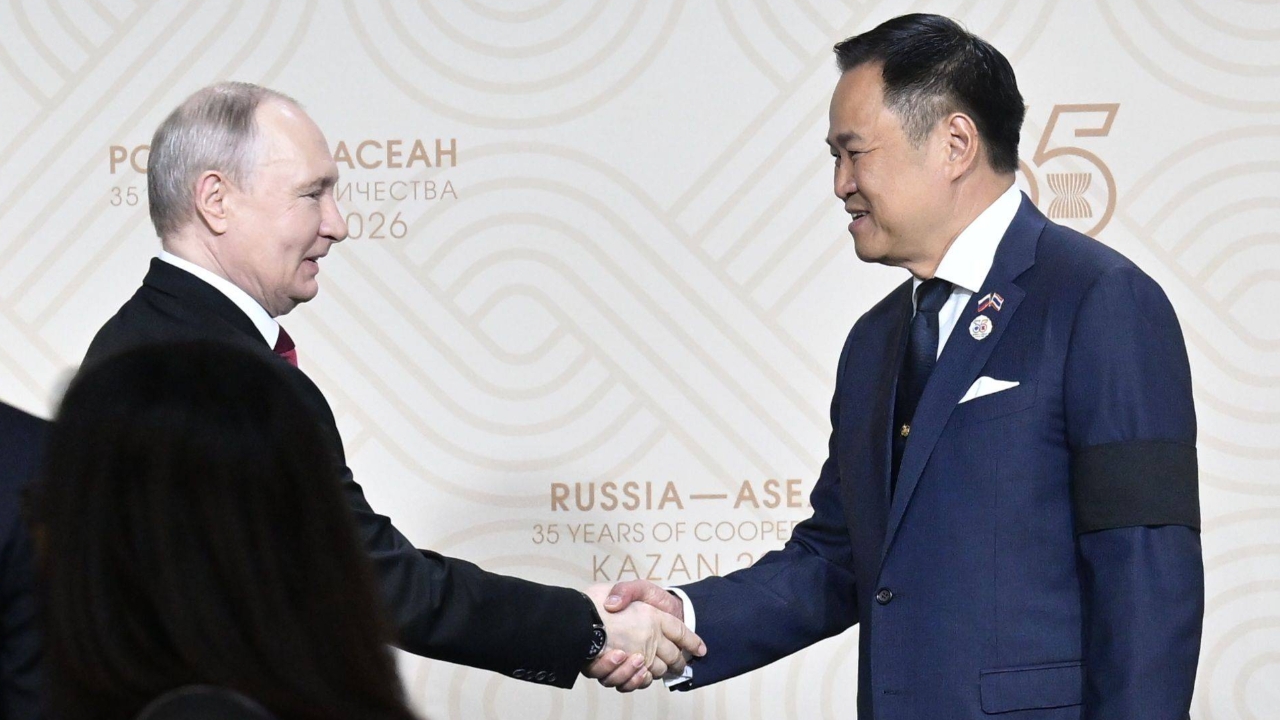
The Prime Minister expressed gratitude to President Vladimir Putin and the Tatarstan government for their condolences to Thailand on the passing of Princess Bajrakitiyabha and proposed the 3Rs framework to guide ASEAN-Russia cooperation in addressing global challenges.
On 18 June 2026 at 10:00 local time (Kazan is 4 hours behind Thailand) in Plenary Session Hall 1, Pavilion A2, Kazan Expo International Exhibition Center, Kazan, Russian Federation, Ms. Rachada Thanadirek, spokesperson for the Office of the Prime Minister, announced that Prime Minister and Minister of Interior Anutin Charnvirakul participated in the Special ASEAN-Russia Summit (full delegation) alongside ASEAN member state leaders to set the direction for ASEAN-Russia cooperation on the 35th anniversary of ASEAN-Russia relations, chaired jointly by H.E. Mr. Vladimir Putin, President of the Russian Federation, and H.E. Mr. Ferdinand Romualdez Marcos Jr., President of the Philippines.
The Prime Minister thanked President Vladimir Putin and the government of the Republic of Tatarstan for their warm welcome and expressed appreciation to other national leaders who conveyed condolences to Thailand on the passing of Her Royal Highness Princess Bajrakitiyabha Narendiradebyavati, reflecting friendship and support during this time.

This meeting marked a significant moment to review and elevate partnerships to respond to current global challenges and generate tangible benefits for all peoples, particularly amid the Middle East conflict affecting the international community. The Prime Minister welcomed diplomatic efforts seeking peace agreements and hoped these would contribute to sustainable peace and stability in the region.
The conflict demonstrated that in an interconnected world, regional instability can quickly impact trade, energy security, food, and people's livelihoods broadly. Thailand believes security depends on dialogue, trust, and cooperation. Therefore, ASEAN-Russia partnerships should promote peace and security by maintaining dialogue channels, building confidence, and driving practical cooperation on shared interests.

On this occasion, the Prime Minister proposed that ASEAN-Russia cooperation focus on three key areas (3Rs) namely,
1) Regionalism Strengthening ASEAN’s role by emphasizing ASEAN as the core foundation of the ASEAN-Russia partnership. ASEAN has consistently contributed to regional peace and stability. Amid a changing global context, ASEAN-led mechanisms remain crucial as forums for dialogue, confidence-building, practical cooperation, and opportunities for like-minded countries to advance mutual interests. He commended Russia’s constructive role in engaging with ASEAN-led mechanisms and its ongoing support for ASEAN centrality.
2) Resilience Building resilience and readiness to face challenges, which is central to ASEAN-Russia cooperation. Currently, resilience includes preparedness for risks such as food security, energy, climate change, and supply chain vulnerabilities that cross borders and cannot be addressed by any one country alone. Cooperation should enhance joint capacity to anticipate risks, adapt to changes, and recover effectively from crises, especially in food and energy security sectors where tangible outcomes can be achieved.
As a major agricultural producer and exporter, Thailand sees potential to expand cooperation with Russia in fertilizer supply chains, agricultural innovation, and strengthening food system security. Cooperation in energy security, future energy technologies, and human resource development to strengthen the region complements efforts to promote sustainable growth and energy transition.

3) Relevance Meeting the needs of the people, which defines the true value of ASEAN-Russia relations. Cooperation should be people-centered and jointly address emerging challenges directly affecting citizens’ safety and quality of life, such as online scams, cybercrime, and transnational crime networks often linked to money laundering, human trafficking, and illicit cross-border financial flows. Thailand supports enhancing cooperation in information exchange, capacity building, law enforcement, and digital security to better protect citizens and the economies of all countries.
Furthermore, the Prime Minister emphasized the importance of preparing society to seize future opportunities as technology transforms lifestyles, work, and economic competition. Investment in human resource development and future skills is essential. He encouraged ASEAN and Russia to expand cooperation in digital transition, AI, new technologies, and education, as well as promote knowledge exchange, skills development, youth empowerment, and people-to-people exchanges to create new opportunities for future generations.

In conclusion, the Prime Minister stated that over the past 35 years, ASEAN and Russia have developed a partnership adaptable to changing global contexts that delivers tangible benefits to their peoples. He welcomed the joint endorsement by ASEAN leaders of the Kazan Declaration and the summit’s outcome documents, which will provide a key framework for advancing ASEAN-Russia cooperation going forward. He affirmed Thailand’s readiness to build a strong, resilient partnership contributing to peace, stability, and prosperity in the region and globally for present and future generations.
Subsequently, the meeting endorsed and acknowledged four outcome documents:
(1) The Kazan Declaration 2026 "ASEAN-Russia: Unity in Diversity – 35 Years Together," affirming shared commitment to promoting peace, security, stability, and cooperation on key issues such as maritime security, biosecurity, combating transnational crime, trade, investment, energy, food, tourism, science, technology, and artificial intelligence.
(2) The Joint ASEAN-Russia Statement on Energy Cooperation, aiming to enhance energy security, manage energy crises, develop clean and renewable energy, hydrogen, low-carbon technologies, and regional energy infrastructure connectivity.

(3) The Joint ASEAN-Russia Statement on Cultural Cooperation, focusing on promoting cultural diversity, heritage conservation, exchanges in arts, literature, film, music, creative industries development, and supporting cultural entrepreneurs and startups.
(4) The Comprehensive Action Plan to Implement the ASEAN-Russia Strategic Partnership 2026–2030, outlining cooperation frameworks in three pillars: political-security, economic, and socio-cultural. It covers key areas such as counter-terrorism and transnational crime, trade and investment, energy and food security, transportation, agriculture, climate change, public health, disaster management, migration, and smart city development.
