

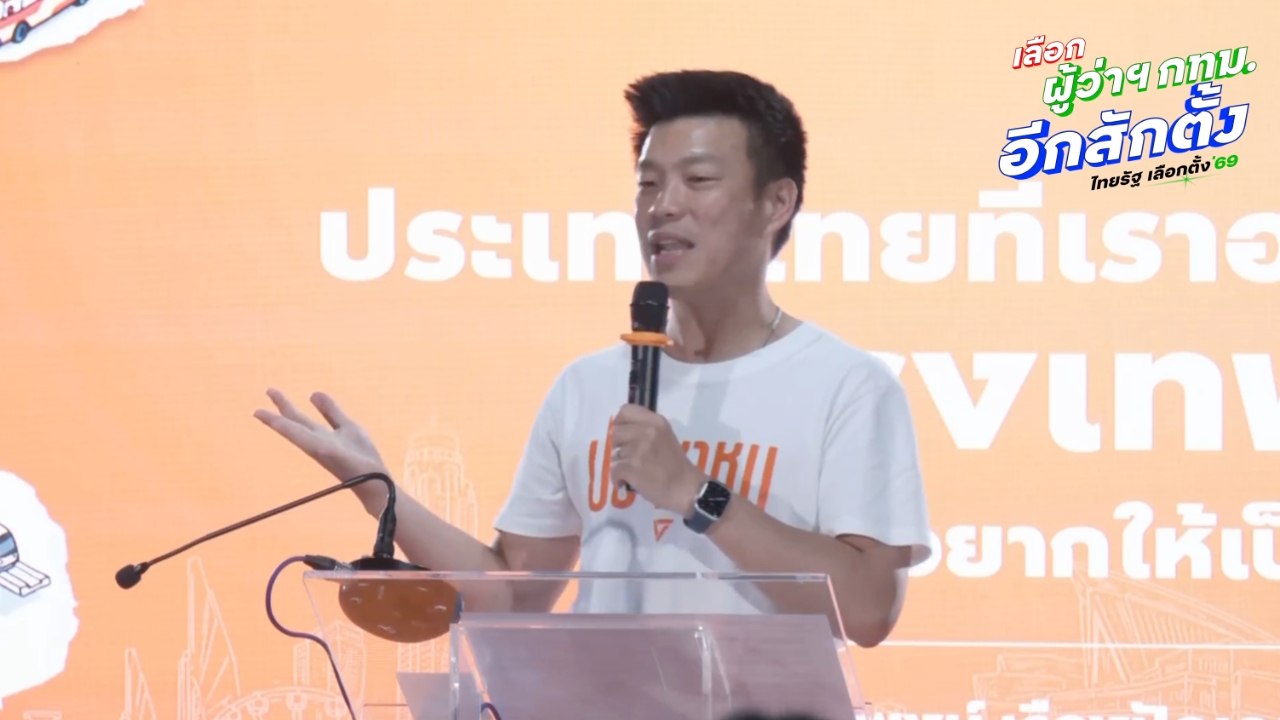
"Teng" points out that the Bangkok election is the People's Party's big dream, urging voters to choose Dr. Joe and party district council candidates to tackle extortion, overhaul the hundred-billion-baht budget system, and use digital tools more advanced than Traffy Fondue. He joked about microphone issues, likening its fragility to Thai politics, where a slight touch can lead to legal cases.
On 20 June 2026, Nattapong Rueangpanyawut, party-list MP and leader of the People's Party, spoke on "The Thailand We Want to See, The Bangkok We Want" at the City Cares Policy Fest at the Future Forward Building. He said that since their time in the Future Forward Party and Move Forward Party to now the People's Party, the most important thing has been "dreaming big." He cited a short phrase they have yet to fully achieve: "Make the highest power belong to the people."
We still have many big dreams already achieved, such as progressive alcohol laws, marriage equality, and ending compulsory military conscription. Currently, all political parties are moving in the same direction. Thus, over the past 8-9 years, even without being the administration, dreaming big, taking real action, and having the people alongside us have made everything possible.
The Bangkok local election is another big dream of the People's Party since the Future Forward era: to advance local politics and push city agendas and decentralization. For example, provincial administrative organizations (PAOs), municipalities, and subdistrict administrative organizations often have limited budgets—some only tens of millions, others hundreds of millions like Lamphun PAO. Budget constraints limit their power, but they can still deliver policies to the people.
Nattapong cited Lamphun PAO's success in providing school transport for low-income families and highlighted childcare centers, especially in Phuket and Pattaya, where parents work night shifts in the service sector but childcare centers operate only during office hours. Phuket PAO extended service hours to meet these families' needs. These small policies in local politics, achieved with modest budgets but dedication and attention to detail, have significantly improved rural people's quality of life.
Today, he poses a bold question to Bangkok residents: from a budget of just a few hundred million baht per year to a hundred billion baht annually, with full authority, if the People's Party and their candidate for Bangkok governor, Chaiwat Sathawornwijit, along with 50 district council candidates, are given a chance, how much change can we bring? How much can we improve the quality of life for Bangkokians?
In many foreign cities with more expensive land, like Singapore and Hong Kong, housing rents and purchase prices relative to monthly income are actually lower than in Bangkok. Yet, life in Bangkok is hard—people have insufficient money, incomes don't cover expenses, and debts accumulate. Policies successfully implemented in many localities give confidence that with power in hand today, we can do even more.
Making Bangkok a more caring city cannot be done by the governor alone. Basic problems like potholes, broken sidewalks, water drainage, poor lighting, and uncollected garbage are issues any governor must address. But there are bigger, less visible problems we feel daily.
Today, does Bangkok have the authority to enact progressive regulations and manage unfair concessions—from electric trains to the On Nut waste facility—and budget transparency? Although the governor has full authority to draft an annual 100-billion-baht budget, it must be approved by 50 district council members. If we cannot change the politics within the Bangkok Council or if budget approval involves conflicts of interest, how can we truly make the budget transparent? The invisible budget treadmill demands strong council power to drive change.
He has campaigned in over 20 districts, hearing merchants uniformly complain about difficulties in business, energy crises, economic stagnation, and extortion. Former governor Chadchart Sitthiphan also acknowledged the existence of municipal extortion. Should we allow this system to continue oppressing small people? If we want to create change and make Bangkok's bureaucracy more transparent, can a governor and a small executive team effectively manage all 50 district offices?
If we want change at the district level, transparent politics, and efficient bureaucracy, representatives elected by the people must manage it. Bangkok's political problems stem partly from district representatives not being elected, especially district directors who are appointed and hold the highest authority over local operations. If district directors are not linked to the people, who will earnestly monitor these issues? We must accept that bureaucratic climbing exists everywhere, with position fees and bribes extracted from citizens—this is normal and not to blame individuals.
"It is wrong yet normal in Thai society. The big question is: Do Thai people really want this? Do Bangkokians truly want this? If you want change, this is the opportunity."
Nattapong said that in the 28 June election, he does not want voters to choose merely the next city governor but to select a leader who can bring real change. One governor alone cannot transform Bangkok. A city leading change must have three qualities:
1. Clear political will, volunteering to serve the people without conflicts of interest.
2. A professional management team ready to work from day one after taking office.
3. District council members under their control to push progressive agendas through local politics.
Nattapong added that as a bonus, Chaiwat not only has these three qualities but also 119 fellow MPs ready to push legislation nationally to make Bangkok a more caring city. Additionally, there are four principles guiding city management:
1. Desire for transparency in national politics.
2. Desire for a democratic constitution.
3. Desire for an efficient bureaucracy.
4. Desire to make the ultimate power in the country belong to the people.
Nattapong said that if Bangkokians want a country embodying these four points, on 28 June he invites everyone to vote with the same will—to vote for change once again, to make the country transparent, bureaucracy efficient, to use digital tools beyond Traffy Fondue, and to make Bangkok a city that cares for its people, centered on citizens, with change starting from local politics.
A reporter noted that during part of Nattapong's speech, the microphone failed, forcing a switch to a handheld mic. Nattapong jokingly said, "Microphones are as fragile as Thai politics—just a slight touch and you face legal cases," eliciting laughter from the gathered supporters.