

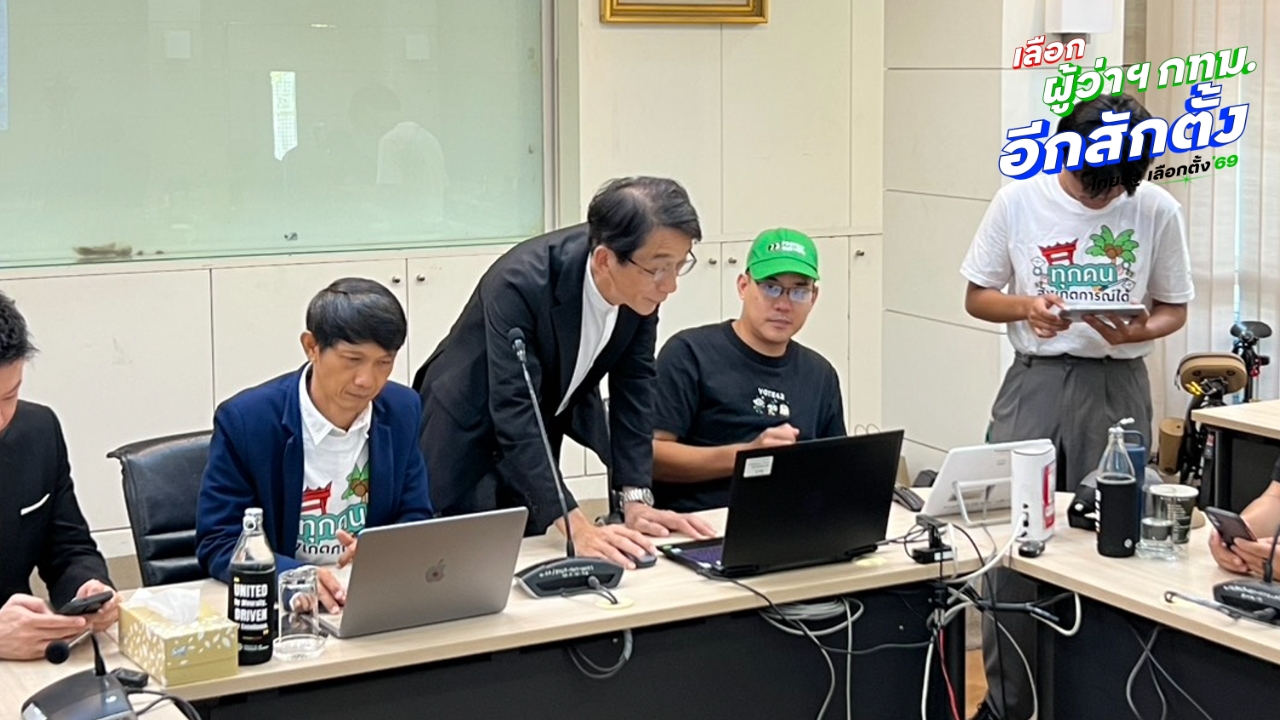
Civil society is calling for close monitoring of the Bangkok and Pattaya elections. "Parinya" asks everyone to join in observing the process, while "Somchai" laments that the Election Commission did not employ innovations, instead leaving the public to verify on their own.
On 21 Jun 2026, at the Jitti Tingsapath Conference Room, Faculty of Law, Thammasat University, Tha Prachan campus, civil society organizations held a press conference titled "Monitoring Transparency in the Bangkok and Pattaya Elections" scheduled for 28 June 2026.
Participants included Associate Professor Parinya Thewanaruemitkul from Thammasat University's Faculty of Law; Associate Professor Somchai Srisutthiyakorn, former EC commissioner; data scientist Thamthee Sukchotirat; Pongsak Chan-on from We Watch; Yingcheep Akkhananont of Vote62; and Ms. Kalyakorn Sunthornprak from iLaw.
Emphasizing principles of transparency and public participation.
Associate Professor Parinya said that the election on 8 February raised many questions about transparency and how to prevent such doubts in future Thai elections. Local elections, a special form, include provincial administrative organizations, municipalities, and subdistrict administrative organizations, with Bangkok and Pattaya holding special elections simultaneously. Therefore, civil society organizations like We Watch, iLaw, and their networks, which have observed multiple elections, have organized activities to oversee this election to restore transparency and public participation. Ensuring fairness means voters' rights are fully respected, and democracy amid diverse opinions is ultimately settled at the ballot box.
Thus, every ballot should be counted according to the voters' intent, and the tally should reflect the voters' decisions marked on the ballots. Winners and losers should be determined by the true choices of the electorate. However, when transparency issues arise and participation declines, questions emerge. Therefore, iLaw and We Watch have initiated this campaign to explore ways to ensure this election is transparent.
Focus on monitoring the Pattaya mayoral election.
Pongsak said many feel the campaign lacked meaningful debate, creative policy discussion, or constructive clashes of ideas benefiting the public. Instead, discrediting opponents to reduce their votes occurred, which does not advance competition or campaigning. This aspect should be improved. Regarding the Pattaya election, previous experiences show very low voter turnout at 49.96%, posing a challenge. Problems such as lost ballots or tampered ballots have occurred, even causing delays in counting and orders for re-elections in some polling stations.
Somchai expresses regret over lack of innovation.
Associate Professor Somchai said that comparing the Local Election Act with the general MP Election Act shows the local election law is more progressive. For example, the MP Election Act mandates only ballot papers, while the local election law allows various methods, such as ballot papers or electronic voting machines, to facilitate voter access. The EC should use the local elections as an opportunity to improve election management efficiency, review innovations for future general elections, prove transparency, enhance operational efficiency, encourage public participation, and enable rapid, effective result reporting. Instead, the EC chose not to seize this opportunity, stating they would make the best of the Bangkok and Pattaya local elections but leaving it to private and civil society sectors to handle.
Reiterating that all Thais are owners of the election.
At the end of the press conference, Associate Professor Parinya said that all citizens own the election and should jointly observe it to prevent fraud. Various tools are available, including photography, video recording, and AI assistance. Importantly, election observers should raise objections if they notice irregularities during vote counting, such as unclear tally boards or tally boards placed too far away, to ensure transparency and accuracy.