

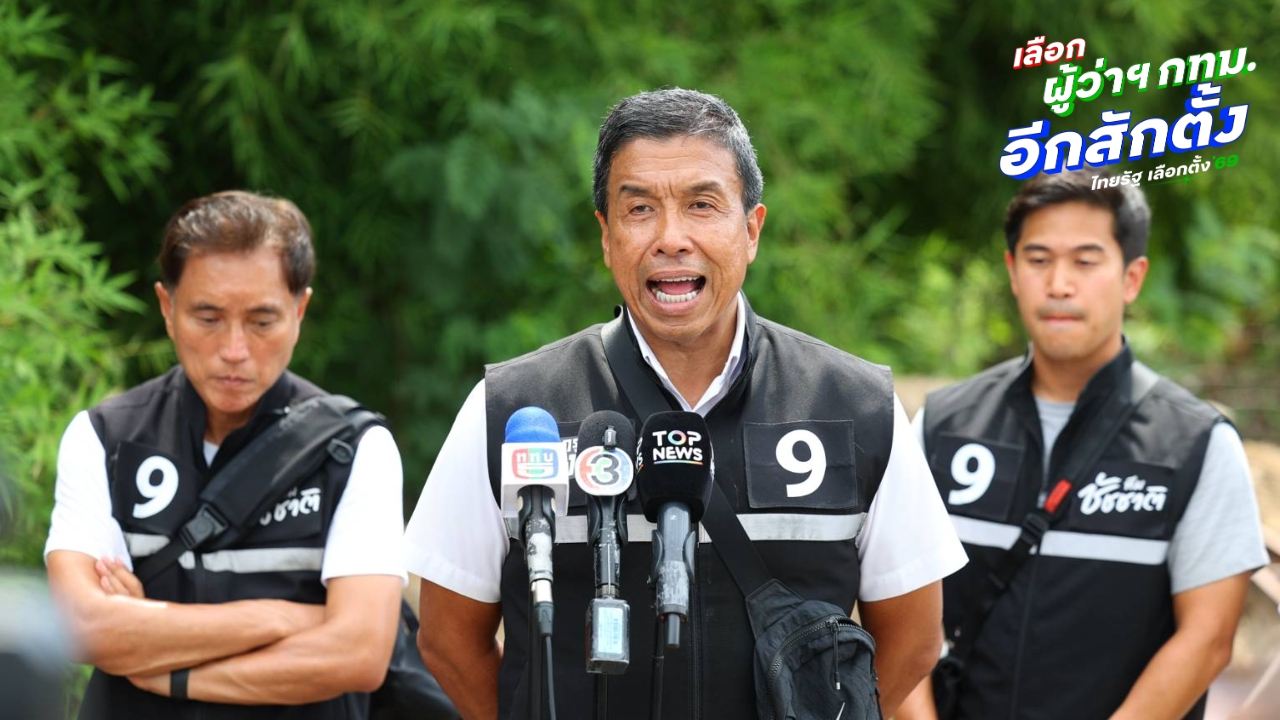
Chadchart, candidate for Bangkok governor, campaigns in four districts to motivate farmers to reduce burning and address PM 2.5 pollution at its source, continuing the mission to restore clean air after successfully reducing burning hotspots in Bangkok by 44%.","tags":["Chadchart","Bangkok governor election","PM 2.5 pollution","agriculture burning reduction"]
21 June 2026 GMT+7","tags":["date"] Mr. Chadchart Sithiphan, candidate for Governor of Bangkok,"tags":["Chadchart Sithiphan","Bangkok governor candidate"] along with the Bangkok Working Team, campaigned in Saphan Sung, Khlong Sam Wa, Nong Chok, and Min Buri districts, presenting policies to tackle PM 2.5 by reducing agricultural burning. The "Dust Detective Project" data shows that biomass burning is a major source of PM 2.5 pollution in Bangkok."tags":["campaign","PM 2.5","agriculture","biomass burning"]
At the Khao Chao Nakhon Kao Klai Rice Center in Nong Chok district, Chadchart said,"tags":["Khao Chao Nakhon Kao Klai Rice Center","Nong Chok","Chadchart statement"] Bangkok has never been complacent and has worked to control burning within the city, successfully reducing hotspot occurrences by 44%. It also monitors agricultural areas in nearby provinces like Nakhon Nayok and encourages farmers to change behaviors, such as lending free straw balers and researching plant varieties, which has led to zero burning incidents, effectively reaching zero hotspots."tags":["Bangkok","burning control","hotspot reduction","agriculture"]


Moving forward, solutions will focus on sustainable root-cause approaches, cooperating with neighboring provinces to promote burn-free production. The plan supports farmers comprehensively by lending tractors and straw balers, distributing and encouraging the use of microorganisms to decompose rice stubble and straw, with free inoculants provided by the Department of Agriculture and the Land Development Department. Technology such as waterless microorganisms is also used to eliminate stubble. Real-time hotspot monitoring via NASA Firm data combined with the Environmental Office is in place, with district offices promptly intervening to stop any detected burning."tags":["sustainable solutions","neighboring provinces","farmer support","technology","monitoring"]
Simultaneously, the focus is on educating farmers about making compost and fermented microbial liquids from rice straw. The Bangkok G standard is promoted to brand "No Burn Farm" products, with Farmer Markets arranged in public parks where farmers can directly sell their produce."tags":["education","composting","Bangkok G standard","Farmer Market"]
A key highlight of this campaign is the announcement of the establishment of a “Comprehensive Burn Monitoring and Farmer Assistance Center,” which will systematically manage real-time hotspot tracking and alerts, regulate burning times when necessary to minimize urban impact, coordinate personnel and equipment to suppress fires in vulnerable areas, and gather evidence to enforce laws against illegal burning. This center will also connect markets to add value to burn-free agricultural products, coordinate the purchase of compressed straw for processing to provide alternative income for farmers, and aim to develop sustainable agricultural practices."tags":["Burn Monitoring Center","fire suppression","law enforcement","market linkage","sustainable agriculture"]
"Last year, the number of days with excessive dust in this district dropped by 50%. I believe our approach to managing PM 2.5 among farmers is on the right track," Chadchart said."tags":["air quality improvement","Chadchart statement"]


Chadchart added that during this visit, feedback from residents in agricultural areas like Nong Chok raised concerns about water management, a crucial aspect of farming. Water issues here include water needed for dry-season farming and drainage during rainy seasons. Bangkok has initially addressed this by building check dams to store water effectively, but drainage during the rainy season remains inadequate, leading to polluted water problems."tags":["water management","agriculture","Nong Chok","drainage issues"]
A major challenge in managing water gates is equipment loss, such as the 'pulley' of the check dams, which cannot be left installed because of frequent theft. Staff must remove and store them elsewhere, causing delays in opening and closing water gates. Additionally, stored water often becomes polluted, severely affecting residents in areas without piped water who rely on natural sources for daily use."tags":["water gate management","equipment theft","water pollution","community impact"]
"One problem is that the pulleys for water gates cannot be left in place due to theft, so staff must remove them, causing delays in managing water gates. Residents also report that stored water becomes polluted, especially in areas lacking piped water, making it unusable for daily needs. I believe the key is managing water to align with the lifestyles and needs of each community," he said."tags":["water management challenges","community needs","Chadchart statement"]


Additionally, under the 'Bangkok and Beyond' concept, the “Chadchart Team” policies cover other pollution sources, such as expanding Low Emission Zone (LEZ) measures to include four-wheel pickups and old diesel vehicles, partnering with the Department of Industrial Works to set up a War Room monitoring emissions through real-time CEMs systems, establishing a dust detective team, and developing a “Super Station” advanced air quality monitoring station for in-depth real-time dust analysis to improve forecasting accuracy."tags":["Bangkok and Beyond","LEZ expansion","emission monitoring","dust detection","air quality"]
"One main cause of PM 2.5 pollution is vehicles, so we need stricter controls on pickups as well. Until now, the Low Emission Zone has only covered six-wheel vehicles, but in the future, it will expand to pickups and diesel vehicles that emit toxic smoke," he added."tags":["vehicle emissions","LEZ policy","Chadchart statement"]
The Bangkok Working Team is also preparing to implement the Clean Air Act by launching plans within 60 days after the law's enactment, alongside proposing a Bangkok Clean Air ordinance to the Bangkok Metropolitan Council. This aims to collect fees from all polluters—vehicles, factories, or illegal burners—to concretely restore clean air for Bangkok residents."tags":["Clean Air Act","policy implementation","pollution fees","Bangkok Metropolitan Council"]}]}