

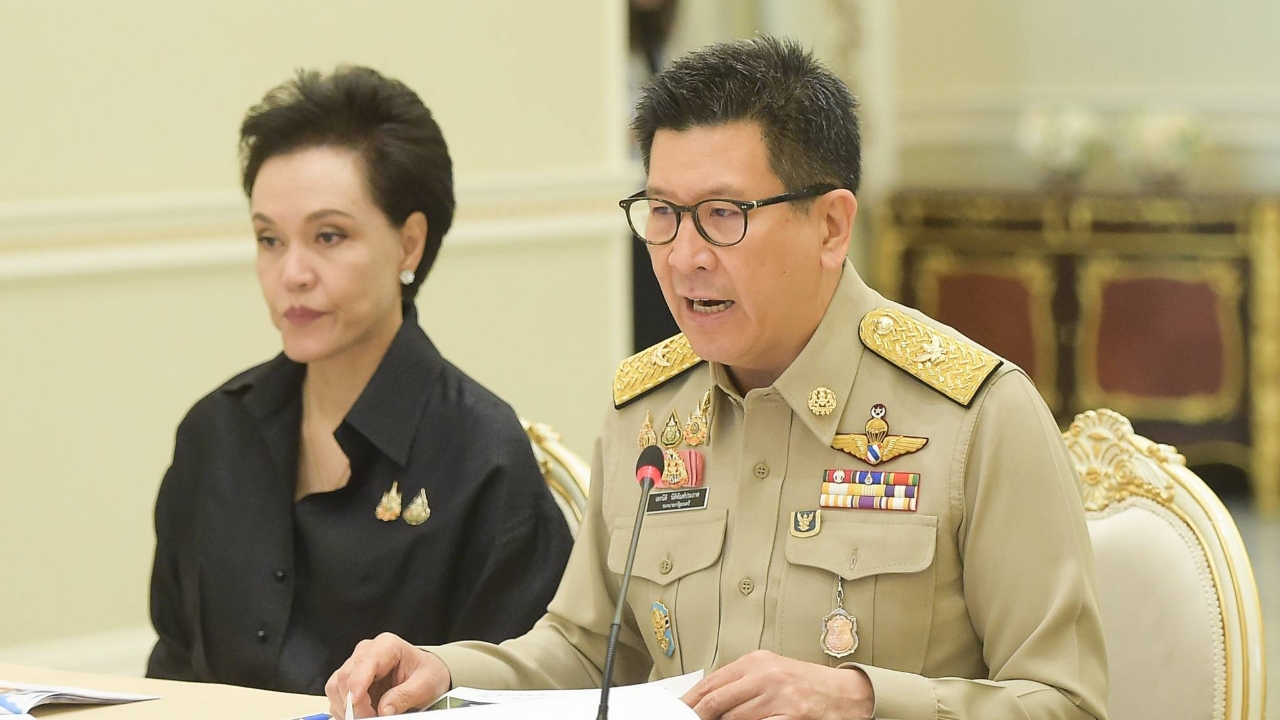
Deputy Prime Minister Akniti announced at the first NSC meeting the adoption of a major 12-year economic roadmap aimed at elevating Thailand to a high-income country. The plan aims to place Thailand in the global Top 20 competitiveness rankings by 2030, accelerating efforts around four key pillars and seven strategic industries.
22 Jun 2026 GMT+7 Mr. Akniti Nitithanprapas, Deputy Prime Minister and Minister of Finance, . . . disclosed the results of the first meeting of the National Steering Committee (NSC) for economic problem-solving, noting that at this inaugural meeting, there was a consensus to set a long-term goal of driving Thailand to become a high-income country within 12 years.
In the medium term, the goal is to elevate Thailand’s competitiveness to be among the world's Top 20 by 2030 and to increase the country’s potential economic growth rate above 3% (currently at 2.7%). To achieve high-income status in the future, potential growth may need to reach 5–5.5%.
Mr. Akniti added that today's NSC meeting emphasized teamwork between public and private sectors. The plan includes four layers: the 'defense' layer focuses on fiscal discipline and economic stability to build investor confidence amid global volatility. Despite recent fluctuations in some countries’ financial markets over the past 7–8 months, Thailand remains strong with stable credit ratings due to solid fundamentals. The 'midfield' or infrastructure layer aims to ensure sufficient electricity and water, accessible clean energy, AI readiness, clear laws, and a skilled workforce to support the 'offense' layer in generating targeted income.

The 'offense' layer focuses on seven main sectors in which Thailand is strong and will support moving forward:
1. Agriculture and Food
2. Automotive, leveraging Thailand’s strong production base to transition toward future vehicles
3. Electronics and Digital
4. Pharmaceuticals and Health
5. Tourism
6. Trade
7. Creative Economy
Regarding implementation, the economic drive is based on four pillars:
Pillar 1: New investment. Within four years, the investment ratio aims to approach 30% of GDP, up from the current 22%, which would significantly boost economic potential. Key initiatives include:
1. Future Investment Hub FastPass, solving issues with a single registration process
2. AI and Digital Hub
3. Financial Hub
4. Green Hub
5. Smart Automotive Hub

Pillar 2: Trade and Services, including:
1. Tourism and Wellness Hub
2. Agriculture and Food Security
3. Creative Economy
4. Retail and Wholesale
5. International Trade
Pillar 3: Human Capital,
1. Strategic R&D for New Growth Engines
2. STEM and Future Workforce Platform
3. Innovation and Startup Hub
4. Skill Acceleration for Existing Workforce
5. AI Literacy and AI Manpower Development
Pillar 4: Public Sector Efficiency, comprising:
1. Digital Government
2. Ease of Doing Business
3. Increased Transparency
4. Public Sector Restructuring
5. Public Asset Management
"All four pillars have assigned tasks, prioritizing Quick Big Win and Big Win initiatives that positively impact the economy. These will be presented next month. Thailand has long-standing structural issues, so the focus is on Big Win projects driven by all four pillars. Our clear goal is to boost competitiveness into the Top 20 by 2030 by removing obstacles and accelerating toward this target," he said.

Meanwhile, Mr. Danucha Pichayanan, Secretary-General of the National Economic and Social Development Council (NESDC), added that Thailand’s current average income per capita is $8,000–9,000, while high-income countries average around $15,000. "We believe Thailand’s per capita income will rise over the next 12 years, but whether it reaches high-income status depends on maintaining higher economic growth. High-income countries currently average $15,000 per capita, and that will increase further in 12 years. It is up to us to grow the economy sufficiently to raise our per capita income continuously," he said.
At the same time, Deputy Prime Minister and Minister of Commerce, Mrs. Supachai Sutthaman, stated that the global trade environment is rapidly changing, requiring the government and related agencies to urgently adjust economic policies. The focus is on proactive goals in trade, exports, agriculture, and tourism, with clear results expected within four years.
"Our aim is to become a free trade hub with key FTAs, such as those with Europe and the United States, and ongoing negotiations with countries like Canada and the United Kingdom. This will diversify Thailand’s export markets to reduce reliance on any single country and promote balanced exports over the next four years," she said.
Currently, Thailand has over 30,000 exporters, but main income is concentrated among about 7,000 large businesses, while over 22,000 SMEs have not fully realized their revenue potential, with some even operating outside the formal system. The government plans to adjust strategies to distribute income and growth opportunities more equitably to SMEs and communities within four years.

To address income distribution in agriculture, the approach is divided into two phases:
Short-term: Address oversupply and mismatched production issues, while implementing relief measures to ease farmers’ burdens.
Long-term: Restructure the agricultural sector focusing on processing and upgrading products to meet global market demands, opening new markets to position Thailand as a regional and global "Food Security Hub" within four years.
In tourism, a significant shift will occur from focusing on visitor numbers to promoting high-value, quality, and sustainable tourism. Future efforts will involve integrated collaboration across ministries, emphasizing safety and showcasing Thailand’s strengths, combined with high-value economic sectors such as gastronomy and community economy to ensure income spreads to local areas.

Deputy Prime Minister Mr. Pakorn Nilprapunt revealed plans to expedite revising laws that hinder business operations. A list of urgently needed legal reforms will be proposed to shift the government’s role from regulator to inspector and facilitator, enabling the private sector to operate more flexibly and generate greater national income. Some reforms have already begun.
Moreover, regarding public asset management, the Prime Minister has ordered expedited improvements to procurement laws to enhance efficiency. This is a crucial mechanism to ensure government budget spending flows directly and effectively into the economy at a faster pace.

. . . Deputy Prime Minister and Minister of Higher Education, Science, Research, and Innovation (MHESI), Mr. Yotsanan Wongsawat, stated that investment promotion strategies emphasize the urgent need to develop the country’s workforce, as attracting foreign investment depends on having skilled labor ready.
Workforce development will focus on high-level skills to support new industries establishing production bases, enable adaptation of existing workers by improving productivity, and build foundational AI knowledge nationwide. There will also be efforts to cultivate advanced AI talent to support future industry transformations.
The meeting approved appointing four subcommittees as follows:
1. Subcommittee on New Investment Development, chaired by Deputy Prime Minister and Finance Minister Akniti Nitithanprapas.
2. Subcommittee on Trade, Tourism, and Community Economy Development, chaired by Deputy Prime Minister and Minister of Commerce Supachai Sutthaman.
3. Subcommittee on Human Resource Enhancement and Technology Development, chaired by Deputy Prime Minister and Minister of Higher Education, Science, Research, and Innovation Yotsanan Wongsawat.
4. Subcommittee on Business Facilitation Development, chaired by Deputy Prime Minister Pakorn Nilprapunt.
The NSC instructed all four subcommittees to determine their membership and responsibilities as appropriate, submit to the secretariat for further procedures, and develop strategic implementation priorities, including Quick Big Win and Big Win initiatives, along with targets, indicators, and action plans. Progress reports are to be submitted to the NSC every two months.