

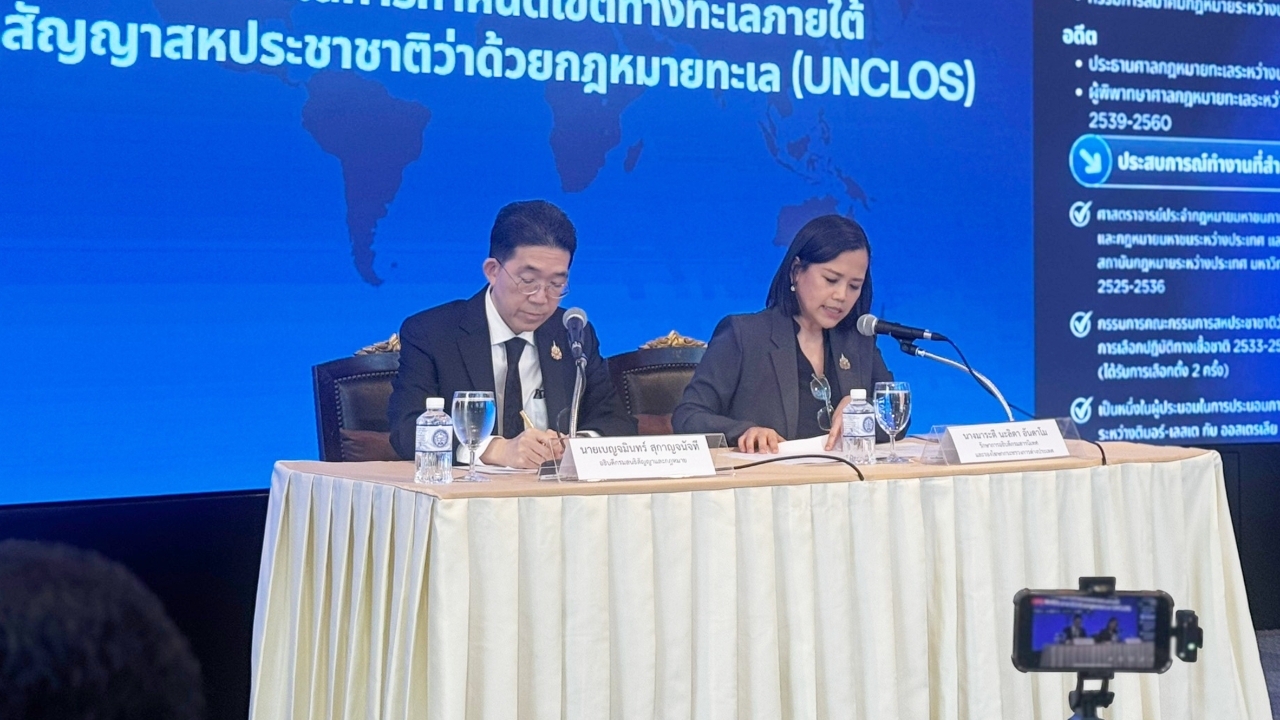
The Ministry of Foreign Affairs explained that Thailand has entered into the compulsory conciliation process regarding the maritime boundary between Thailand and Cambodia under the UNCLOS treaty. It emphasized that this is not a court proceeding and hopes to peacefully and sustainably resolve the maritime boundary dispute.
On 22 June 2026, Ms. Maratee Nalita Andamo, Acting Director-General of the Information Department and Deputy Spokesperson of the Ministry of Foreign Affairs, together with Mr. Benjamin Sukanjanajati, Director-General of the Department of Treaties and Legal Affairs, jointly held a press briefing on the matter. Thailand has agreed to participate in the conciliation process concerning the delimitation of maritime boundaries under the United Nations Convention on the Law of the Sea, 1982 (UNCLOS).
Ms. Maratee stated that on 19 June, Thailand officially sent a letter to Cambodia accepting participation in the compulsory conciliation process under UNCLOS, following Cambodia’s initiation letter dated 2 June 2026. The summary of Thailand’s letter to Cambodia is as follows: First, Thailand reaffirmed its objective is solely to delimit the maritime boundary. Second, Thailand appointed two representatives for the conciliation process: Mr. Sihasak Phuangketkaew, Deputy Prime Minister and Minister of Foreign Affairs, as the principal representative, and Mr. Songchai Chaipratiyut, Ambassador to Kuwait and former Deputy Director-General of the Department of Treaties. Thailand also named two conciliators chosen to serve on the Conciliation Commission: Mr. Albert J. Hoffman from South Africa and Mr. Rüdiger Wolfrum from Germany. Both are judges with widely recognized expertise in maritime law and international law.
Following the 30-day period from the submission of Thailand’s letter to Cambodia, by mid or late July, the four conciliators from Thailand and Cambodia will jointly select a fifth conciliator to serve as Chairperson of the Conciliation Commission. The process will then take 12 months or longer if both parties agree to an extension. The conciliators will prepare a report based on consultations, considering the perspectives of both countries and interpreting relevant international law, maritime law, and maritime boundary disputes. The report will include recommendations for the parties to consider. These recommendations are non-binding but serve as guidelines for negotiations toward a mutually acceptable resolution, aiming to return to Thailand’s preferred approach of bilateral negotiations.
She emphasized that conciliation is not a court proceeding. The conciliators are not advocates for either party but neutral mediators who listen to both sides, understand the context and origins of the dispute, and seek a balance between the parties. The outcome is not a legally binding judgment but a set of recommendations acceptable to all involved. As a responsible member of the international community that respects international law and global norms, Thailand decided to engage in conciliation under UNCLOS. The Ministry of Foreign Affairs and related agencies are fully prepared to perform their duties professionally, prioritizing national interests, and will provide transparent progress reports regularly.
“Thailand participates sincerely and hopes the conciliation process will help both countries peacefully and sustainably resolve the maritime boundary dispute in the future.”
Regarding questions about the 2001 Memorandum of Understanding (MOU) that stipulated benefit-sharing discussions must proceed alongside land boundary talks, and how the compulsory conciliation will operate, Mr. Benjamin explained that the 2001 MOU required joint delimitation of maritime boundaries in overlapping areas. However, over the past 25 years, there was no progress because Cambodia prioritized joint development. Legally, if the upper boundary line is unclear, it will affect the clarity of the lower joint development area.
Thailand canceled the 2001 MOU due to differing priorities and because Cambodia had become a party to UNCLOS, which focuses primarily on maritime boundaries. Joint development in overlapping areas is a subsequent condition after delimitation. Both sides may have legally and academically valid but differing views, making lower-area delimitation difficult. Thailand emphasizes completing maritime boundary delimitation to avoid leaving overlapping areas that could cause future development issues, focusing mainly on maritime boundary division.
The compulsory conciliation process remains bilateral but includes a third party. Discussions are expected to conclude within one year. If delimitation is achieved, a separate agreement will be signed. Upon completion, the process must be presented to the Cabinet and Parliament because it involves sovereign authority.
When asked about concerns that Thailand might be disadvantaged due to political factors in the Thailand-Cambodia border dispute and how Thailand will ensure political interference does not affect the process, Mr. Benjamin stated that conciliation is a global process. Attempts to manipulate or pressure through international politics are inappropriate. He believes the conciliators from both sides will remain mindful of this.
The Conciliation Commission comprises globally recognized experts who will not jeopardize their reputations. The Timor-Leste case serves as an example studied by international law scholars. Therefore, there is confidence that political interference will not influence the conciliators. Participating countries act in good faith. From his perspective, attempts to create international media hype are unproductive and may discomfort the conciliators, who have the right to issue warnings. This process, known since joining UNCLOS, involves shared obligations and trust in compulsory conciliation, which Thailand chose over court proceedings. He emphasized that the 12-month process may not conclude definitively but may produce useful recommendations to guide future bilateral negotiations, which he views as a positive first step.
Mr. Benjamin added that it is not straightforward to say whether Thailand gains or loses in compulsory conciliation. Online media show both sides trying to claim as much as possible, but ultimately a reasonable and realistic boundary line must be drawn. This is not about winning or losing but about mutual success through a clear boundary line. For 25-26 years, both sides have been unable to fully utilize maritime resources. He believes both sides will ultimately benefit. Thailand has prepared evidence including historical data, negotiation records, international law developments, and expert consultations. Thailand has also engaged foreign legal advisors and has its own mapping experts. He urged confidence that Thailand will do its best.
However, if land-related issues arise during the conciliation process, Mr. Benjamin explained that maritime dispute conciliation is separate from land disputes or other relations. On the contrary, he believes successful maritime delimitation will promote other aspects of the bilateral relationship. Thailand is ready to engage in this process.