

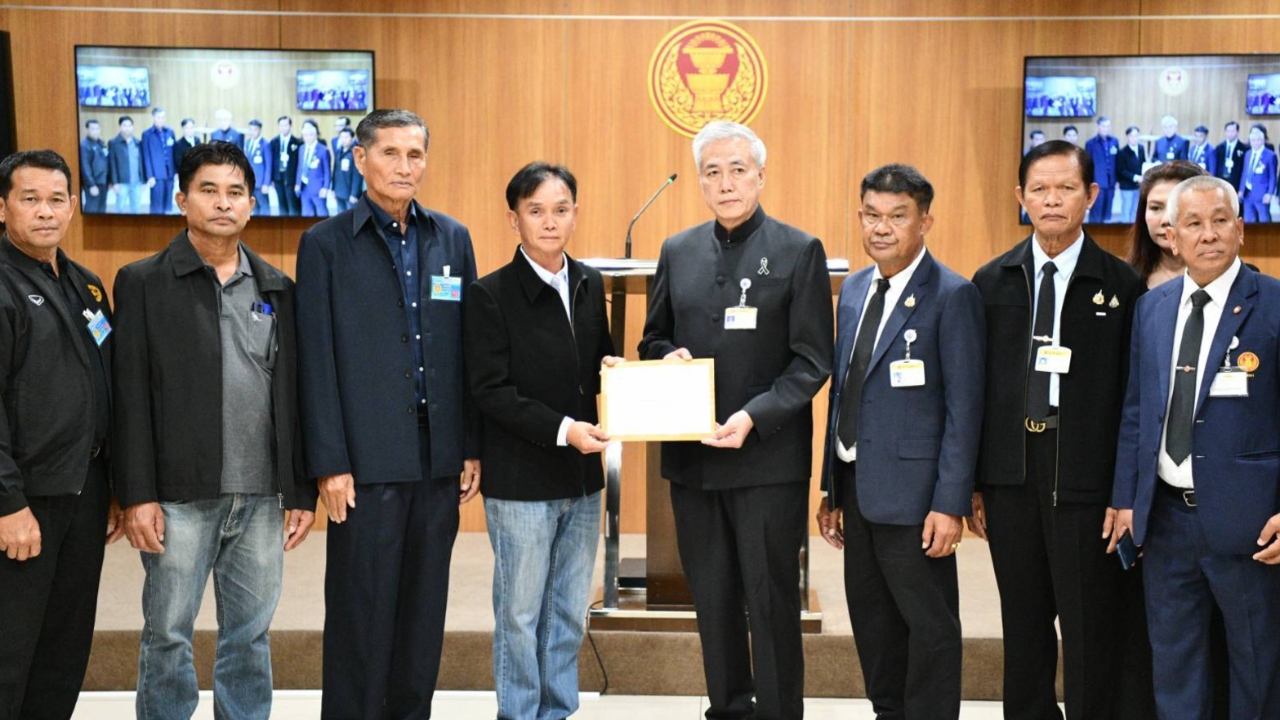
The dairy cooperative network appealed to the Senate Agriculture Commission opposing the new Dairy Bill draft, fearing it would enable corporate domination of Thailand's dairy industry. Meanwhile, Senator Sarenai criticized two department chiefs for abandoning dairy farmers and siding with private companies, declaring he would buy a tin can to cover his head.
On 23 June 2026 at the Parliament, Mr. Sunthon Chaokitcha, Chairman of the Senate Agriculture and Cooperatives Committee, received a letter from the dairy cooperative network, including Takfa Agricultural Cooperative Ltd. from Nakhon Sawan, Thai-Denmark Dairy Cooperative Union Ltd. from Saraburi, Nong Pho Ratchaburi Dairy Cooperative Ltd. (under royal patronage) from Ratchaburi, and representatives from agricultural educational institutions. They submitted a letter opposing the new Dairy and Dairy Products Bill draft, approved by the Senate on 22 June, particularly objecting to the Milk Board's committee composition, mostly from the private sector. They also requested fairness in school milk quota allocation and assistance addressing raw milk production issues faced by dairy farmers.

Mr. Theerachai Kriangkraiwekin, Chairman of the Thai-Denmark Dairy Cooperative Union and representative of dairy farmers, stated that the cooperatives represent over 3,000 families. The Dairy Farming Promotion Organization of Thailand (DPO) announced it could no longer buy excess raw milk beyond the MOU agreement, about 80-90 tons daily, affecting farmers nationwide. The main cause is the economic slowdown reducing production, combined with a cut in school milk quotas from the requested 265 tons to only 90 tons per day. Currently, DPO buys about 400 tons of raw milk daily. Without increased school milk quotas, farmers must sell raw milk at prices lower than quota milk, resulting in a monthly loss of 4-5 million baht, accumulating over 50 million baht. They demand the government restore fairness in school milk quota allocation to DPO to stabilize the dairy profession and reduce farmers' impact.

Mr. Sunthon said he would take the matter under consideration, inviting relevant agencies to meetings to discuss solutions for farmers' hardships within the committee's authority. He plans to use the issues raised to develop policy proposals for the government to provide concrete and sustainable support for farmers.
Senator Sarenai Anilaboon stated that dairy farmers came seeking help and urged the Senate Agriculture Committee to reconsider the issue. The committee chairman has accepted the case for further discussion. The bill was passed by the Senate on 22 June and now must be submitted for royal endorsement and promulgation. However, if the 11 articles are allowed to stand as passed, dairy farmers will petition, as dairy farming is a royal-granted occupation established by King Rama IX for the benefit of youth and Thai farmers. Allowing this bill to become law would destroy the system and cause the profession to vanish from the country in the future.
Senator Sarenai said the current major problem stems from the Milk Board's administration, composed of operators with vested interests in the milk business. This has resulted in policies favoring private capital groups for a long time. Recently, trade liberalization has allowed powdered milk imports at zero tariff, costing as little as 15 baht per kilogram, which is diluted, packaged, and promoted at cut-rate prices. Meanwhile, 100% pure raw milk from Thai farmers and DPO is restricted and quota rights are revoked. Currently, DPO and cooperatives like Nong Pho hold massive raw milk stocks with no storage space and carry debts totaling 6-7 billion baht.


The school milk program, with a budget of 1.4 billion baht annually, suffers from flawed benefit allocation, causing disputes among influential groups. As a result, many students have not received milk as scheduled after the school term began. When public pressure arose, the government resorted to distributing 'paper milk' or retroactively issuing claims that children had consumed milk for reimbursement, but in reality, they did not. This manipulation harms both the state and youth.
"The school milk program is a public service. Now DPO and Nong Pho Cooperative have surplus milk stocks. Why is the Ministry of Agriculture hesitant to decide to allocate budget to buy milk from Thai cooperatives for children during the first three months when quotas remain unsettled? They fear harming private companies, even though those companies have been wealthy for decades due to preferential policies," he said.
Senator Sarenai also criticized the Department of Livestock Development and Department of Cooperative Promotion for focusing intensely on inspecting small farmers and local cooperatives to find grounds to cut quota rights, while lacking the capacity to inspect large private factories. Often, advance warnings are given, raising suspicions of collusion and shared benefits. If this continues, local cooperatives will gradually collapse, and DPO or the Red Cow brand, symbolizing the royal-granted profession, will disappear. Thailand will then rely entirely on imported powdered milk despite having the capacity to produce domestically.
"I am disappointed with the heads of the Department of Livestock Development and Department of Cooperative Promotion. Today, will they still stand with the people, or facilitate private companies while neglecting the farmers they helped nurture? They have failed to support cooperative groups to receive fair treatment. This is now a national issue. If these two departments cannot perform, I will buy a tin can to wear on my head and no longer face the farmers," he concluded.