

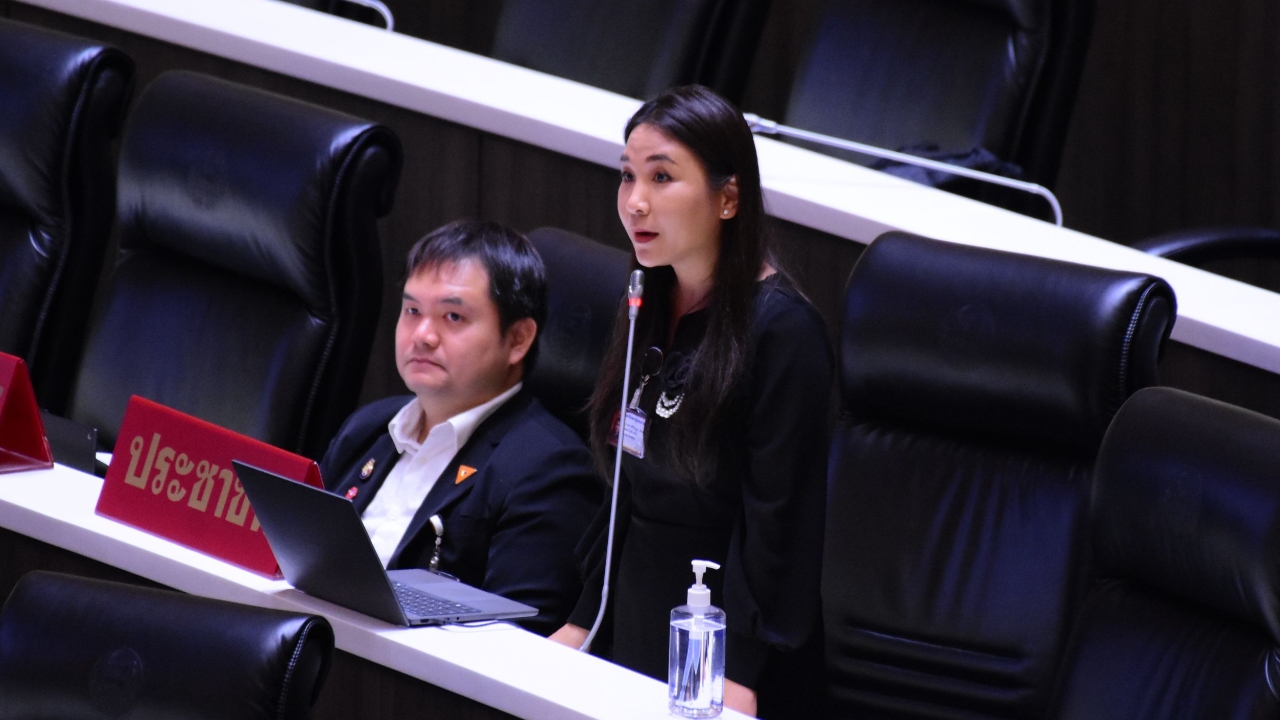
Sirikan pointed out that transferring a 10-billion-baht budget reflects the government's fragile financial condition, struggling to make ends meet. It signals a Treasury crisis beginning, causing disruptions in government spending. She questioned whether the budget reallocation serves the country or merely props up the government itself.,
On 25 June 2026, during a House of Representatives session considering the 2026 Budget Transfer Bill amounting to 10.328 billion baht, Sirikan Tanakul, a party-list MP from the People’s Party, participated in the debate. She stated that budget transfers or reallocations before borrowing are not unusual in a crisis. However, this bill does not address such a crisis; rather, it prepares the budget to support the government’s own crisis, reflecting its severe financial problems, struggling to make ends meet, and having to gather every baht to cover looming debt obligations.
“I previously warned the government that this budget transfer might not be worthwhile because it occurs in the third quarter of the fiscal year, leaving little time to use the budget. Prior to that, the government aggressively accelerated disbursements during the first three months, particularly for training and seminars. By the end of March, when the first budget transfer bill was issued, spending rates had already exceeded 60%."
Sirikan continued that these events caused chaos among budget-receiving agencies. The Comptroller General’s Department circulated directives urging completion of debt commitments by 30 April; otherwise, remaining projects would have their budgets transferred away. Many agencies rushed; some failed to keep up and gave up, delaying spending to see if their budgets would be pulled. This caused the first round of government disbursement stoppage.
Later, the government feared that accelerating the budget transfer law before approving the 2027 budget might require repaying the 2025 treasury advances, delaying the transfer schedule further. The entire bureaucracy entered a waiting period, causing a second disbursement halt. Consequently, the transfer target dropped from 80 billion baht in April to 50 billion by late April, then to 20–30 billion baht, and finally only about 10 billion baht by the time the bill reached the House.

Sirikan said the government must continue because it lacks funds. The central contingency budget, which the prime minister claimed was exhausted, was actually not fully used for crisis support—only about 3 billion baht was approved for that. This transfer is to cover debts not from borrowing but from unpaid obligations to contractors or litigants, such as nearly 10 billion baht for the Orange Line Skytrain debt and nearly another 10 billion baht for Klong Dan compensation due to litigation. Additionally, funds must be prepared for disasters, border security, and numerous other obligations.
According to the cabinet’s explanation to the Constitutional Court on issuing a 400-billion-baht loan decree, 140 billion baht was to repay debts. However, the Budget Bureau recently reported outstanding debts of only about 50 billion baht. The cabinet must clarify the exact amount of unpaid debts nationwide lacking budget coverage, yet the bureaucracy has repeatedly been disrupted by alternating acceleration and halts.
Sirikan continued that the 2020 budget transfer during the COVID-19 crisis was justified and managed to mobilize over 88 billion baht because the 2020 budget was delayed by six months and principal debt repayments were reduced. But in 2026, with no comparable extraordinary crisis, it is unsurprising that only about 10 billion baht could be transferred.
“Prioritizing new projects during a crisis is crucial for pre-borrowing reallocations. But within this 10 billion baht, 93% of the transferred budget is investment expenditure. If about 9 billion baht circulated in the economy, it would create greater economic multipliers than distributing cash or programs like Thai Ruay Thai Plus 60/40, which have been overused. Yet the government has cut a large portion of investment spending, mostly by postponing project installments due to procurement delays. This indicates the government does not prioritize budget reallocation properly.”
Sirikan added that ironically, while citing the need to reserve funds for future disasters, the government cut 1.033 billion baht from the Integrated Water Resource Management Plan and hundreds of millions from the Disaster Management Plan under the Department of Public Works. Moreover, projects without contracts before 2 June were not reduced despite being inappropriate from the start. The government also did not touch budgets of courts or independent agencies, which were not transferred at all.
During the 2026 budget debate, many problematic projects were identified, such as the Office of the Attorney General’s construction projects with contract management and delayed disbursements that could have been postponed to reclaim large sums, or the personnel development center (actually the NACC’s sports center). This raises serious doubts about whether the government genuinely reprioritized or merely drew funds from agencies that allowed it and postponed installments, avoiding ineffective expenditures.
“In a crisis like this, we see no leadership from national leaders prioritizing new allocations when facing a crisis. They lack foresight and good financial and fiscal management, waiting for debts to balloon before scrambling for money, backed into a corner needing every baht in this lump sum, yet unwilling to cut unnecessary items or prioritize properly. This reflects that the 10 billion baht budget transfer is just to help the government juggle finances, while the country pays with halted government disbursements,” Sirikan said.
Sirikan stated that compared to debt obligations exceeding 140 billion baht, none related to energy or economic crises, the transferred budget is less than 10% of what is needed to service debt. This budget transfer is not only inefficient but also a clear warning sign. If this government were a private company, it would have severe financial problems, cash flow shortages, and huge debts to suppliers and litigants, not even from borrowing.
Unfortunately, the House cannot amend this budget transfer law because of Constitutional Section 144: reducing or increasing budget items is considered an increase, while cutting inappropriate projects and adding others also counts as an increase. Thus, no changes can be made to this budget transfer bill.
“Nonetheless, I still insist the House must scrutinize this budget transfer bill thoroughly, even if no amendments are possible. At minimum, observations about inappropriate actions should be recorded so the House can fully exercise its authority when approving the 2026 budget bill. If any changes occur, it should be the House’s prerogative to approve them.”