

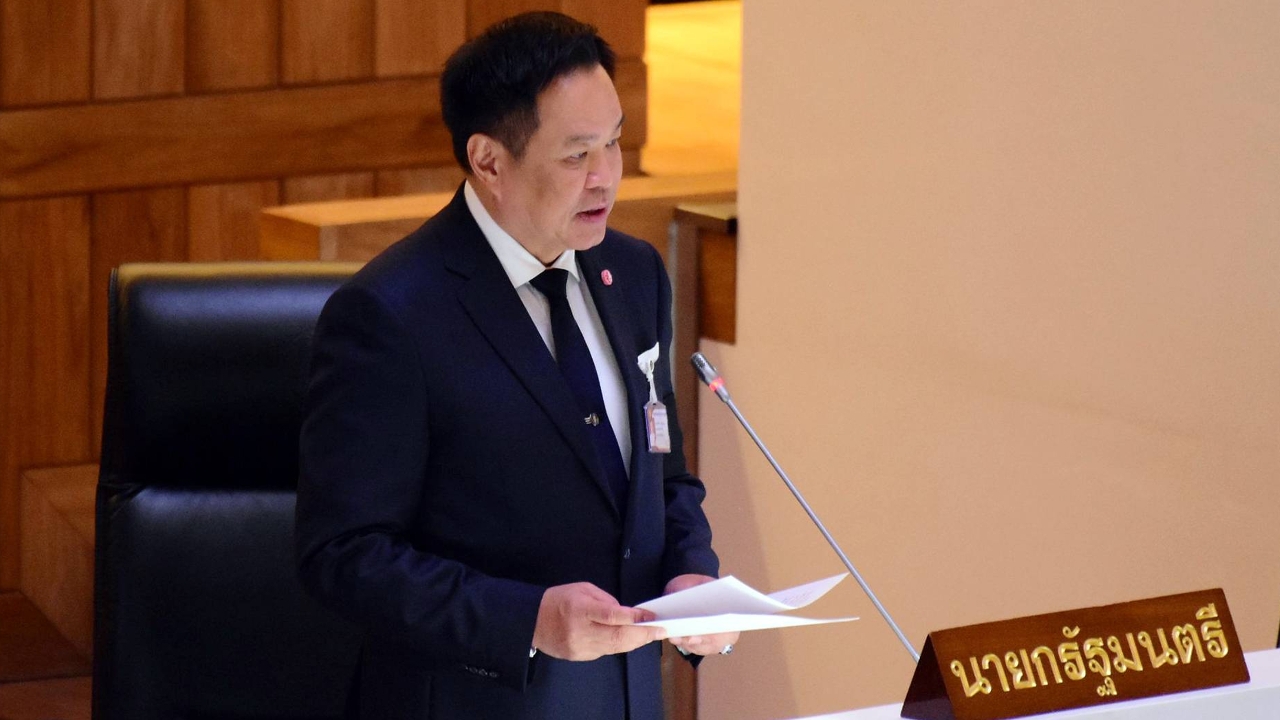
The House of Representatives voted to approve the 2026 budget transfer bill. The Prachachat Party criticized the lack of prioritization, while Akniti affirmed that the leftover funds allocated to the central budget act as a reserve fund to handle crises.
At 09:30 on 25 June 2026, the House of Representatives convened at the Parliament, chaired by Sopon Sarum, Speaker of the House. The urgent matter under consideration was the 2026 budget transfer bill proposed by the Cabinet. Prime Minister and Minister of Interior Anutin Charnvirakul presented the rationale, explaining that certain items of the 2026 regular expenditure budget would be transferred to the central budget as a reserve for emergencies or necessities, totaling 10.328 billion baht. This aims to enable the government to address and alleviate impacts from economic and social crises, both domestic and international, and to serve as a tool to resolve issues related to security, economy, society, environment, or any urgent needs toward the end of the fiscal year 2026 to respond promptly to situations. The bill aligns with the state's fiscal discipline framework. The budget items considered for transfer come from regular expenditure items not yet disbursed or whose obligations can be delayed, such as seminar expenses, training, public relations, single-year investment expenditures, or commitments that cannot yet proceed with procurement, including canceled or postponable items without causing damage to government agencies.
. . .
Anutin stated that the government manages expenditures for the third and fourth quarters in line with the state’s basic policy. The 10.328 billion baht proposed for transfer consists of 9.039 billion baht in regular expenditures and 1.288 billion baht in integrated budgets. Once the transfer bill is enacted, budget-receiving units can request allocations from the central reserve for emergency or necessary expenses to execute urgent or essential tasks, according to central budget management regulations. He expressed hope that MPs would approve the bill’s principles, allowing the government to use the funds for urgent and necessary matters with cost-effectiveness, transparency, and national benefit.
. . .
Sirikanya Tansakul, party-list MP of the Prachachat Party, argued that most of the budget cuts, approximately 93%, come from investment expenditures. If the over 9 billion baht were allowed to circulate in the economy, it would generate a higher economic multiplier than distributing handouts or running the Thai Help Thai Plus projects. She criticized the government for lacking seriousness in prioritization, noting that while the government claims the funds are reserved for future disasters, it cut 1.033 billion baht from the integrated water resource management plan and reduced investment expenditures instead of cutting regular expenses. She questioned whether the government truly prioritizes or merely extracts what it can without touching inefficient expenditures. This reflects a lack of national leadership and prioritization during crises, as if waiting for debt to increase before seeking funds. The 10-billion-baht budget transfer essentially helps the government cover cash flow issues at the cost of delaying government agency spending. Compared to debt service obligations exceeding 140 billion baht, the transfer yields little benefit and signals serious financial problems akin to a company unable to meet its payments, heavily indebted to suppliers and litigants—not from loans.
. . .
Korn Chatikavanij, party-list MP and deputy leader of the Democrat Party, criticized the budget transfer bill details as resembling children's play rather than national fiscal management. He called it a lame duck bill incapable of enabling the government to use tax revenues effectively to solve public problems as intended. Originally, the government planned to transfer 100 billion baht and issue this bill since April. Any procurement contracts not yet signed would be considered for transfer appropriately. However, neglect delayed the bill’s issuance, causing ministries to rush to sign contracts regardless of urgency or importance. Ultimately, the transferable amount shrank from 100 billion to just 10.3 billion baht. He demanded explanations for this drastic reduction and questioned the rationale, as the economic impact is negligible. Compared to the 80 billion baht budget transferred during the government of Prayut Chan-o-cha’s COVID-19 response, this appears as embarrassment management and legal justification. The government’s announcement to parliament of the budget transfer bill was to avoid criticism; legally, it aimed to show efforts to raise funds before resorting to loan decrees. Without this bill, the government might face constitutional court issues over borrowing without prior budget transfers.
. . .
At 10:30, the meeting grew heated when Dr. Warong Dejkitvigrom, party-list MP and leader of the Thai Pakdee Party, spoke, alleging non-transparency and specification rigging in the TH-AI Passport project. Nuntana Songpracha, party-list MP of the Bhumjaithai Party, protested that the discussion was off-topic, as the session was for the 2026 budget transfer bill, not a no-confidence debate. This led to verbal clashes with Dr. Warong, who retorted by questioning fears of his speech. Sopon Sarum, presiding as Speaker, warned Dr. Warong against off-topic debate, threatening to deny him further speaking time, emphasizing the discussion must relate to the budget transfer bill and was not a gag order. Nonetheless, Dr. Warong persisted in discussing the TH-AI Passport and requested to show slides, supported by Seripisut Temiyavet, party-list MP of the Seri Ruam Thai Party. Bhumjaithai MPs continued to protest and asked the Speaker to maintain order. The session became unsettled as Dr. Warong insisted on addressing the TH-AI Passport. Sopon repeatedly cautioned him to stay on topic, noting the project’s alleged issues remain unproven. Dr. Warong persisted, prompting the Speaker to immediately end his speech.
. . .
Abhisit Vejjajiva, party-list MP of the Democrat Party, expressed that while the party supports and is prepared to approve the budget transfer bill, it does so with great disappointment. Reflecting on the government’s policy statement to parliament during the Middle East war crisis, he supported the government’s plan to issue the budget transfer bill and noted that the finance minister had not yet considered borrowing. He believes that if the government had seriously focused on reducing energy costs and expediting the budget transfer, the current 400 billion baht borrowing would not be necessary. The expectation was for the transfer bill to be a crucial tool, but the amount dropped from 100 billion to just 10 billion baht. The explanation for delay—waiting for the 2027 budget—was unusual, as no previous year had such issues. Slow action resulted in minimal funds transferred. Historically, unspent funds over 100 billion baht have been common annually. The government’s delay and lack of serious direction for agencies to review spending led to a signal encouraging rapid expenditure. The small transfer amount is ineffective against the crisis. He questioned whether the government purposely limited transfers to justify larger loans, possibly for political gain. The Democrat Party supports the transfer with disappointment due to delays and minimal amounts, unable to effect change. As party-list MP Korn Chatikavanij noted, fiscal management has been politically defeated; if this continues, the finance minister is at risk, but the country is the greater concern.
. . .
Deputy Prime Minister and Finance Minister Akniti Nitithanprapas explained that Thailand and many countries face overlapping crises: war, energy, and consequent livelihood crises. This year also involves drought and border security crises requiring budget for national security and Thai dignity. The budget is limited, so the government must manage everything within these constraints amid global economic challenges, striving to maintain overall balance. He clarified misinformation suggesting a 100 billion baht transfer, explaining that few projects remain at the procurement stage, resulting in only about 10 billion baht transferable.
Akniti expressed regret over perceptions that the finance sector yields to politics and neglects fiscal discipline. He acknowledged that some members might distrust him but pointed to Moody’s, a global credit rating agency, which revised Thailand’s economic outlook from negative to stable. This reflects the reality of maintaining fiscal discipline alongside economic care. The remaining funds will be allocated to the central budget as a reserve for energy crises and drought emergencies. He reaffirmed that his previous tenure as finance minister helped Thailand’s economic recovery exceed expectations and pledged to manage the budget efficiently with the country’s best interests as priority.
. . .
At 13:50, after all members completed their debates, the meeting voted to approve the 2026 budget transfer bill with 462 votes in favor, none against, and one abstention. A 25-member special committee was appointed to review the bill in its second reading, with the first committee meeting scheduled for 26 June. The bill is expected to be considered in its second and third readings on 2 July.